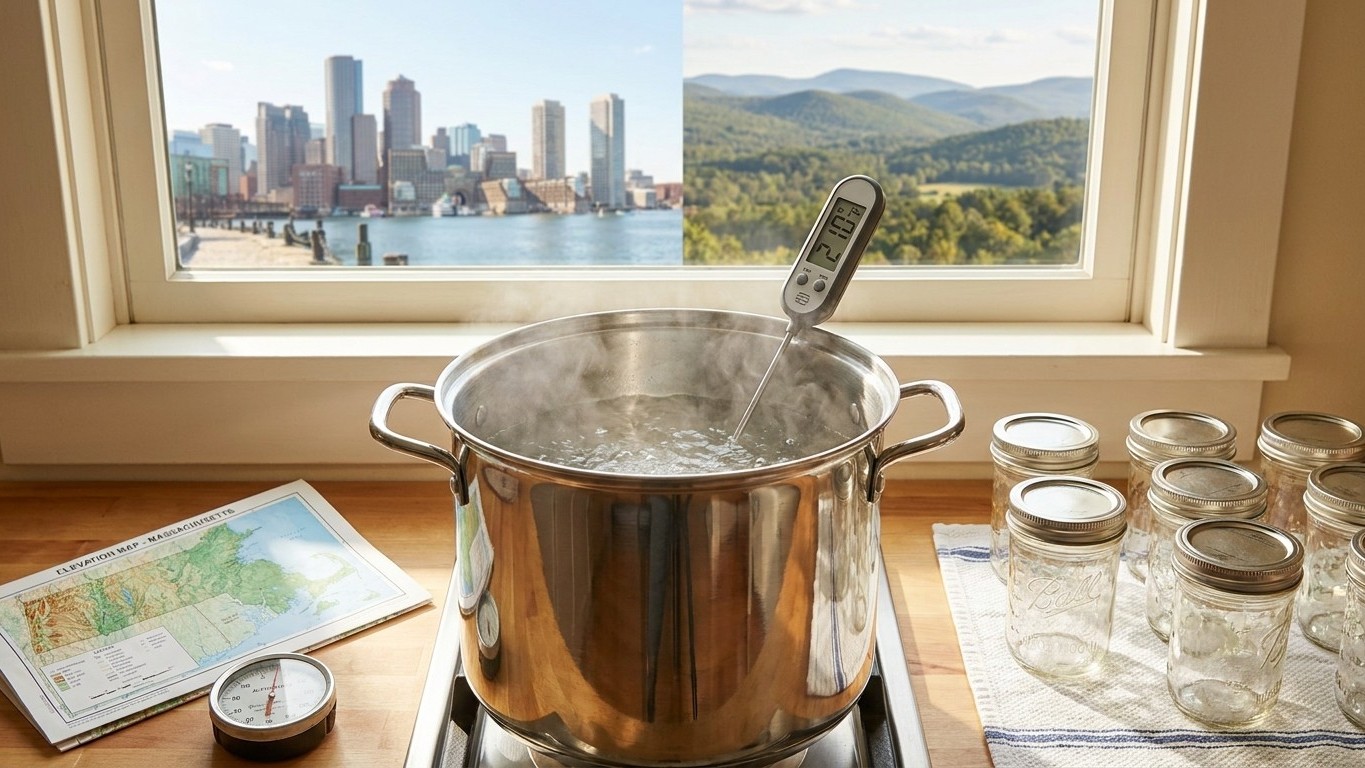

Boston, the reference point used throughout this guide, sits at just 46 feet above sea level according to geographic elevation data. Water there boils somewhere between 208°F and 212°F, well inside the range most tested canning recipes assume. For a canner working near sea level, that’s likely a non-issue. But Massachusetts runs from tidal marshes to the Berkshire hills, and the elevation that decides whether a jar is safely processed is the reader’s own, not the state’s.
The short answer

Boston anchors the elevation figure for this guide at 46 feet above sea level, a number drawn from geographic elevation data rather than any canning authority. At that height, water boils somewhere between 208°F and 212°F, the two published temperatures that bracket the 0 to 2,000 foot elevation band. That’s a narrow window, and it sits close enough to the 212°F sea-level baseline that a canner working near Boston’s elevation is unlikely to need any special adjustment for most boiling-water recipes.
Compare that to a kitchen at 6,000 feet, where water boils well below 208°F. Every minute of processing time there buys less heat than the same minute at sea level, and a tested recipe has to add time, or, for pressure canning, add pounds of pressure, to make up the difference. At 46 feet that gap barely exists. At 6,000 feet, it changes every jar on the shelf.
Massachusetts isn’t one elevation, though. Boston sits low, right at the harbor. The Berkshires in the western part of the state climb well above a thousand feet, and towns scattered through the Pioneer Valley and the hill towns of Franklin and Berkshire counties sit at heights Boston’s number says nothing about. The 46-foot figure describes the reference city named here, nothing more. A reader canning tomatoes in Pittsfield or Great Barrington is working at a different elevation entirely, and the boiling point at their own stove is the one that decides whether a recipe needs adjusting.
Why the reference city matters here
Using a single city to stand in for an entire state’s elevation only works if that stand-in is understood for what it is: a data point, not a rule. Boston’s elevation comes from geographic sources, not from USDA or the National Center for Home Food Preservation. Those two organizations publish the boiling-point tables and tested processing times; the elevation itself is simple geography. Knowing Boston sits at 46 feet tells a Boston-area canner they’re likely inside the low-elevation range most tested recipes assume. It tells nobody else in the state anything definite about their own kitchen.
Why a lower boil is a weaker process
Water’s boiling point drops as elevation rises, because atmospheric pressure drops with it. At sea level, that pressure holds water back until it reaches 212°F before it turns to steam. Climb higher and there’s less air pushing down, so water gives up and boils at a lower temperature. At 10,000 feet, published USDA and NCHFP figures place that point at 194°F. Thinner air simply means a cooler boil.
That matters because the entire canning process depends on heat destroying organisms inside the jar, above all the spores of Clostridium botulinum. Those spores tolerate heat that would wipe out almost anything else, and tested processing times are built around boiling water reaching 212°F. Drop that to 208°F, or 201°F, or 194°F, and the same number of minutes delivers less total heat to the jar’s contents. Spores that would have died at the tested time and temperature might not.
Turning up the burner doesn’t fix this. Boiling water can’t get hotter than its boiling point, no matter how hard it boils. A violent, rolling boil and a barely-there boil sit at exactly the same temperature, whatever that temperature is at that elevation. More flame just makes more steam faster; it doesn’t raise the ceiling. This is the detail that trips people up most, because a harder boil feels like more heat. It isn’t.
What actually compensates for a cooler boil is time, or, in a pressure canner, pressure. A boiling-water canner run at higher elevation needs more minutes to deliver the same total heat a shorter run would give at sea level. A pressure canner takes a different route: instead of adding time, tested recipes call for higher gauge pressure, because raising the pressure inside a sealed canner raises the temperature the water can reach above 212°F even where the surrounding air is thin. Either way, the fix isn’t a hotter boil. It’s a longer or higher-pressure one, and the exact figure belongs to the tested recipe for that specific food.
Finding your own elevation
The 46-foot figure attached to Boston says nothing about a kitchen in Springfield, Worcester, or a hill town in the Berkshires. Before any tested recipe’s altitude adjustment means anything, a canner needs their own number, not the reference city’s.
- Start with the address or nearest town center, since elevation can shift within a few miles, especially anywhere near the hills of western Massachusetts.
- Use the National Center for Home Food Preservation’s Find Your Elevation page, built specifically for this question, to look up the figure for that location.
- Write the number down in feet, since USDA and NCHFP processing charts are built in feet, not meters.
- Match that figure to the elevation band listed in the tested recipe being used, whether it’s a boiling-water time chart or a pressure canner’s dial or weighted-gauge chart.
- Recheck if canning happens somewhere new, since a household that shifts from the coast to the Pioneer Valley, or up into the hills for a weekend, can cross into a different elevation band entirely.
Borrowing Boston’s 46 feet, or any other city’s figure, as a stand-in for a different location is exactly how an under-processed jar happens. The elevation band a recipe calls for is tied to the actual boiling point of water at the canner’s location, and that number can shift by hundreds of feet within a single county.
What goes wrong
- A jar that seals perfectly but was under-processed. A sealed lid only proves the jar cooled and a vacuum formed; it says nothing about whether the contents reached a safe temperature during processing. At elevation, sea-level times can seal a jar just fine without ever heating it enough to kill the spores that matter. The fix is using the elevation-adjusted time or pressure from the start, not judging safety by the sound of a popping lid.
- A recipe pulled from a sea-level source with no elevation note. Older cookbooks, family recipe cards, and plenty of websites publish processing times without mentioning elevation at all, because they assumed sea level. Using that time in a Berkshires kitchen delivers less heat than intended. The fix is treating any processing time without an elevation range as incomplete, and checking it against a tested NCHFP or USDA source first.
- A pressure gauge read as though elevation doesn’t exist. Pressure canning adjusts for elevation by raising the pounds of pressure, not the minutes, and it’s easy to set a dial or weighted gauge to a sea-level number out of habit. That pressure may be too low to reach the necessary temperature higher up. The fix is confirming the gauge type and correct pressure for both the food and the elevation band, every time.
- Assuming one elevation covers an entire canning season. A household canning at a cabin in the hills one weekend and near the coast the next is working two different elevation bands, even in the same summer. The fix is checking elevation for each location where canning actually happens, rather than settling on a single number for every batch.
Where the exact adjustment comes from
Nothing here states how many minutes to process a jar or how many pounds of pressure to run a canner at. That number belongs to the tested recipe for the specific food, because processing times and pressures vary by acidity, density, and jar size, not just elevation.
The National Center for Home Food Preservation publishes tested, elevation-adjusted charts for the specific foods and methods home canners use, and that source, along with the USDA Complete Guide to Home Canning, is where the actual adjustment should come from. Guessing, rounding up “to be safe,” or borrowing a figure from a different food’s chart isn’t a substitute for the tested one.
This matters because Clostridium botulinum, the organism these processing times exist to control, produces a toxin with no taste and no smell. A jar under-processed because of a skipped elevation adjustment can look, smell, and taste completely normal. The only protection is using the correct, tested, elevation-adjusted process before the jar is ever sealed.
Common questions
Does Boston’s elevation apply to my kitchen if I live elsewhere in Massachusetts?
No. Boston’s 46 feet is a reference point drawn from geographic data, describing Boston specifically. A canner in Worcester, Springfield, or the Berkshires needs their own elevation, found through the NCHFP’s Find Your Elevation page, not Boston’s figure.
Do I need to adjust boiling-water canning times if I live near Boston?
At 46 feet, Boston sits close to sea level, with water boiling between 208°F and 212°F there. Most tested recipes are built around that same range, but the specific recipe being used should still be checked against its own elevation guidance.
What happens if I use a sea-level processing time at a higher elevation?
The water in the canner boils cooler than the recipe assumed, so the same number of minutes delivers less total heat to the jar’s contents. That can leave the food under-processed even though the jar seals normally and looks fine on the shelf.
Where should I find the exact time or pressure for my elevation?
The National Center for Home Food Preservation publishes tested, elevation-adjusted charts for specific foods and canning methods. That source, along with the USDA Complete Guide to Home Canning, is where the actual adjustment for a given recipe and elevation comes from.