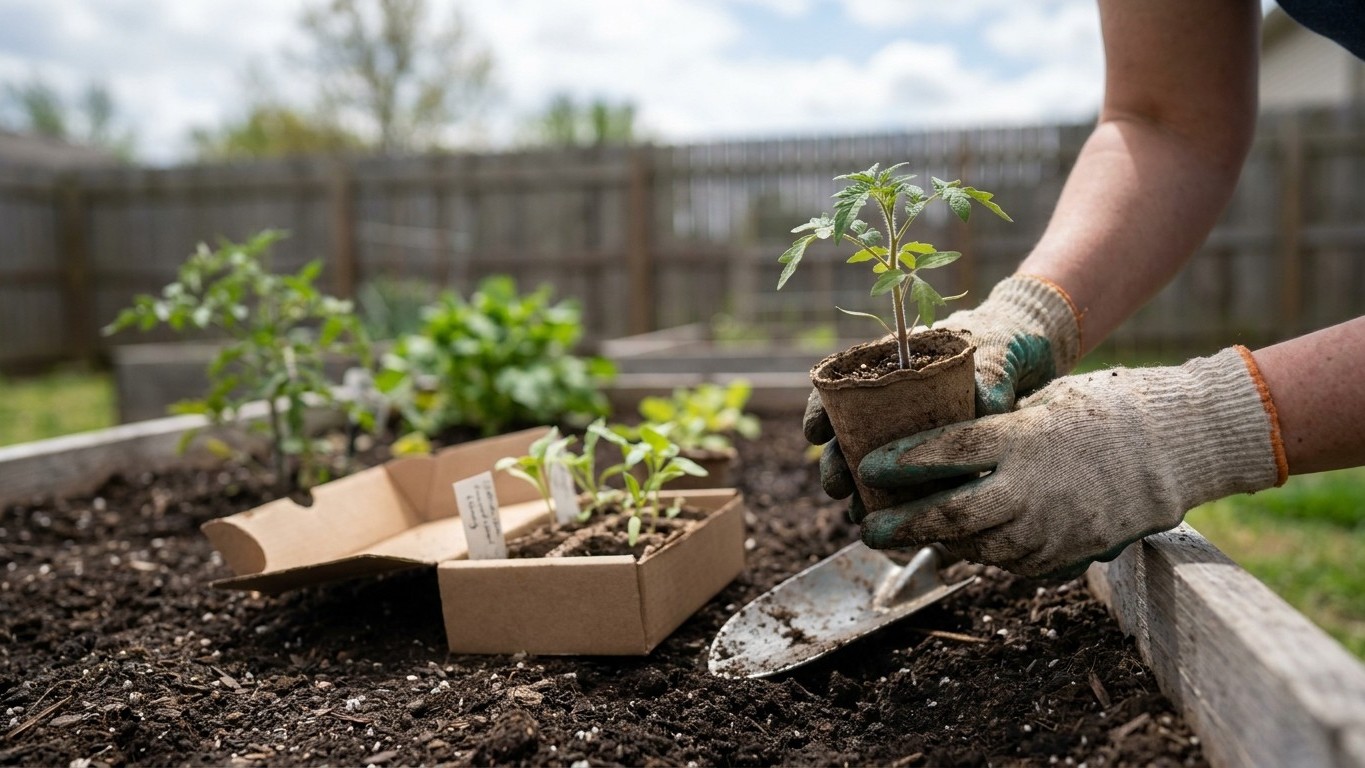

Kansas City’s last spring freeze lands somewhere between April 6 and April 20, and that ten-day spread is the whole problem with picking a tomato planting date in Missouri. A seed packet gives you a single number; the sky gives you a window that moves every year. Tomatoes can’t shrug off a near-freeze the way spinach can, so the safe move isn’t guessing at the early edge of that window but working backward from its close, especially in
What this comes down to in Missouri

In the Kansas City area, NOAA’s NCEI 1991-2020 climate normals put the last spring freeze between April 6 and April 20, and the first fall freeze between October 18 and October 29. Everything about when you set out tomato transplants in Missouri starts from that window, not from a date on a seed packet or a habit carried over from last year. The frost window is the hard boundary, and the actual date you plant on is something you work out from it, since it shifts a little every year depending on how the spring runs. This page deals only with that calendar problem; the basics of siting and raising the plants themselves are covered in growing tomatoes in Missouri.
A tomato transplant set into the ground before that window closes risks a freeze that kills it outright, or a chill injury that stunts growth for weeks even if the plant survives. Tomatoes come from warm, frost-free country, and they do not shrug off near-freezing nights the way lettuce or spinach do. Waiting until the window has safely passed, rather than gambling on its earliest edge, is the more reliable habit, especially in a spring that turns warm early and then drops back.
USDA’s Plant Hardiness Zone Map, built from the same 1991-2020 period, places Missouri across zones 5b through 7b. That range spans the whole state, from the colder north to the milder Bootheel in the south, so on its own it tells you almost nothing about your yard. What actually decides a planting date is the frost window at your nearest station, not the hardiness zone, since the zone is built from winter minimum temperatures and has nothing to do with spring freeze timing.
The practical answer for most of the state, translated from the Kansas City frost data, is that tomato transplants go into the ground from mid-April to early May, once the worst frost risk has passed and the soil has had a few warm days to shed its winter chill. That is not a single date. It is a range you narrow down yourself using the method below, and it moves earlier or later depending on how far you garden from Kansas City.
Working it out for your own garden
Start with the frost window itself: NOAA’s Kansas City normals put the last spring freeze at April 6 to April 20, and the first fall freeze at October 18 to October 29. Don’t count from the earliest end of that range until the soil has caught up. Soil that’s still cold from winter stalls a tomato root system even on a frost-free night, so most gardeners in this window wait past the earliest date, not right up to it, before setting transplants out. That reasoning is behind the mid-April to early-May transplant window used across the cultivar list below.
Once you have a transplant date, add the cultivar’s days-to-maturity figure to see when the first fruit should ripen, then check that ripening date against the fall frost window. Sun Gold, for example, lists 57 days from transplant. Set out in the mid-April to early-May window and count 57 days forward, and the first ripe fruit lands in late June, roughly 110 days ahead of the earliest fall frost date. That’s a wide enough cushion to absorb a slow, cool spring without any risk to the crop.
Compare that to Amish Paste, the longest-season cultivar in this comparison at 85 days from transplant. Set out in the same mid-April to early-May window, the first fruit lands around late July, which still leaves about 82 days before the fall frost window opens in mid-to-late October. That margin is real but noticeably tighter than Sun Gold’s, and it’s the kind of gap a delayed transplant date, from a cold, wet spring that pushes planting into mid-May instead of April, can eat into fast.
The arithmetic across a few named cultivars
Here’s the same calculation run for several cultivars, all counted from the same mid-April to early-May transplant window and the same Kansas City fall frost range:
| Cultivar | Days to maturity | First ripe (calculated) | Margin before fall frost |
|---|---|---|---|
| Sakura | 55 | late June | 112 days |
| Sun Gold | 57 | late June | 110 days |
| Cherokee Purple | 72 | mid July | 95 days |
| San Marzano II | 78 | late July | 89 days |
| Amish Paste | 85 | late July | 82 days |
Every cultivar in that table still finishes comfortably before the Kansas City area’s fall frost window, because catalogue days-to-maturity figures for tomatoes sold in this market are already bred toward a season this length. Where the method actually matters is a cultivar that runs longer than that, or a transplant date pushed later by a cold spring. A 100-day heirloom slicer set out in early May instead of mid-April would ripen around mid-August, and any fruit setting after that point would be racing a fall frost window that can open as early as October 18. That’s the line: once days-to-maturity plus your transplant date creeps past roughly 90 days from a mid-April start, run the arithmetic yourself before committing bench space to it. For a full rundown of which named cultivars clear that bar, see Tomato Varieties That Ripen in Time in Missouri.
What changes across the state
The Kansas City frost window is a single reference point, and Missouri is a long state, running from the Iowa line to the Arkansas Bootheel. Every one of those numbers shifts as you move away from Kansas City, and the direction of the shift is predictable even though the exact figure for any other town varies.
Latitude does most of the work. Northern Missouri counties sit closer to the colder air masses that drop down from the plains, so their last spring freeze tends to run later than the Kansas City normals, and their first fall freeze tends to arrive earlier, shortening the season on both ends. Southern Missouri, down toward the Bootheel, warms up earlier in spring and holds off frost longer in fall, which is exactly the pattern NOAA’s caution on this data points to: the milder south stretches the transplant window wider than it runs around Kansas City.
Elevation and terrain matter inside a single county, too. Low ground along creek bottoms and river valleys collects cold air on a still night, so a tomato bed at the bottom of a slope can see frost when a bed thirty feet upslope stays clear. Urban areas hold heat longer than open farmland, which is part of why the downtown Kansas City station runs about five days earlier in spring than the airport station these normals are drawn from. A city lot and a rural garden twenty miles apart can genuinely land on different transplant windows even at the same latitude.
None of this changes the method from the previous section, only the inputs that go into it. Whatever your local frost window turns out to be, the days-to-maturity arithmetic for a given cultivar works the same way. What it does mean is that a Kansas City figure copied straight onto a garden in the Bootheel or in far northern Missouri will be off in a predictable direction, and it’s worth adjusting rather than using as-is.
The mistakes this state punishes

The most common mistake is planting into the frost window’s first warm stretch instead of waiting for its safe end. Missouri springs regularly throw a run of warm days in late March or early April, right inside the period NOAA’s normals still count as meaningful freeze risk. Transplants set out during that stretch often meet a freeze a week or two later, once the warm spell breaks. Treat an early warm week as a preview, not a signal, and hold transplants until the frost window itself has passed.
The second mistake is choosing a long-season cultivar without running the arithmetic from the section above. An 85-day paste tomato like Amish Paste still clears the Kansas City area’s fall frost window with real margin, but only if it goes in during the mid-April to early-May window and not two or three weeks late. A cold, wet spring that delays planting into late May, stacked onto an 85-day or longer cultivar, is exactly the combination that leaves green fruit on the vine when the first fall frost arrives.
The third is hardening off too fast, or skipping it. A transplant raised indoors or in a greenhouse has soft tissue that scalds in direct sun and stresses in a stiff spring wind. Moving it straight from a shelf to the open garden the same week the frost risk clears is a common way to lose a week of growth to shock, even without a frost involved.
The fourth is trusting air temperature over soil temperature. The air can sit safely above freezing while the soil four to six inches down is still cold enough to stall root growth. A transplant that goes in during that gap often just sits there, no bigger in three weeks than the day it went into the ground. None of these four mistakes involve insects or disease, which follow their own separate timeline, covered in Tomato Pests in Missouri: Which Ones Actually Show Up Here.
Checking this against your county
Kansas City is one reference point, not a state-wide instruction, and every figure here is measured there. Missouri Extension keeps county-level guidance and a local planting calendar through the University of Missouri at extension.missouri.edu, and it’s worth checking before you commit trays of transplants to a date pulled from another part of the state. Your county extension office can also tell you how far your local frost window differs from the Kansas City normals, particularly if you garden near a river bottom, a north-facing slope, or the far north or south end of the state, where the gap from Kansas City is largest.
Common questions
Can I put tomatoes in the ground before the last frost date if I cover them?
A row cover or wall of water buys a few degrees of protection, not immunity, and it’s more useful for stretching the season a week early than for ignoring the frost window outright. If a hard freeze is forecast, cover or no cover, transplants set out well ahead of NOAA’s frost window will still take damage.
What if I miss the mid-April to early-May window, can I still plant in June?
Yes, tomatoes can go in through June, but check the days-to-maturity math against the fall frost window before you do. A short-season cultivar like Sun Gold or Sakura, at 55 to 57 days, has enough margin to handle a late start. A long-season cultivar like Amish Paste, at 85 days, gets risky the later you push the transplant date.
Does the transplant date change if I’m starting from seed instead of buying starts?
No, the transplant date stays the same either way, since it’s set by the frost window, not by how the plant was raised. What changes is when you start seed indoors, which you’d back-calculate from the same transplant window using the number of weeks your seed packet lists for starting indoors.
My tomatoes went in on time but haven’t grown in weeks, what’s wrong?
The most likely cause is cold soil rather than cold air. Even after the air temperature is reliably above freezing, soil a few inches down can still be cold enough to stall root growth for weeks, especially in a spring that warmed up fast on the surface. Give it time once the soil itself has warmed, or check a soil thermometer before assuming disease or a bad transplant.
Some gardeners also time this by the Moon: when to plant tomatoes by the moon, as almanac tradition rather than fact.