
Missouri’s tomato pests show up on a schedule that tracks the frost calendar more than the calendar month. Around Kansas City, NOAA’s 1991-2020 climate normals put the last spring freeze between April 6 and April 20, and that window is when cutworms and flea beetles start working on fresh transplants. By the time the first fall frost arrives between October 18 and October 29, hornworms, stink bugs and spider mites have usually had their turn too. Check transplants for a severed stem or shot-holed leaf in the first two weeks after they go in the ground. That single habit catches the two pests most likely to take out a young plant before it has a chance to establish.
What this comes down to in Missouri

The state doesn’t have an unusual pest list compared to the rest of the Midwest, but the order they arrive in is worth knowing before you plant. Early pests hit stems and young leaves. Midsummer pests go after foliage and sap. Late-season pests go after the fruit itself, right when you’re finally getting tomatoes worth protecting. Knowing which stage of the season you’re in narrows the list fast, and that’s more useful than trying to memorize every insect that could theoretically land on a tomato plant here.
Cutworms
Cutworms are dull gray or brown caterpillars, plump, 1 to 2 inches long, that curl into a tight C when you disturb them. They hide in the top inch of soil during the day and feed at night, right at the base of the stem. A transplant that was fine yesterday and is lying flat this morning, severed clean at soil level, is cutworm damage. A paper or foil collar pushed an inch into the soil around each stem at planting time stops them cold.
Flea Beetles

Flea beetles are tiny, shiny black or bronze beetles about the size of a pinhead that jump when the plant is brushed. They leave rows of small round holes, sometimes called shot holes, across young leaves. Seedlings take the worst of it since a few holes matter more on a small plant. Row covers over transplants until they’ve hardened off keep flea beetles off; pull the covers before flowering so pollinators can reach the blossoms.
Aphids

Aphids are small, soft-bodied, pear-shaped insects, usually pale green but sometimes black or pink, clustered on the undersides of leaves and at new growth tips. They suck sap, curl and yellow the leaves, and leave a sticky honeydew residue that grows sooty mold. A strong jet of water knocks back a light infestation. Heavier colonies respond to insecticidal soap, and cutting back on nitrogen fertilizer helps too, since aphids favor the soft new growth that heavy feeding produces.
Colorado Potato Beetle
This beetle is oval, about 3/8 inch, yellow-orange with five black stripes down each wing cover. The larvae are humpbacked, orange-red with two rows of black spots along the sides, and they do more damage than the adults. Both stages strip leaves down to the veins if left alone. Handpicking adults and the bright yellow egg clusters on leaf undersides works on a small planting.
Spider Mites

Spider mites are barely visible without a hand lens, pale yellow to red, and live on leaf undersides where they spin fine webbing. They show up as a fine yellow stippling on the leaves that turns to bronzing in a bad infestation, and they’re worst during hot, dry stretches of summer. Syringing the foliage with water on a regular basis discourages them. Avoid broad-spectrum insecticides here, since those kill off the mite’s natural predators and can make an infestation worse.
Tomato Hornworm

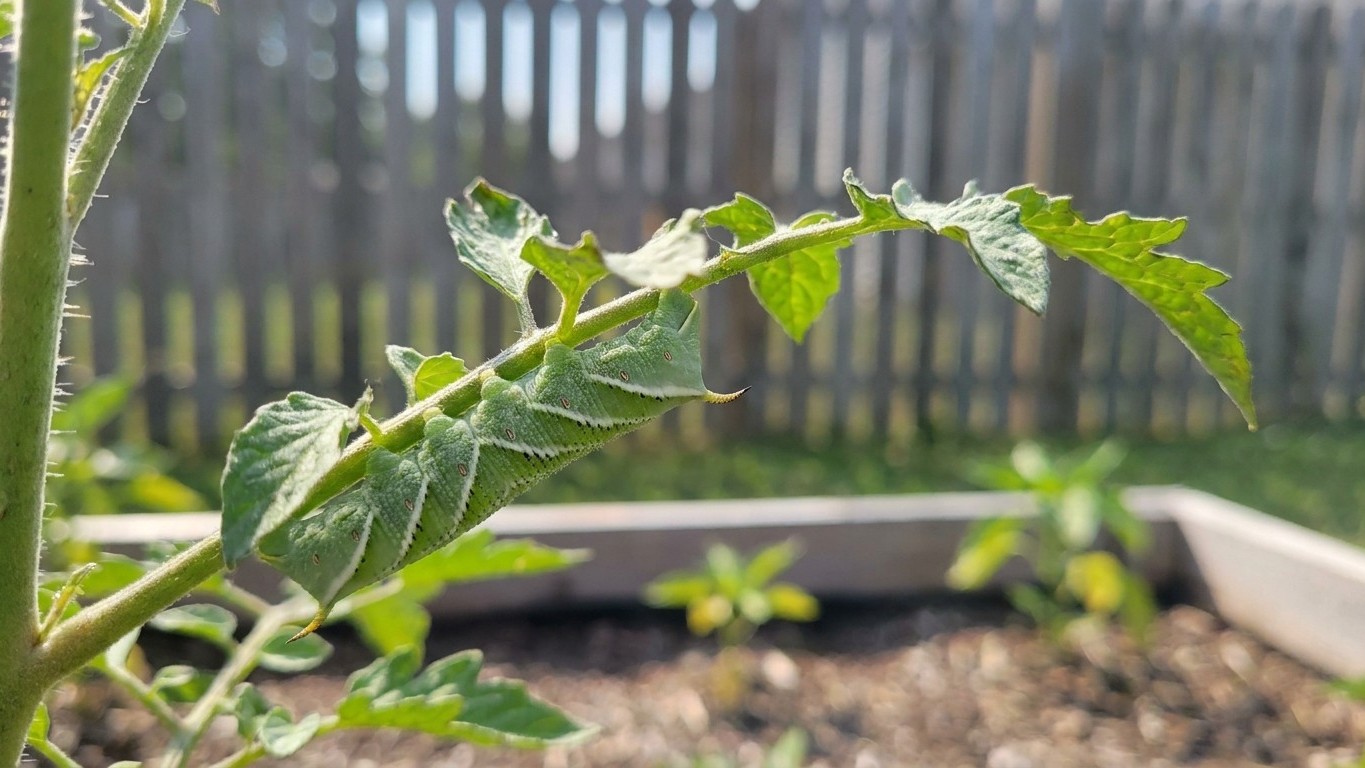
The hornworm is hard to miss once you know what you’re looking at: bright green, up to 4 inches long, with white diagonal stripes down each side and a curved horn at the tail end. It strips whole branches of foliage overnight and leaves dark green droppings on the leaves below as the giveaway. Handpicking works well since they’re large and slow. Leave any hornworm carrying small white cocoons on its back alone, those are parasitic wasp larvae already killing it from the inside.
Stink Bugs

Stink bugs are shield-shaped, 1/2 to 5/8 inch, brown or green depending on the species, and look the same in the nymph and adult stages. They pierce ripening fruit and leave pale, cloudy spots under the skin that only show up when you slice into the tomato. Sprays reach them poorly once fruit is heavy on the vine, so removing weedy hosts nearby and hand-picking are the more reliable options by that point in the season.
Working it out for your own garden
Figuring out which pest you’re dealing with starts with two questions: what part of the plant is damaged, and what point in the season you’re at. A severed stem in the first two weeks after transplant is almost always a cutworm. Shot holes in young leaves around the same time point to flea beetles. Curled, yellowing new growth points to aphids. Skeletonized leaves in early summer, especially with orange larvae attached, mean Colorado potato beetle. Stippled, bronzing leaves in a hot dry stretch mean spider mites. Missing branches of foliage with pellet droppings below mean hornworms. Cloudy spots inside ripening fruit mean stink bugs.
A quick scouting routine
- Check the soil line and stem base in the first two weeks after transplant for cutworm damage
- Turn leaves over weekly to catch aphids and mite webbing before it spreads
- Scan foliage for hornworm droppings on the leaves underneath the plant, not just the leaves themselves
- Slice a couple of ripening fruit if you suspect stink bugs, since the damage is often internal only
The transplant date itself matters here too, since that’s when the earliest pests get their shot at the plant. That window is covered in detail in Tomato Planting Dates in Missouri: Counting Back From Your Frost Window, and it’s worth reading before you decide when to set plants out, since a plant that goes in too early sits stressed and cold for longer, and stressed plants draw more aphids and cutworm activity than a plant that gets moving right away.
| Pest | When it shows up | What it damages | First sign to check |
|---|---|---|---|
| Cutworms | First two weeks after transplant | Stem at soil line | Plant lying flat, stem severed |
| Flea beetles | Early, on young leaves | Leaf surface | Small round shot holes |
| Aphids | Spring through the season | Sap, new growth | Curled, sticky leaves |
| Colorado potato beetle | Late spring into early summer | Whole leaves | Yellow egg clusters underneath leaves |
| Spider mites | Hot, dry stretches of summer | Leaf tissue | Fine stippling, webbing |
| Hornworms | Mid to late summer | Foliage | Dark droppings on lower leaves |
| Stink bugs | As fruit ripens | Fruit interior | Cloudy spots when sliced |
What changes across the state
Missouri stretches across USDA hardiness zones 5b to 7b, and that spread matters more for pest timing than most gardeners expect. The frost figures used here come from Kansas City, and NOAA’s own data notes that the downtown station runs about five days earlier in spring than the airport reading, with southern Missouri milder still. A milder, longer season in the Bootheel and the southern Ozarks means aphids and flea beetles can complete more generations before frost shuts things down, and Colorado potato beetle can emerge from overwintering earlier than it does farther north.
Elevation and distance from the Missouri and Mississippi rivers add another layer. Higher ground in the Ozark Plateau tends to run a few degrees cooler at night than the river valleys, which slows pest development slightly and can push the hornworm’s peak activity a bit later into the summer. Urban areas around Kansas City and St. Louis hold heat overnight, which can extend the window for heat-loving pests like spider mites compared to open farmland nearby. None of these differences change which pests show up, only when they show up and how many generations they get through before the season ends. A gardener in the northern part of the state should expect the same pest list as one in the south, just compressed into a shorter window.
The mistakes this state punishes

The most common mistake is treating a warm stretch in late March or early April as a green light. Missouri’s frost window still runs into mid to late April around Kansas City by NOAA’s own normals, and a transplant set out during a warm snap ahead of that window can sit through a cold night that stunts it badly, even if it survives. A stunted plant recovers slowly, and slow-growing tomatoes are exactly what cutworms and aphids target first.
Another mistake is spraying broad-spectrum insecticide the moment any bug is spotted. That kills the parasitic wasps that keep hornworms in check and the predatory mites that keep spider mites in check, which often makes the following month worse, not better. Handpicking and targeted treatments cost more time up front but avoid that trade-off.
A third mistake is ignoring resistance codes when choosing what to plant, since a plant already fighting nematodes or a wilt disease has fewer resources left to shrug off insect pressure. The Tomato Varieties That Ripen in Time in Missouri page lists which cultivars carry resistance to nematodes and common wilts, and pairing that resistance with the pest habits above gives a plant a real head start rather than fighting two problems on two fronts at once. It’s part of the same planning that goes into growing tomatoes in Missouri in general: the pest calendar only works in your favor if the plant going into the ground is already suited to the season.
Checking this against your county
The frost window and pest timing above are anchored to Kansas City, and a county in the Bootheel or the northern edge of the state will run on a different schedule. Missouri Extension maintains county offices that track local pest pressure and can confirm what’s actually active in your area in a given week. Start at extension.missouri.edu and search for your county’s office before assuming the state-wide pattern above applies exactly where you garden.
Common questions
Do I need to spray for pests every year or only if I see damage?
Only if you see actual damage or a pest itself. Spraying on a schedule regardless of pressure kills beneficial insects along with pests and tends to make aphid and mite problems worse the following month.
How do I tell hornworm damage from deer or rabbit damage?
Hornworms leave dark green pellet droppings on the leaves below the damage, while deer and rabbits leave torn or bitten stems without that droppings pattern. Check the underside leaves for the caterpillar itself if you’re unsure, since it’s large enough to spot once you know its green-and-white pattern.
Are the tomato hornworm and the tobacco hornworm the same thing?
They’re closely related and both feed on tomato plants in Missouri, look nearly identical, and are treated the same way. The horn color differs slightly between the two, but that distinction doesn’t change how you’d handle either one in the garden.
Will planting marigolds actually keep these pests away?
Marigolds are not a substitute for the checks and controls described above for any of the pests on this list. Some gardeners find they reduce nematode pressure in the soil, but that’s a different issue from the above-ground insects covered here.