
Yes, Insulation earns its keep in Montana summers, but here summer is the smaller half of the story. With around 28 days a year climbing above 90°F at the Billings reference station, the heat load is real but brief. Montana’s Insulation dollar does its heaviest lifting through the long cold season, with the summer benefit riding along at no extra cost.
The short answer for Montana

Insulation helps here, and the honest way to size how much is to look at how many days actually demand it. NOAA’s 1991-2020 climate normals put Billings at 28.3 days a year reaching 90°F or higher. That’s a hot stretch worth taking seriously for water use, heat stress, and any cool-season plants left unprotected in the yard, but it’s not a five-month cooling season. Compare that to states where triple digits stack up for a hundred-plus days, and the picture is different: Montana’s summer is a defined, limited event, not the dominant climate story.
The state’s position on the country’s energy map backs that up. The whole of Montana sits in IECC climate zone 6B, with no county exceptions on the code’s zone table. That’s a genuinely useful fact, because most states are split across two or three zones and a homeowner has to look up their own county. Montana residents don’t have to do that homework. Zone 6 sits firmly on the cold, dry side of the country’s climate divide, the same broad category as much of the northern Rockies and the upper Midwest.
What that means in practice: a house built or insulated to the standards this zone calls for is primarily a house built to hold heat in through a long winter. The material doesn’t know which direction the heat is trying to move. Whether it’s built to fight off January cold or turned around to fight off a July afternoon, the Insulation is the same, working the same way. So the short answer holds together this way. Yes, insulation reduces summer cooling loads in Montana. But if a homeowner here is choosing where to spend a limited budget, the calculus tilts toward winter performance first, with the summer payoff as a genuine, but secondary, bonus. A house that’s well-sealed and well-insulated for a Montana winter is, almost automatically, a house that copes well with the two or three dozen hot days each summer brings. The reverse framing, treating this state’s insulation project as primarily a summer cooling measure, would be misreading its own climate.
What happens above the ceiling
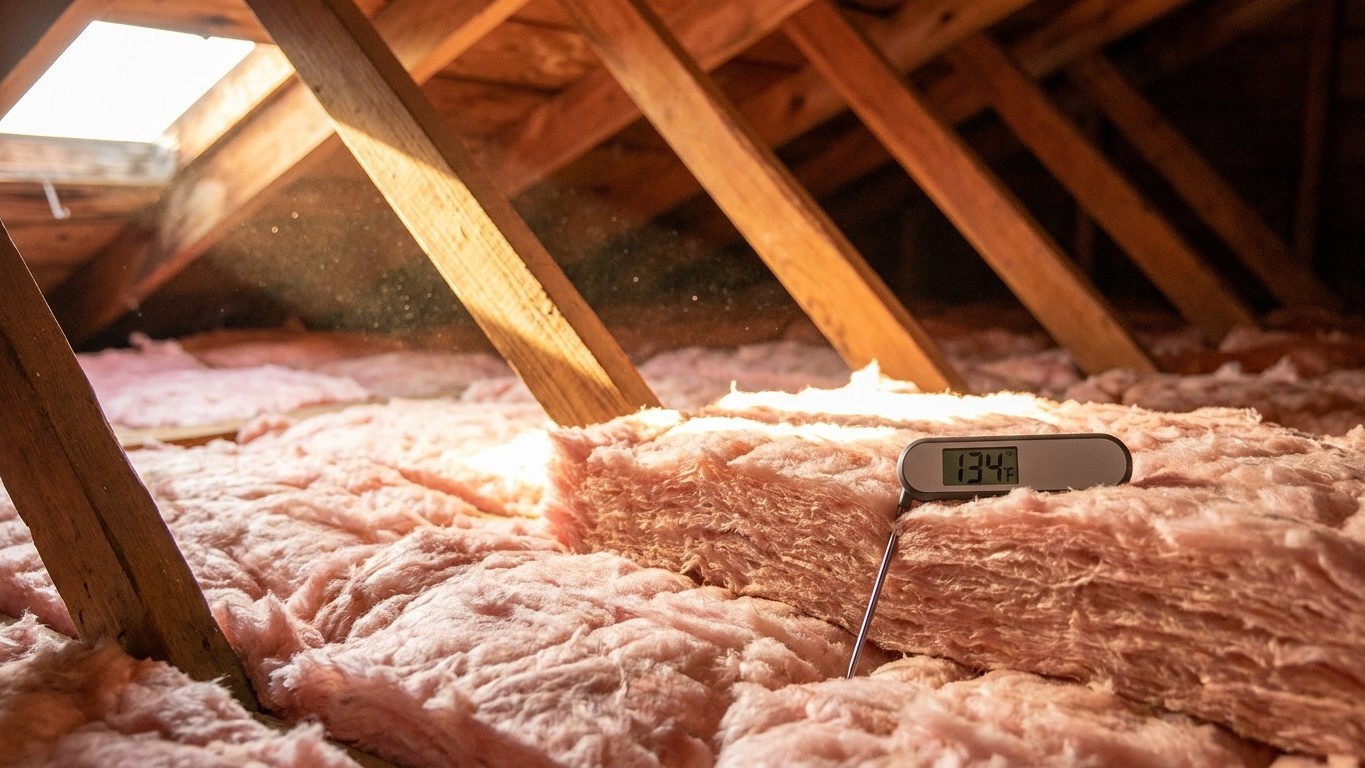
On a hot summer afternoon, the attic is doing something the rest of the house isn’t built to handle. Direct sun on an asphalt shingle roof deck can push attic air far hotter than the outdoor temperature, sometimes 40 or more degrees above it. That superheated air sits directly above the ceiling drywall, above any ductwork routed through the space, and above whatever boxes and holiday decorations are stored up there. Without a real barrier, that heat works its way down into the living space below, and an air conditioner spends the afternoon fighting a battle it didn’t need to have.
This is the point worth sitting with: attic insulation is not a winter-only product that happens to have a side benefit in summer. It’s a resistance to heat flow, full stop. In January that flow runs upward, warm air trying to escape into a cold attic. In July it reverses, and the same material resists heat trying to push downward from that superheated roof deck. One material, two seasons, no compromise between them.
What ENERGY STAR recommends
ENERGY STAR’s retrofit guidance for existing wood-framed homes breaks its recommendations out by climate zone, with the attic column split into two cases (a home with no existing insulation, and one that already has 3 to 4 inches), plus a separate figure for floor insulation:
| Zone | Attic, uninsulated | Attic, already has 3-4 in. | Floor |
|---|---|---|---|
| 1 | R30 | R25 | R13 |
| 2 | R49 | R38 | R13 |
| 3 | R49 | R38 | R19 |
| 4A and 4B | R60 | R49 | R19 |
| 6, 5 and 4C | R60 | R49 | R30 |
| 7 and 8 | R60 | R49 | R38 |
Since Montana sits entirely in zone 6B, the applicable row is the one grouped as “6, 5 and 4C”: R60 for an uninsulated attic, R49 if 3 to 4 inches are already in place, and R30 for floors over unheated spaces such as crawl spaces. These are retrofit levels for existing homes, not the requirement for new construction. Of every upgrade a Montana homeowner could make, attic insulation is the one that pulls double duty, cutting furnace load all winter and knocking the edge off attic-driven heat every one of those 28 summer days.
What homes in Montana cool with
The Energy Information Administration’s Residential Energy Consumption Survey gives a clear read on how homes here actually stay cool. Of households surveyed, 65% report using some form of air-conditioning equipment, 40% run a central air-conditioning system, and 30% rely on individual equipment: a ductless mini-split, a window or wall unit, or a portable. Ceiling fans show up in 60% of homes. Those figures describe what’s installed, not what’s recommended, and they’re a share of households surveyed, not a share of the state’s total housing stock.
The gap between the 65% figure and the 40% central-air figure is the real story. Roughly a quarter of households that cool their homes at all are doing it without a central system, likely because the house predates central air or because a window unit or mini-split was the more affordable retrofit. That distinction matters for how insulation fits in.
In a home with central air and ducts routed through the attic, those ducts sit in the hottest space in the building, right under that superheated roof deck. Ceiling insulation does essentially nothing to protect duct performance there; sealing and insulating the ducts themselves is a separate, and often overdue, job. For Montana’s guides on that specific fix, see the site’s duct sealing and insulation resources. In a home cooled by a window unit or a mini-split instead, the equation is simpler: the insulation and air-sealing of that one room’s walls, ceiling, and windows is what determines how hard the unit has to work, which is where the site’s room air conditioner guides pick up the thread.
What the heat asks for that the cold does not
Two tools belong specifically to hot-climate homes, and neither is a natural fit for a state where summer heat shows up on fewer than 30 days a year on average.
A radiant barrier is not insulation. It carries no R-value and works on a different principle entirely, reflecting radiant heat away from the roof deck rather than resisting conducted heat the way fiberglass or cellulose does. It earns its keep under roofs that take a sustained, intense solar load, which is why it shows up so often in the specifications for homes in the Southwest and Deep South. For a Montana attic, where the heat challenge is real but limited to a few dozen days a year, and where the much larger job is holding winter heat in, a radiant barrier isn’t the tool this house needs. The money is better spent on the R60/R49/R30 levels above, which work in both directions.
Vapor movement is the second hot-climate consideration, and it runs the opposite direction from what a cold-climate homeowner might expect. In warm, humid climates, moisture-laden air sits outside the house in summer, pushing inward, which is exactly why the model energy code drops the requirement for an interior vapor retarder in its warmest zones. Montana’s zone 6B is a cold, dry designation, not a warm humid one, so that particular code exception doesn’t apply here the way it would in Louisiana or coastal Georgia. Getting the vapor-barrier placement right in a zone 6B house is its own topic, with its own seasonal logic, and it’s covered on this site’s dedicated vapor barrier page rather than settled in a paragraph here.
What the work is worth
ENERGY STAR puts a number on all of this: “EPA estimates that homeowners can save an average of 15% on heating and cooling costs (or an average of 11% on total energy costs) by air sealing their homes and adding insulation in attics, floors over crawl spaces, and accessible basement rim joists.” Both figures matter, and neither works without the other, 15% against the heating-and-cooling bill specifically, 11% against the whole energy bill including everything else the household runs.
That 15% figure covers heating and cooling together, as one combined number, not a winter savings that happens to spill over into July. That’s the entire reason this comparison matters for a Montana home. The work doesn’t split into a winter project and a separate summer project. It’s one job, sized against the whole year’s energy use.
Two limits worth keeping in mind before anyone budgets around this. It’s an average drawn from energy modeling of a typical existing U.S. home, not a guarantee for any specific house, and the modeling covers attics, floors over crawl spaces, and accessible basement rim joists specifically. It doesn’t extend to walls, windows, or doors, which are separate upgrades with their own math. And it’s worth noting plainly that the federal 25C tax credit that once offset some of this work closed at the end of 2025, so any current project stands on its energy savings alone.