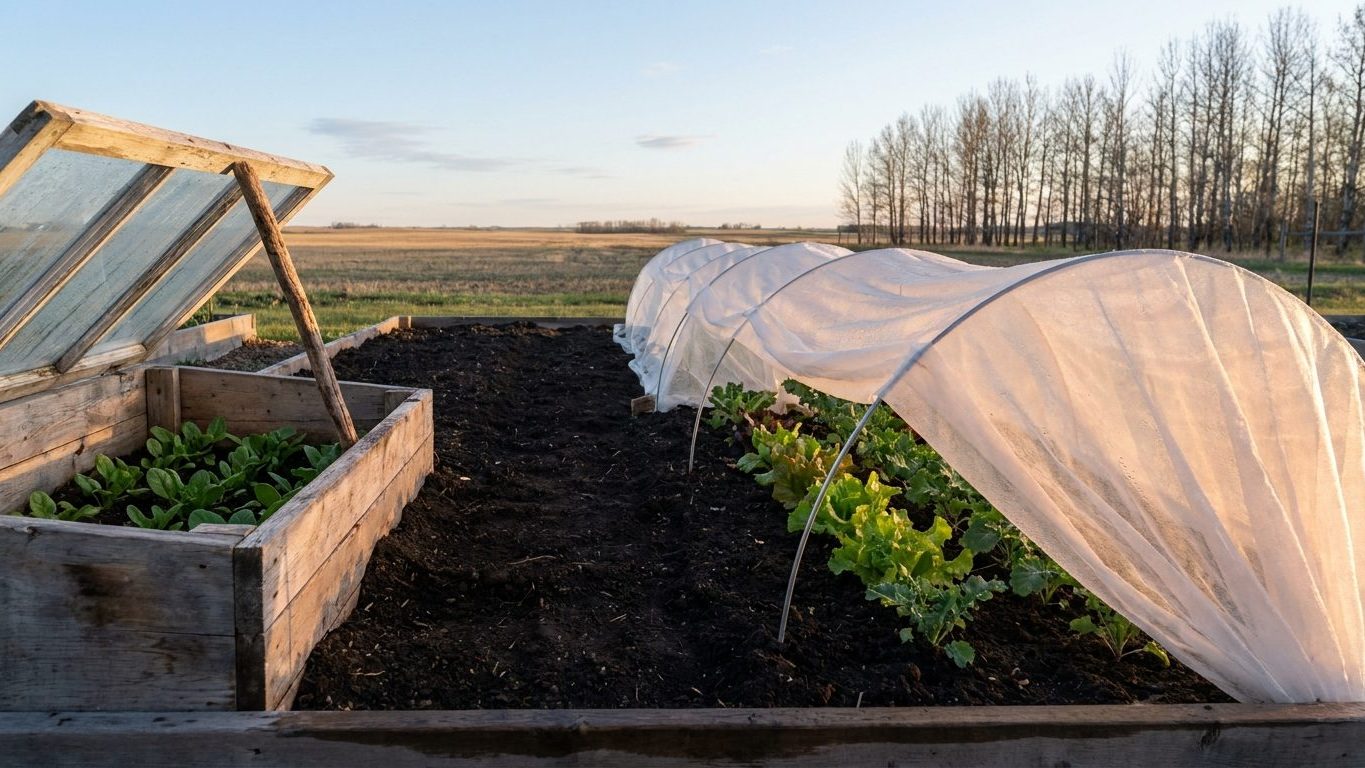

Lightweight floating row cover on hoops and a cold frame do the most work for the least money in Montana. A high tunnel or small greenhouse is the upgrade when tomatoes and peppers need to finish. Wind, hail, and late freezes decide what survives, so anchoring and venting matter as much as the material. Here is what each option does and where it falls short.
The short answer for Montana
Match the extender to the job. Row cover handles frost nights. Low tunnels warm early spring beds. Cold frames hold hardy greens and harden off seedlings. A walk-in structure is the only option that reliably ripens warm-season crops. Water-filled plant protectors suit a handful of transplants.
How long is the growing season?
Billings, the reference station, gives a useful baseline. The last spring freeze (32°F) falls between April 29 and May 10. Those dates mark the band where the chance of a freeze runs from 30 to 70 percent, so a freeze after May 10 still happens in some years. The first fall freeze falls between October 1 and October 14, and it can come before October 1. Billings is one of the milder valleys. Mountain valleys elsewhere in Montana can frost in any month.
An extender does not turn that into a southern season. It moves each end by some weeks, a bit earlier in spring and a bit later in fall. The coldest month at Billings has a mean daily minimum of 17.9°F, which leaves room for hardy greens under cover in the mildest valleys but not for anything tender.
Which season extender fits which job?
| Extender | Best use | Main limit |
|---|---|---|
| Floating row cover on hoops | Frost nights in spring and fall, insect barrier | Tears in wind, too light alone for a hard freeze |
| Low tunnel with clear plastic | Early spring beds of cool-season crops | Overheats on sunny days unless vented |
| Cold frame | Hardening off, spring and fall lettuce and spinach | Small, and the lid needs opening daily |
| Water-filled plant protectors | Early tomato or pepper transplants | One plant each, slow to set up |
| High tunnel or greenhouse | Tomatoes, peppers, early and late harvests | Cost, wind anchoring, snow load |
Most gardeners start with the first and third rows. For timing, see When to Cover Your Garden in Montana, and for the wider picture, Extending the Growing Season in Montana.
What will not work here
Can a cover turn a short season into a long one?
No. A season that ends with a freeze in the first two weeks of October will not ripen a long-season crop just because it wears a cover. Sweet potatoes and big watermelons need a long run of warm nights, and an extender adds weeks, not months. Choose varieties with the shortest days to maturity on the packet. Count from sowing for direct-sown crops like melons and squash, and from transplanting for tomatoes and peppers.
Setting tender transplants out on the average last frost date also fails. With April 29 to May 10 marking a 30 to 70 percent chance of a freeze, some years bring frost after the band ends. A cover that is ready beside the bed works. A cover still in the garage does not.
Why do plastic tunnels and row cover fail in Montana wind?
Wind is the usual killer. Thin fabric flaps and tears when it is only tucked in, and loose plastic acts like a sail. Anchor the edges with soil, sandbags, or boards, and keep hoops snug and close to the ground. In the lee of the Rockies, warm chinook winds can swing temperatures fast. Under clear plastic that heat builds quickly, and a bed can overheat on a sunny day that began below freezing. Vent in the morning, close up before the sun drops, and do not leave a closed tunnel unattended through a warm spell.
Snow is the other problem. Wet spring and fall snow can flatten low hoops and collapse a tunnel that lacks a steep arch. Brush it off, and pick a shape that sheds snow.
Does one layer protect a vegetable garden in a hard freeze?
Rarely. A single layer of light fabric buys a few degrees, which handles a light frost but not a hard one. In valleys where frost can arrive in any month, plan on a second layer, such as a heavier fabric or a blanket over the hoops on the coldest nights. Pull it off in daylight.
Winter growing has its own limit. At 45.81 degrees north, the latitude of Billings, December light is short enough that greens under cover mostly hold rather than grow. Sow in late summer so they are nearly full size before the darkest weeks, then harvest through winter.
What changes across Montana
Montana has no single answer. The USDA Plant Hardiness Zone Map (2023 edition) puts the state in zones 3a to 6a, and other parts of the territory differ. That system rests on one variable, the average annual extreme minimum temperature, so it says what survives winter and says little about how soon a bed can be planted. Two gardens in the same zone can still have very different frost-free periods.
The Billings dates, a coldest-month mean daily minimum of 17.9°F, and a latitude of 45.81 degrees north all belong to that one city. Readers in the far north of the state sit at a higher latitude and get less winter light. Readers at altitude get a shorter, cooler season.
What should a reader in the north or at altitude shift? Everything slides later in spring and earlier in fall. Start with the earliest-maturing varieties, favor row cover and tunnels for cool-season crops, and treat a walk-in structure as the realistic route for tomatoes and peppers. Use a heavier cover than the Billings advice suggests, and expect frost nights in summer.
To find your own zone, use the USDA map and enter your ZIP code. Then check your latitude if you live near the state’s northern edge, because day length shifts with it.
Where to check this for your own county
Montana State University Extension is the best next stop. The Montana State University Extension network has county and reservation offices staffed by people who work with local soils, frost pockets, and wind. When you reach your county office, look for two things.
- The local planting calendar, with frost dates for your area.
- The vegetable varieties trialled in your county, including any high tunnel or season-extension guidance.
A county recommendation beats a state one. Statewide advice, including everything above, rests on one Billings reference station and general principles. It sets a sensible starting point, but a county office knows whether your valley holds cold air, whether the wind funnels through a gap, and which varieties actually ripened there.
If your county office publishes a planting calendar, treat its dates as the starting line and the cover as insurance on either side of them. If a trial lists varieties that finished in a cold year, those are safer picks than any packet claim.
Checking this against your own garden
Your own observation outranks every date above. Three things are worth watching, and none needs an instrument.
First, soil warmth by feel. Push a bare hand into the bed in the morning. If the soil still feels cold and clammy, warm-season seed will sit and rot. Beds that feel warm earlier, often a south-facing slope or a spot against a wall, are your early microclimate. Beds that stay cold are your late ones.
Second, the first male flowers on squash. Male blooms open before the female ones, and their arrival shows the plant is getting enough warmth to move into production. If they show up late under cover, your site is cooler than the average suggests. If they come early, you have room to push planting dates.
Third, the first true leaves on seedlings. The first pair are seed leaves, and the true leaves that follow mark real growth. Seedlings that stall before they appear are telling you the bed is too cold or too shaded. Note which beds produce true leaves first, and plant there ahead of the rest.
Write the dates down for a couple of seasons. After that, your notes will tell you more about your garden than any regional figure can.
Common questions
Do I need a high tunnel in Montana?
Not for hardy greens, peas, and root crops, which do well with row cover and cold frames. A high tunnel pays off when you want tomatoes, peppers, or melons to ripen reliably, especially at altitude or in the north.
Is row cover enough for a hard freeze?
One layer of light fabric handles a light frost. For a hard freeze, add a second layer or a heavier fabric over hoops, and remove it in daylight.
When should I plant tender crops under cover?
At Billings, the band for the last 32°F freeze runs from April 29 to May 10, so frost after that is still possible. Keep covers ready beside the bed. At altitude or in the north, wait longer and check with your county office.
Can I garden through the winter under cover?
Hardy greens will hold under cover in the mildest valleys, but growth slows sharply when days are short. Sow in late summer so plants are nearly full size by the darkest weeks, then harvest as needed.