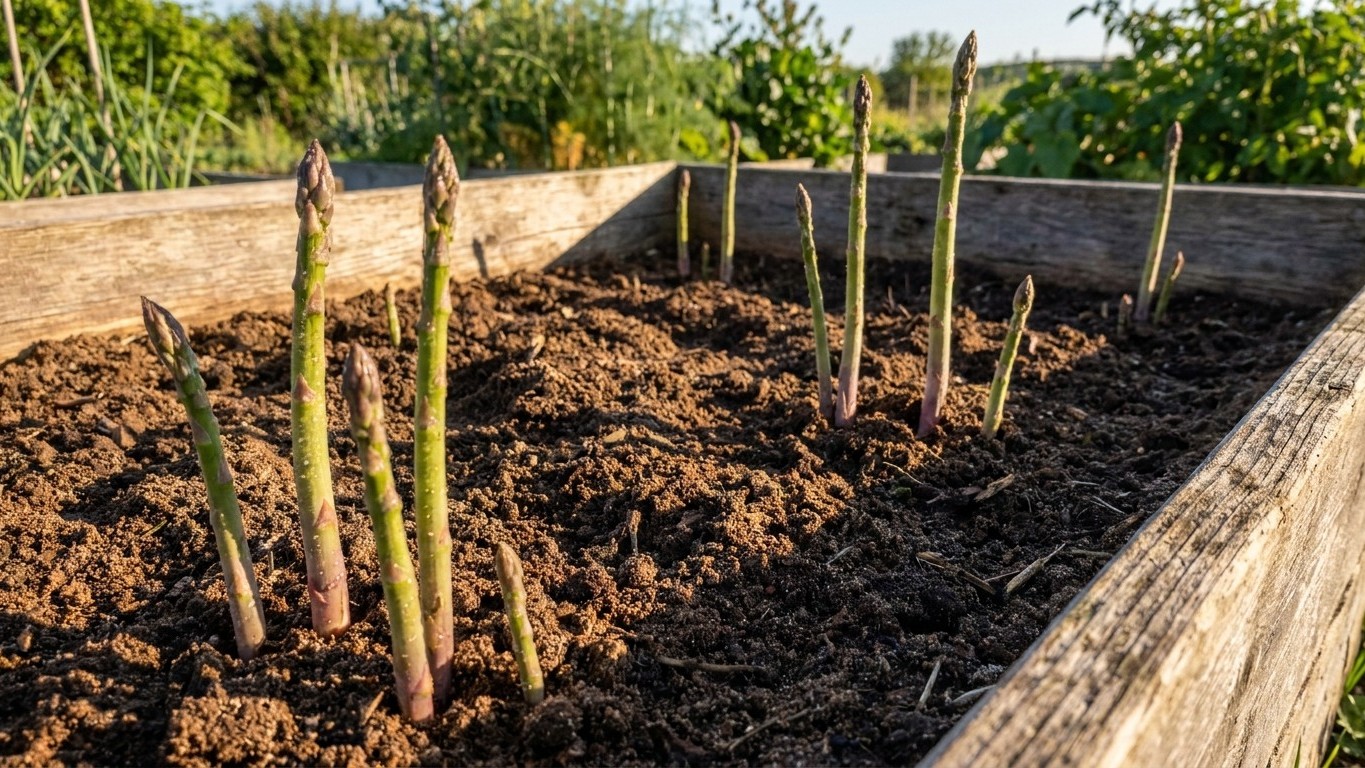

Stop cutting when most of the spears coming up are thinner than a pencil. That is the signal, and it matters more than any date on the calendar. Spears you have cut keep best just above freezing, in air close to saturated, with the cut ends wet. A bed that has settled in will bring the next season of spears on its own schedule, so start with how the cutting season runs.
How do you know when to stop cutting asparagus?
Asparagus is planted as crowns in 8-inch furrows in early spring, and nothing is harvested until year 3. After that the bed produces for 10 to 15 years, according to Utah State University Extension. Taking “just a few spears” earlier than year 3 weakens a crown that is still building its reserves, so skip it.
What does the pencil rule actually tell you?
Each spear is a shoot the crown pushes up from stored energy. Early in the season the spears come up thick, because the crown is full. As you keep cutting, the crown spends its reserves and the new shoots get thinner. When most of them are thinner than a pencil, the crown is running low. Put the knife away and let the spears open into ferns, which feed the roots for next year.
The rule is an object, so it adjusts to your ground. At the reference weather station, the mean last spring frost falls between April 12 and April 23, according to NOAA NCEI freeze probabilities. Suburban and rural gardens usually see the last frost one to two weeks later, and more at elevation. Your first spears and your last cut will shift with that, so check your county extension office for local frost timing. The first cut of a given year may come a week or two later than a neighbor’s in town.
What does the bed need after the last cut?
The ferns now carry the crowns through the rest of the year. Rainfall at the reference station averages about 12.6 inches across June, July and August. That is 4.44 inches in June, 3.55 in July (the driest month) and 4.6 in August, out of 31.9 inches for the year. Those are normals, and a summer thunderstorm that arrives in one burst often runs off rather than soaking in. Days at or above 90°F pull water out of the ground quickly. A rain gauge on your own plot tells you more than any average.
Soil decides how that rain behaves. The state soil, the Holdrege series, is a deep, dark prairie loam to silt: 11 percent sand, 22 percent clay and 67 percent silt, with about 2.0 percent organic matter, and it drains well. That is good news for a bed you will keep for fifteen years. It describes the state’s typical ground, though, and river bottoms, hill country and scraped building lots differ. Run a soil test before you dig, and see Will Nebraska Soil Hold an Asparagus Bed for Fifteen Years? if water lingers in your yard. Furrows are backfilled gradually through the first year, not all at once. For the beetles and other pests that visit the ferns, see What Eats Asparagus in Nebraska, and When. The full planting path is in Growing Asparagus in Nebraska.
Keeping it, and for how long
Asparagus does not wait. Once a spear is cut, it keeps losing water and toughening, and the right storage slows both. The UC Davis Postharvest Technology Center gives the targets for green asparagus, and they are tighter than most produce.
What temperature and humidity keep asparagus best?
UC Davis lists the optimum temperature as 0°C to 2°C, which is 32°F to 35.6°F. The optimum relative humidity is 95 to 100 percent. Its fact sheet states that high relative humidity is essential to prevent desiccation, so dry cold alone does not do the job. A spear in cold, dry air shrivels at the tip and goes woody.
Both edges of that window are close. Spear toughening occurs rapidly above 10°C, or 50°F, and a kitchen counter is well past that. Freezing injury, a water-soaked look that ends in extreme softness once the spear thaws, is likely at -0.6°C (30.9°F) or lower. That leaves a gap of only a few degrees between a fridge that is too cold and one that is nearly right. Cold spots against a back wall, or a dial turned all the way up, can push spears into the damage range.
How long will cut spears keep?
Any storage time you read about is a ceiling. It describes spears held at the optimum for temperature and humidity from the moment of cutting. Few home setups reach that, and each degree above it, or each hour in dry air, takes some of the time away. The practical answer is to cook the spears within a day or two of cutting. Eating them the day they come out of the ground is better still, which is one reason to grow your own.
The clock also starts at the cut, not when you get the spears home. A bundle left in a hot truck cab or on a sunny porch has already begun to toughen. Bring a pail or a bag into the garden, and move the spears into the cool as soon as the last one is cut. You will notice the difference between spears handled this way and spears that sat out, particularly at the thick ends.
Where in the house that actually is
A home refrigerator runs warmer than the 32°F to 35.6°F optimum, and the door runs warmest of all, because it opens and closes through the day. Leave the spears on a door shelf and they sit in the worst spot in the kitchen.
Which shelf comes closest to the optimum?
The lower shelf toward the back is usually the coldest part of a household fridge, and it is the closest you will get. Check it with a fridge thermometer set in a glass of water for a few hours, since the air temperature in the middle of the shelf is what counts. If the reading falls near or below 31°F, move the spears forward or up a shelf. A crisper drawer helps hold moisture, but it is not automatically cold enough, so take its reading too.
How do you create near-saturated air at home?
A domestic fridge does not hold 95 to 100 percent humidity on its own, and the dry air inside pulls moisture from the spears first through the cut ends. Stand the spears upright in a jar with an inch of water under the cut ends, the way you would treat cut flowers. Then cover the tips loosely with a plastic bag to hold humid air around them. Skip it and the ends dry, the tips soften and the stalks lose snap, even if the temperature is perfect.
If the jar does not fit, wrap the cut ends in a damp paper towel and slip the bundle into a bag. Do not seal the tips tightly while they are wet, because trapped water on the tips can turn them slimy. Refresh the water or the towel every day. Keep the jar away from the back wall, where the coldest spot can drop below 30.9°F and the spears go water-soaked.
Common questions
Can you cut asparagus the year you plant the crowns?
No. Nothing is harvested until year 3. The crowns spend the first seasons building the root mass that will feed spears for 10 to 15 years.
How do you know the season is over if the weather is still cool?
Look at the spears. When most of what comes up is thinner than a pencil, stop cutting. A cool spring can keep the shoots coming longer, but thin spears mean the crown is spent whatever the weather is doing. Let them grow into ferns.
Should I set the fridge as cold as it will go?
No. Freezing injury is likely at 30.9°F or lower, and thawed spears turn water-soaked and extremely soft. The target is 32°F to 35.6°F, with near-saturated air. A thermometer in a glass of water on the lower back shelf will show you where you stand.
Does the variety change when to stop cutting?
The pencil rule applies to all of them. Choose among them as you like, and cut by the same schedule.