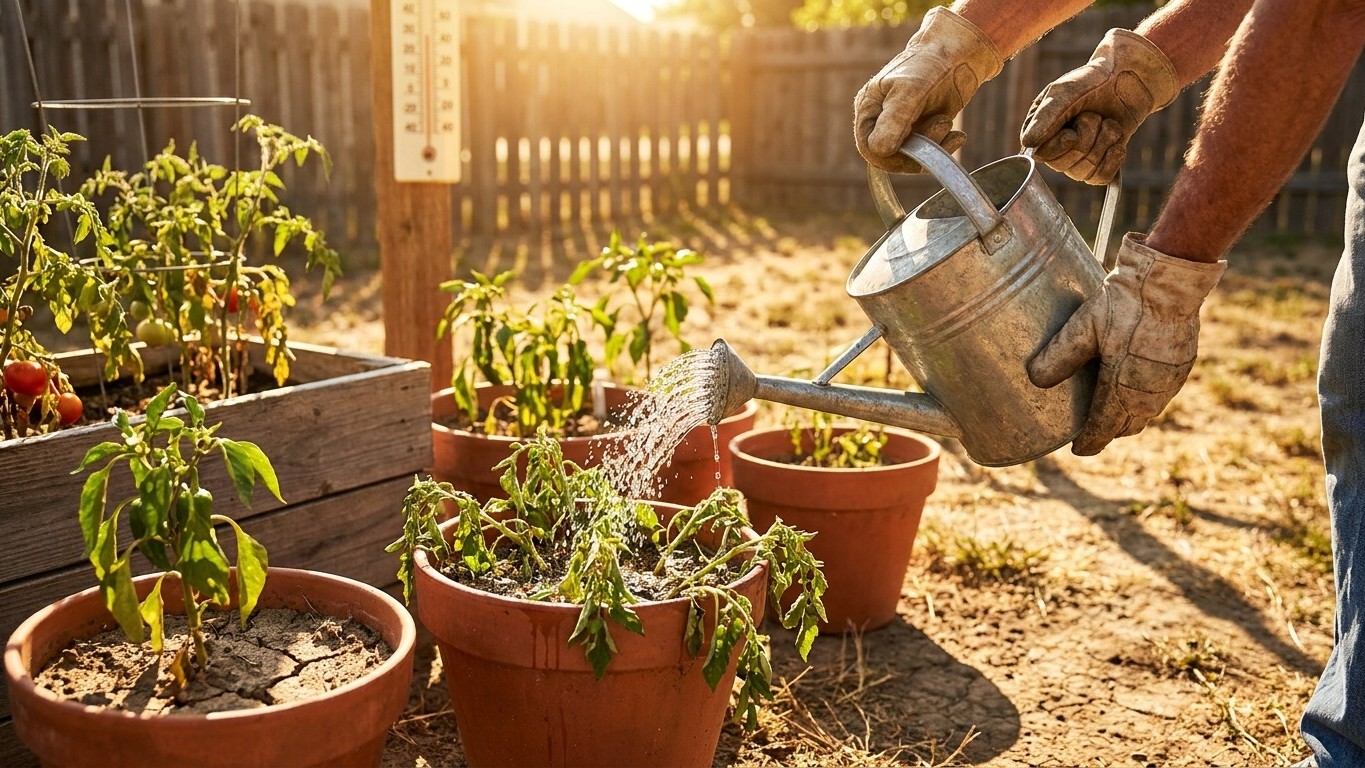

Nebraska gardens get by on about 3.55 inches of rain in July, the driest month of summer, while the mercury climbs past 90F on 28.1 days a year on average. The short answer: water deeply once or twice a week rather than daily, check soil moisture two inches down before you turn on the hose, and expect to make up the difference the sky leaves behind during peak heat.
What changes here

Two numbers set the terms for watering in this state. July’s normal rainfall sits at 3.55 inches, the lowest of the summer months, and the reference station used for these normals logs 28.1 days a year at or above 90F. Put together, that means the driest stretch of the growing season overlaps almost exactly with the hottest stretch, rain tapers off right when evaporation demand peaks.
Run the arithmetic and the gap becomes concrete. A vegetable bed or flower border generally wants about an inch of water a week to keep growing steadily. July, at 3.55 inches spread across roughly four and a half weeks, delivers about 0.8 inch of that inch naturally. The gardener has to carry the rest, somewhere around 0.2 inch a week, which works out to a bit over a tenth of a gallon per square foot if you want to measure it that precisely. That’s not a huge amount on paper, but it lands during the weeks when 90-degree afternoons are pulling moisture out of the soil faster than in June or September.
Soil texture decides how far that inch actually goes once it lands. On sandy ground, water moves through quickly and doesn’t stick around for the roots to draw on later in the week. On heavier clay, the same inch sits closer to the surface and drains slowly, which can carry a bed through several dry days but also risks waterlogging if it’s watered again before it’s had a chance to dry. Nebraska’s soils run the gamut from sandy stretches in the Sandhills region to heavier loams and clays farther east, so there’s no single texture that describes the whole state, checking your own plot with a handful of damp soil, squeezed to see if it holds a shape or falls apart, tells you more than any statewide average.
None of this is a forecast. The 3.55 inches and 28.1 days are averages calculated from 1991-2020 climate normals at a reference station, not a guarantee for this particular July or this particular yard. A rain gauge staked next to the tomatoes will always beat an average at telling you what actually fell.
How to water when it matters
Deep, infrequent watering beats a light daily sprinkle because of what happens underground, not above it. Roots grow toward moisture. If water only ever reaches the top inch of soil, roots stay shallow and brittle, and the first heat wave with 90-degree afternoons cooks them. A deep soak pushes moisture down six inches or more, which pulls roots downward too, giving the plant a reserve to draw on when the surface bakes dry.
Morning watering has a plain mechanical reason behind it: leaves and soil surface dry out over the course of the day, which starves fungal spores of the damp conditions they need to take hold. Water applied at the base rather than overhead skips the leaf-wetting problem entirely and cuts evaporation loss before the sun climbs high.
Checking soil moisture at root depth, not just at the surface, is the difference between watering on a schedule and watering because the plant actually needs it. Push a finger or a small trowel two inches into the soil near the root zone. Dry and crumbly at that depth means it’s time to water; cool and damp means it can wait, even if the top half-inch looks parched.
Soil texture changes the rhythm more than it changes the total amount. Sandy soil holds little reserve, so shorter, more frequent soakings work better than one big weekly dose that mostly drains past the roots. Heavy clay holds a week’s worth of water but punishes impatience, watering again before it’s dried invites root rot rather than growth.
- Start with about 1 inch of water a week as a baseline, delivered in one or two sessions rather than daily doses.
- Water early in the morning, before the heat of the day sets in, so moisture reaches the roots instead of evaporating off the leaves.
- Apply water at the base of the plant with a soaker hose, drip line, or watering can aimed at the soil, not the foliage.
- Check soil moisture two inches down with a finger or trowel before every watering session, and skip it if the soil is still cool and damp.
- Adjust frequency for your own soil: shorten the interval on sandy ground, lengthen it on clay, and treat the 1-inch baseline as a starting point to test against what you actually find in the ground.
What goes wrong
A little sprinkle every day
This is the mistake that costs the most in a state logging 28.1 days a year above 90F. A quick daily splash wets only the surface, so roots never have a reason to grow deep. When a genuine heat wave arrives, those shallow roots sit in soil that dries out within hours, and the plant wilts even though it was “watered” that morning.
Soaking the leaves at night
Watering overhead in the evening leaves foliage wet for hours with no sun or breeze to dry it. That damp window overnight is exactly what fungal diseases like powdery mildew and various leaf blights need to establish themselves. Morning watering at the base sidesteps the problem entirely.
Trusting a passing shower
A quick summer thunderstorm can look like it solved the watering problem, but a heavy downpour often runs off a dry, crusted surface faster than it soaks in, wetting only the top half-inch of soil. The fix isn’t complicated: push a finger down two inches after the storm passes and see for yourself before deciding the garden is covered for the week.
Skipping the mulch
Bare soil under a summer sun with nearly a month of 90-degree days gives back moisture almost as fast as it’s applied. A two- to three-inch layer of mulch slows evaporation, keeps soil temperature more even, and stretches every inch of water, sky-delivered or hose-delivered, further into the week.
Local help
The University of Nebraska-Lincoln Extension offers region-specific guidance on soil, irrigation timing, and plant selection for local conditions. Watering restrictions vary by city and water district and can change during dry spells, so check with your local water provider for current rules before setting an irrigation schedule.
Common questions
How much should I water my garden each week in Nebraska?
Start with about 1 inch total, adjusting up during hot stretches and checking soil moisture two inches down rather than sticking to a fixed schedule.
Is July really the driest month?
Yes, by the normals: July averages 3.55 inches of rain, the lowest of the three summer months, against June’s 4.44 and August’s 4.6.
Why does 90-degree heat matter so much for watering?
With 28.1 days a year reaching that mark, evaporation demand spikes well above spring or fall levels, which is why the same inch of water disappears faster during those weeks.
Does soil type really change how often I should water?
Yes. Sandy soil drains fast and needs shorter, more frequent watering; clay holds moisture longer but can drown roots if watered again before it dries.