
Nebraska’s growing season runs hot and dry at the same time, and that combination is what makes watering schedules tricky here. The short answer: water deeply once or twice a week rather than a little every day, check soil moisture two inches down before you turn on the hose, and expect to make up the difference yourself during July, the driest stretch of summer.
What changes here

Two numbers set the terms for every Nebraska garden. July, the driest summer month at the reference station, averages 3.55 inches of rain. The same station logs 28.1 days a year at or above 90F. Put together, that means the month when plants need the most water is also the month the sky provides the least of it, and the heat driving that demand doesn’t let up.
Run the arithmetic and the gap gets concrete. A vegetable bed or a new perennial planting wants roughly an inch of water a week to keep growing without stress. July has about 4.4 weeks in it, so 3.55 inches spread evenly works out to roughly 0.8 inch of rain in an average week that month. That leaves around 0.2 inch a week for the gardener to supply by hand or by irrigation, on a normal year, before evaporation from those 28.1 days of 90-plus heat is even factored in. June runs a bit wetter at 4.44 inches for the month and August close behind at 4.6, so the deficit is narrowest at the edges of summer and worst right in the middle of it, in July.
None of this rainfall arrives as a gentle, even drizzle spread across every week, either. Summer precipitation in this part of the country tends to come as thunderstorms: a half-inch dumped in twenty minutes, then nothing for ten days. A lot of that water runs off before it soaks past the top inch of soil, especially on sloped or compacted ground. Soil texture decides what happens next. Sandy soil lets water drain through quickly and holds little of it in reserve, so the same inch of rain disappears from root zones faster and needs replacing sooner. Heavy clay holds water far longer, sometimes a week or more, but that same trait means clay drowns roots if it gets watered again before it has had the chance to dry out. Knowing which kind of ground is under a given bed matters as much as knowing the rainfall total.
How to water when it matters
The method that works with Nebraska’s summer pattern is deep, infrequent watering at the base of the plant, done in the morning. Each piece of that has a reason behind it. Deep watering pushes moisture down several inches, which trains roots to grow downward chasing it, and deep roots survive heat and short dry spells far better than roots that stay near the surface. Watering at the base, rather than overhead, means the water goes where roots can use it instead of evaporating off leaves in the 90-degree afternoons this region logs 28.1 times a year on average. Morning watering gives plants moisture before the day’s heat peaks and lets any water that does land on foliage dry off in the sun, rather than sitting overnight.
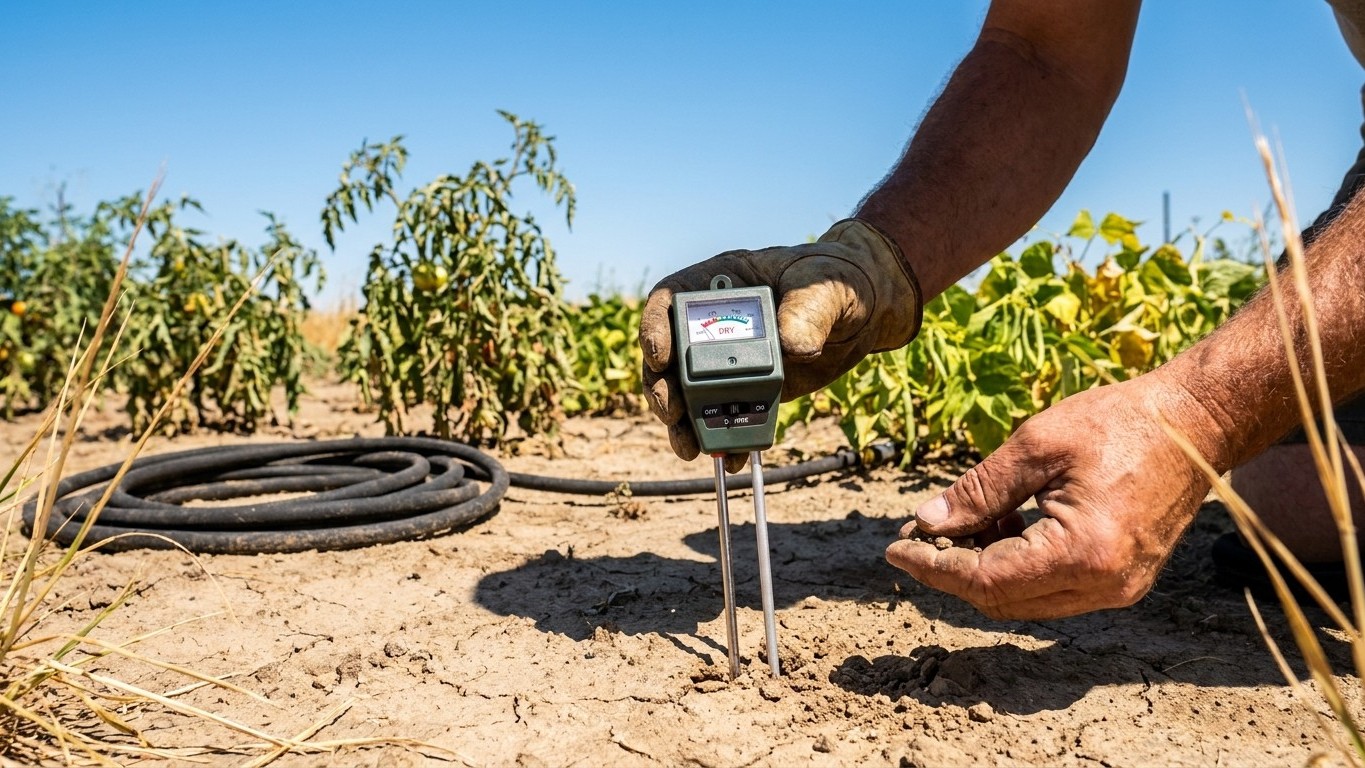
Checking soil moisture beats guessing every time. Push a finger two inches into the soil near the plant, or use a trowel to check just below the surface. If it’s dry at that depth, it’s time to water, regardless of how the surface looks or whether it rained two days ago.
Soil texture changes the rhythm, not the principle. Sandy soil should be watered more often but in smaller amounts, since it can’t hold a large volume without it draining past the root zone. Heavy clay should be watered less often but more slowly, giving the water time to soak in rather than pool and run off, and it should be allowed to dry out somewhat between waterings so roots don’t sit in saturated ground.
- Check soil moisture two inches down with a finger or trowel before watering, rather than watering on a fixed calendar.
- Water deeply enough to reach 6 to 8 inches down, which for most garden beds means roughly 1 inch of water applied in a single session.
- Water in the early morning, before the day’s heat sets in, so moisture reaches roots instead of evaporating.
- Apply water at the base of the plant with a soaker hose, drip line, or watering can, not with an overhead sprinkler that wets the leaves.
- On sandy soil, shorten the interval between waterings; on clay soil, lengthen it and confirm the soil has started to dry before watering again.
The one-inch figure is a starting point, not a rule. A raised bed, a container, or a spot with unusually sandy or heavy soil will need adjusting, and the only reliable way to find that adjustment is checking the soil itself rather than following a schedule someone else wrote for different ground.
What goes wrong
Watering a little every day
A quick daily sprinkle feels responsible, but it only wets the top inch or two of soil. Roots stay shallow because that’s where the moisture is, and shallow roots are the first to bake once a stretch of 90-degree days rolls through. Given that this region averages 28.1 such days a year, this is the mistake that costs the most here: plants that look fine in June collapse in a heat spell in July because their roots never learned to grow deep.
Watering the leaves in the evening
Wetting foliage after dinner leaves it damp all night, since there’s no sun or breeze left to dry it. That damp window is exactly what fungal diseases like powdery mildew and blight need to take hold on tomatoes, squash, and roses. Watering the base in the morning avoids the problem entirely.
Trusting a rain shower
A thunderstorm that dumps a loud half-inch can feel like it solved the water problem for the week. Often it only wet the top half-inch of soil before running off. The only way to know is the same finger test used before any manual watering: two inches down, dry means water it anyway.
Skipping mulch
Bare soil left exposed through a Nebraska summer loses moisture to evaporation almost as fast as it’s applied, especially across those 28.1 days of 90-plus heat. A two- to three-inch layer of mulch around plants, not touching stems, slows that loss and keeps soil temperature more even, which means less frequent watering overall.
Local help
For Nebraska-specific planting advice, soil testing, and seasonal guidance, the University of Nebraska-Lincoln Extension is the state’s land-grant resource. Watering restrictions vary by city and water district and change with drought conditions, so check current rules with a local water provider before setting an outdoor watering schedule.
Common questions
How often should I water my garden in Nebraska during summer?
Most beds do well with a deep watering once or twice a week rather than daily, adjusted based on whether the soil is dry two inches down and how sandy or clay-heavy the ground is.
Is July really the driest month for Nebraska gardens?
At the reference station’s 1991-2020 normals, July averages 3.55 inches of rain, less than June’s 4.44 inches and August’s 4.6 inches, making it the driest of the three summer months.
Does sandy or clay soil need more frequent watering?
Sandy soil drains fast and holds little water, so it typically needs watering more often in smaller amounts. Clay soil holds water much longer but can drown roots if watered again before it dries out.
Why does the number of 90-degree days matter for watering?
At 28.1 days a year averaging 90F or above, evaporation from soil and plant surfaces climbs sharply during those stretches, which is why deep, base-level watering and mulch matter more here than in cooler regions.