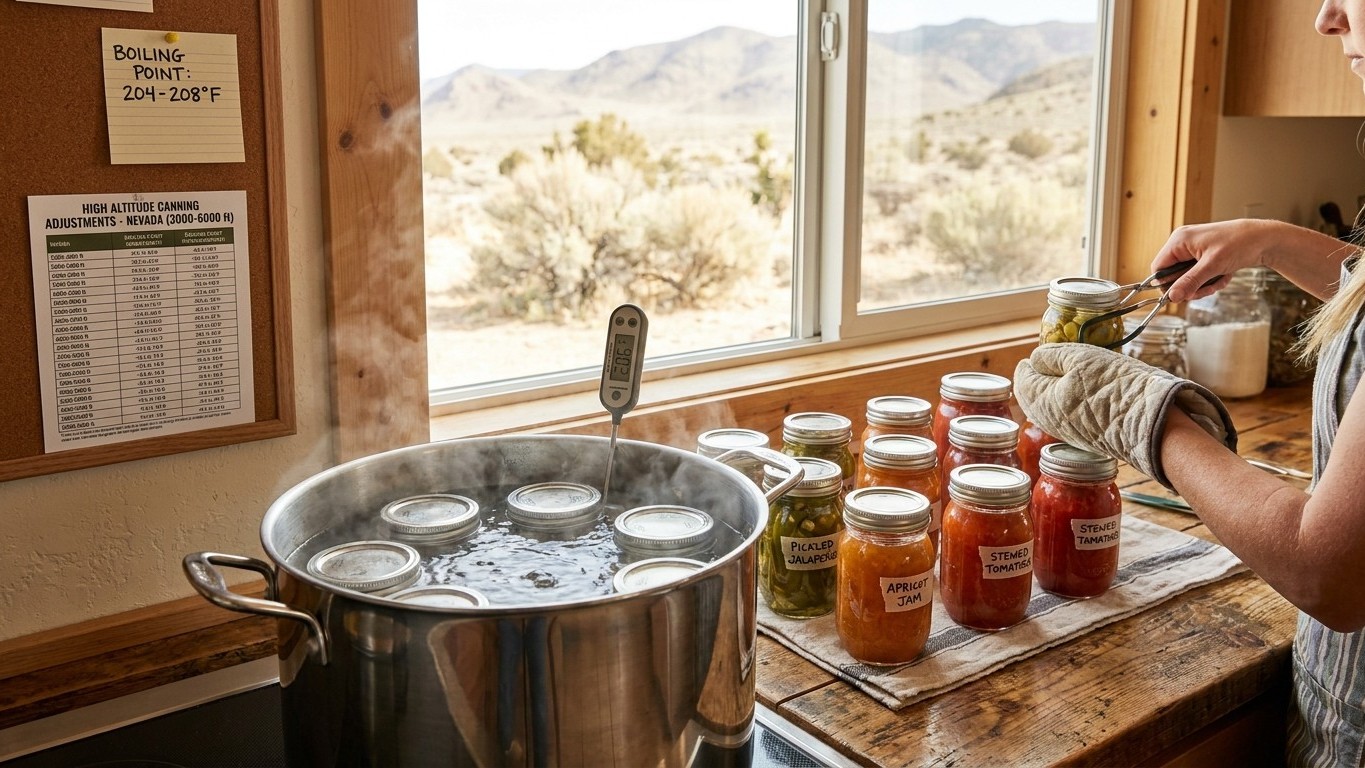

Las Vegas sits at 2,001 feet, where water boils between 204 and 208 degrees Fahrenheit instead of the 212 you’d get at sea level. That gap is small but real, and it’s enough to require longer processing or added pressure for safe home canning. Nevada, though, runs from desert basins to mountain towns well above that mark, so the number that matters is never the state’s, it’s the one where your kitchen actually sits.
The short answer

Las Vegas, the reference city for this figure, sits at 2,001 feet above sea level. At that elevation, water boils somewhere between 204 and 208 degrees Fahrenheit, according to the USDA Complete Guide to Home Canning as published by the National Center for Home Food Preservation. That’s four to eight degrees below the 212 F boiling point most home canning charts assume, and it falls squarely in the 2,000-to-4,000-foot altitude band where adjustments to processing time or pressure start to apply.
If you live at 3 feet above sea level, none of this touches your kitchen. Water still boils at 212 F, and a tested recipe’s processing time works exactly as written. But if you’re canning at 2,001 feet, or anywhere above 1,000 feet, the boil is cooler, and a cooler boil is a weaker heat treatment. That’s not a matter of taste or texture. It’s the difference between a jar that’s actually safe and one that only looks safe on the shelf.
Why the reference city matters here
Las Vegas is named specifically because it’s the reference point behind the elevation figure used in this piece, not because it represents Nevada as a whole. Nevada is one of the most vertically varied states in the country, stretching from low desert valleys to peaks that top 13,000 feet. A resident in Reno, Elko, or Ely is canning at a completely different elevation than someone in Las Vegas, and the adjustment they need reflects their own address, not a statewide average. There is no such thing as “Nevada’s elevation” for canning purposes. There’s only yours.
This matters because plenty of canning charts get shared and reshared with a single altitude baked in, usually the nearest big city. If that city isn’t where you live, the chart is wrong for you. The fix isn’t complicated, but it does require a step most recipe cards skip entirely: figuring out your own number before you touch a jar.
Why a lower boil is a weaker process
Boiling water canning and pressure canning both rely on heat to destroy microorganisms, including the spores that cause botulism. The temperature of boiling water depends on the pressure of the air pushing down on it. At sea level, that pressure is high enough to hold water at 212 F before it turns to steam. As elevation climbs, the air gets thinner, atmospheric pressure drops, and water boils at a lower temperature. At 10,000 feet, for example, water boils at 194 F instead of 212 F. That’s an 18-degree difference, and it happens no matter how vigorously the water is boiling.
This is the part that trips people up. Boiling water does not get hotter by boiling harder. A rolling boil and a gentle boil sit at the exact same temperature at a given elevation, because boiling is a phase change, not a measure of intensity. Cranking up the burner just makes the water boil away faster. It does not add heat to the process. So if you’re at 2,001 feet and your water is boiling at, say, 206 F, that’s the ceiling. No amount of extra flame pushes it past that point.
A cooler boil means less heat energy reaches the food and the jar’s contents over any given minute. Since the entire safety of a canning process rests on holding food at a lethal temperature long enough to destroy harmful microorganisms and their spores, a lower boiling point means the standard processing time simply isn’t enough. The food needs more time at that lower temperature to reach the same cumulative heat exposure, or in the case of pressure canning, more pressure to raise the internal temperature back up to where it needs to be.
That’s exactly how tested recipes compensate. Boiling-water canning recipes add minutes to the processing time as elevation increases. Pressure canning recipes add pounds of pressure instead, because a pressure canner can push the internal temperature above 212 F even when the surrounding air pressure is lower. Both adjustments exist for the same reason: to restore the lethal heat exposure that altitude quietly strips away.
Finding your own elevation
- Start with what you already know locally. Many county extension offices, water districts, or even airport websites list elevation for towns and cities, and that’s often close enough for canning purposes.
- Check a topographic or elevation-lookup tool if your exact address isn’t listed anywhere obvious. These tools use geographic data to give you a number in feet above sea level for the coordinates you enter.
- Round up rather than down if you land between two figures. Overestimating your elevation and processing slightly longer causes no harm. Underestimating it can undercook a low-acid food.
- Use the National Center for Home Food Preservation’s Find Your Elevation page, built specifically to help home canners identify their number before they select a processing time or pressure.
- Write your elevation down somewhere you’ll actually see it again, like inside a canning notebook or taped to the inside of a cabinet, since you’ll need it every time you can, not just once.
What goes wrong
- An under-processed jar that looks perfectly normal. A jar canned at the sea-level time when the kitchen sits at 4,000 feet can seal, look clear, and sit on a shelf for months without any visible sign that it never reached a safe internal temperature. The remedy is knowing your elevation before you start and matching the processing time or pressure to that number, every single batch.
- A recipe pulled from a sea-level source without checking. Cookbooks, older printed cards, and recipes shared online often assume a baseline elevation, sometimes without saying so at all. The remedy is treating every recipe as sea-level by default unless it explicitly states otherwise, then applying your own altitude adjustment from a current, tested source.
- A pressure gauge read as if elevation didn’t exist. Dial gauges and weighted gauges both need altitude-specific settings, and a canner set to 10 pounds of pressure at sea level does not deliver the same internal temperature at 2,001 feet. The remedy is confirming the correct pressure for your elevation band with your canner’s manual and a tested recipe before you seal the lid.
- Assuming a longer boil fixes a cooler boil. Since boiling water cannot exceed its elevation-determined boiling point no matter how long it boils, stretching the time slightly “to be safe” without following a tested adjustment either falls short of what’s needed or wastes time without adding real protection. The remedy is using the exact time given for your elevation band, not a rough guess in either direction.
Where the exact adjustment comes from
Nothing on this page tells you how many minutes to process a jar or how many pounds of pressure to use. That number depends on the specific food, the jar size, and the canning method, and it has to come from a tested recipe, not a general elevation guide. The right place for that figure is the National Center for Home Food Preservation, which publishes altitude-adjusted processing times and pressures for individual foods based on tested research.
This isn’t caution for its own sake. Botulinum toxin, the danger behind under-processed low-acid canned food, has no taste and no smell. A jar can look, smell, and taste completely normal and still be unsafe. Matching your elevation to the specific tested recipe for whatever you’re canning is the only way to know the process actually did its job.
Common questions
Does Nevada have one official altitude for canning?
No. Nevada spans elevations from low desert valleys to mountain towns well above 6,000 feet. The 2,001-foot figure here refers to Las Vegas as a reference point, not to the state as a whole. Your own elevation is what determines your canning adjustment.
Can I just boil food longer if I’m not sure about my elevation?
No. Boiling water cannot exceed the temperature set by your elevation, so extending time without knowing the correct tested figure either under-processes the food or wastes effort without adding real safety. Find your actual elevation first, then use the matching tested time.
Does altitude affect pressure canning the same way it affects water-bath canning?
The mechanism is the same, cooler boiling at higher elevation, but the compensation differs. Boiling-water canning adds processing time as elevation rises. Pressure canning adds pounds of pressure instead, since the canner can push internal temperatures above 212 F regardless of outside air pressure.
Where do I find the actual time or pressure for my recipe and elevation?
The National Center for Home Food Preservation publishes altitude-adjusted processing times and pressures organized by specific food. That’s the source to check once you know your elevation, rather than relying on a general rule of thumb.