
Nevada’s tomato pests track the climate more than they track the calendar. NOAA’s 1991-2020 climate normals put the last spring freeze at Las Vegas’s airport between January 7 and February 1, and the first fall freeze there between December 8 and December 23, one of the longest and hottest frost-free windows in the country. That long, dry heat is exactly what lets sap-sucking pests like spider mites and whiteflies build up into real problems, while gardens at elevation, with a much shorter and cooler season, deal with an earlier-season list built around cutworms and aphids. Check where your own garden sits on that spectrum before deciding which pest to watch for first.
What this comes down to in Nevada

The pests that Actually Show Up in a Nevada tomato patch are the ones built for extremes: long dry heat in the low desert, sharp overnight temperature swings almost everywhere, and a much shorter, cooler season once you climb toward Reno or Carson City. That range is wide enough that a pest list built around Las Vegas heat will miss what’s eating tomatoes in a high-desert garden, and the reverse is also true. What follows is ordered by when each pest typically turns up in the season, not by how serious it is, because the seedling-stage pests and the mid-summer pests rarely overlap on the same plant.
Cutworms

Cutworms hit first, usually right after transplant, when stems are still soft. A plant that was fine yesterday and is lying flat on the ground today, severed clean at the soil line, is the classic sign. The larval stage does all the damage, feeding at night and burying itself in the top inch of soil by day, which is why a daytime inspection rarely finds anything. A cardboard or foil collar pushed an inch into the soil around each transplant stops them cold and costs almost nothing.
Aphids

Aphids show up early too, as soon as new growth appears, and both nymphs and adults feed the same way: piercing the leaf and sucking sap, which curls and yellows new leaves and leaves behind a sticky honeydew that then grows sooty mold. Small populations are more of a cosmetic problem than a real threat, and a strong jet of water or a release of ladybugs often knocks them back before you need to reach for anything else.
Flea beetles

Flea beetles arrive around the same window as aphids and are most dangerous on young seedlings, where a heavy population of adults can shred enough leaf tissue to stall a plant for weeks. The tiny round shot-holes across the leaf surface are the giveaway, and the beetles themselves jump rather than fly when you get close. Established plants tolerate flea beetle feeding far better than seedlings do, so protection matters most in the first few weeks after transplant.
Two-spotted spider mites

Mites are a hot-weather pest, and Nevada’s dry heat, especially in the low desert around Las Vegas, is close to ideal for them. Both nymphs and adults pierce individual leaf cells, which produces a fine pale stippling that turns bronze and dry-looking as the population builds, along with the fine webbing on leaf undersides that confirms the diagnosis. A hard, direct spray of water on the underside of the foliage, repeated every few days, disrupts them more effectively than most home remedies.
Tomato hornworm

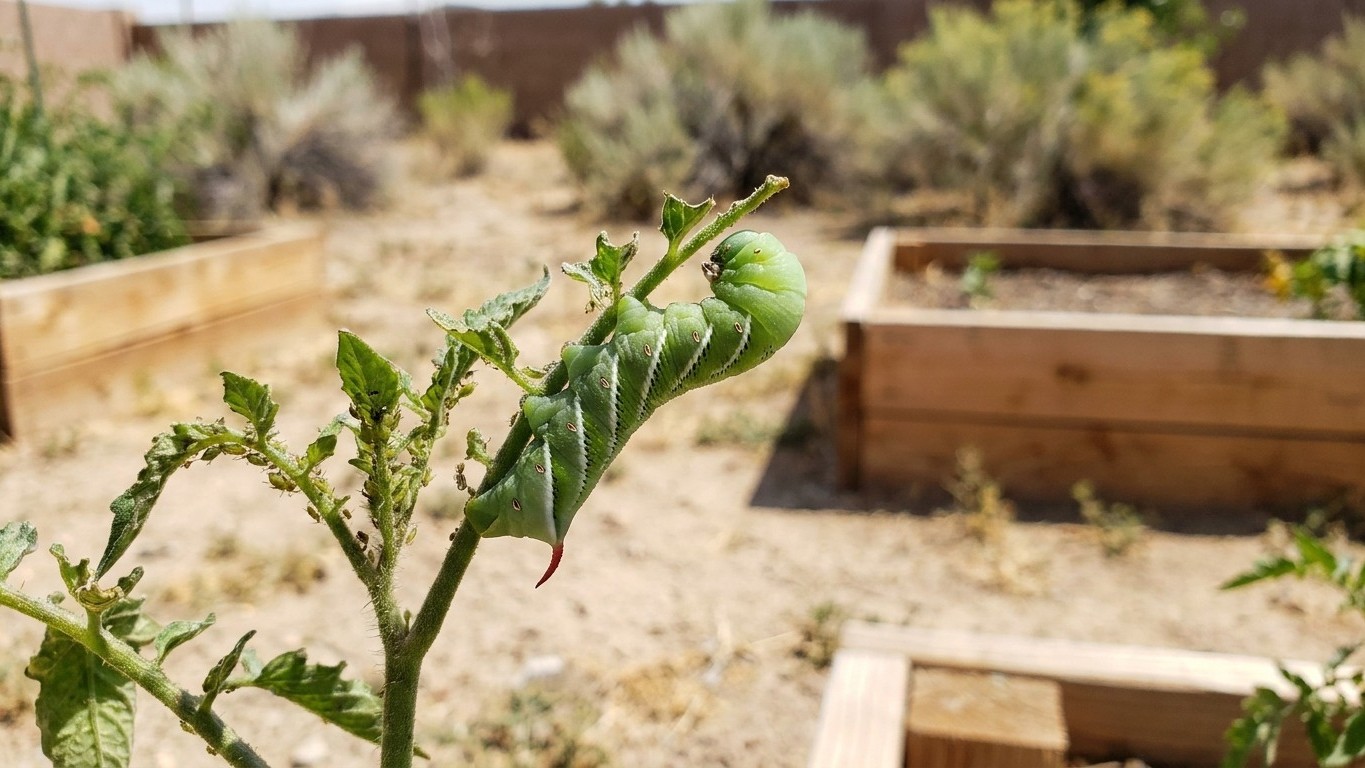
The hornworm is the pest gardeners actually see, because the caterpillar itself is large enough to spot once you know to look. It’s the larval stage that does the damage, stripping whole branches of foliage overnight and leaving behind dark green droppings on the leaves below as the first clue something is there. Hand-picking is still the most reliable control for a home garden, and checking plants in the early morning or evening, when hornworms are actively feeding, makes them far easier to find.
Whiteflies

Whiteflies are the last arrival and the one most tied to sustained heat, which makes them more of a fixture in the low desert than at elevation. Disturb a plant and a small cloud of tiny white insects lifts off the undersides of the leaves. Both the nymphs and adults feed on sap and produce the same sticky honeydew and sooty mold that aphids do. Yellow sticky traps placed near the plants help monitor the population, and a heavy infestation is much easier to prevent early than to knock back once it’s established.
Working it out for your own garden
Matching a pest to the damage on your plant is mostly a process of elimination based on two things: the growth stage of the plant and the time of season. A seedling with a severed stem points to cutworms; a mature plant with stippled, bronzing leaves in the heat of summer points to mites. A plant stripped of foliage overnight in mid to late summer points to hornworms. Matching the damage to the timing narrows the list to one or two suspects before you even flip a leaf over.
| Symptom | Likely pest | When to expect it |
|---|---|---|
| Seedling cut off at soil line | Cutworms | First weeks after transplant |
| Curled, yellowing new growth with sticky residue | Aphids | Early to mid season |
| Tiny round holes across leaf surface | Flea beetles | Early to mid season, worst on seedlings |
| Fine stippling, bronzing leaves, webbing underneath | Two-spotted spider mites | Peak summer heat |
| Large chunks of foliage missing overnight | Tomato hornworm | Mid to late summer |
| Small white insects rise off leaves when touched | Whiteflies | Sustained hot weather, worst in low desert |
The same logic applies to timing your defenses around Tomato Planting Dates in Nevada: Counting Back From Your Frost Window: a transplant set out into cold, damp soil is more vulnerable to cutworms simply because it sits stressed and slow-growing for longer, giving the pest more time to find it. A plant that grows away quickly outruns a lot of early pest pressure on its own, which is one more reason to get the transplant timing right before worrying about sprays.
What changes across the state
Elevation is the biggest variable in Nevada, and it moves pest pressure more than almost anything else. The USDA Plant Hardiness Zone Map puts the state anywhere from zone 4a up to zone 10a, which is an enormous spread packed into one set of state lines, and it means a garden at elevation runs a shorter, cooler season with far less of the sustained heat that mites and whiteflies need to build large populations. Lower, hotter valleys like the area around Las Vegas run in the opposite direction: long stretches of dry heat favor the sap-sucking pests, while the cooler nights at elevation slow them down even when they do show up.
Distance from irrigation and the amount of surrounding open desert also matters in ways a single figure can’t capture. Gardens near flood-irrigated pasture or a lot of green cover tend to see more aphids and whiteflies moving in from those host plants, while an isolated desert lot with mostly gravel and rock around it often sees less aphid pressure but no shortage of mites once the heat sets in. None of this shows up in a single statewide number, which is exactly why the pest list above is a starting point rather than a forecast for any one address.
The practical takeaway is to treat your own microclimate as the reference point, not the state average. A gardener in Carson City dealing with a much shorter, cooler season should expect the early-season pests, cutworms, aphids, flea beetles, to matter more relative to the season’s length, while a gardener in the low desert should plan on watching for mites and whiteflies through most of the hot months rather than treating them as a late-season surprise.
The mistakes this state punishes

The single most common mistake is transplanting into soil that’s still cold after a warm spell fools a gardener into thinking the season has started. A stressed, slow-growing transplant sits vulnerable to cutworms for far longer than a plant that’s growing vigorously, and it also recovers more slowly from any flea beetle feeding it takes in that same window. Wait for the soil itself to warm, not just for a few warm afternoons, before setting transplants out.
The second mistake is assuming a spray schedule from a wetter, cooler state applies here. Nevada’s dry heat changes which pests matter and when: a fungicide-heavy program aimed at humid-climate diseases does nothing for spider mites, and a gardener who isn’t checking leaf undersides for webbing through the hottest stretch of summer can lose a planting to mites before the damage is obvious from a glance at the top of the plant.
The third is choosing a long-season variety that pushes ripening deep into the pest-heavy part of summer without a plan for it. A plant still setting fruit in peak heat is exposed to a longer window of mite and whitefly pressure than one that’s already finished producing, which is one more reason the variety choice covered on Tomato Varieties That Ripen in Time in Nevada and the pest calendar here are worth reading together rather than in isolation.
Checking this against your county
Everything above is a statewide pattern built around Las Vegas’s climate data, and Nevada’s counties do not all behave the same way. Before you commit to a control plan, check with University of Nevada Reno Extension, the state’s land-grant extension service, for guidance specific to your county and elevation. Its county offices track which pests are actually active locally in a given season, which is a level of detail no statewide page can responsibly claim.
If you’re still working out the basics of the crop itself, the broader guide to growing tomatoes in Nevada is the place to start before narrowing in on pest identification.
Common questions
Do I need to spray for spider mites even if I don’t see webbing yet?
No, wait for actual signs, fine stippling on the leaves or the webbing itself, before treating. Spraying preemptively wastes product and can kill off the predatory insects that would otherwise keep mite numbers down on their own.
Are tomato hornworms dangerous to touch?
No, the horn is not a stinger and hornworms don’t bite or sting. The only real risk is to your plant, since a couple of hornworms can strip a branch of foliage in a single night.
Why are my seedlings disappearing but my established plants are fine?
That pattern points to cutworms, which target the soft stems of young transplants and largely leave older, woodier plants alone. A simple stem collar pushed into the soil around each new transplant solves this without any spray.
Do whiteflies mean I have a disease problem too?
Not automatically, but keep an eye out. Whiteflies can spread certain plant viruses while feeding, so a heavy, sustained infestation is worth taking seriously even before you see any leaf mottling or other virus symptoms show up.