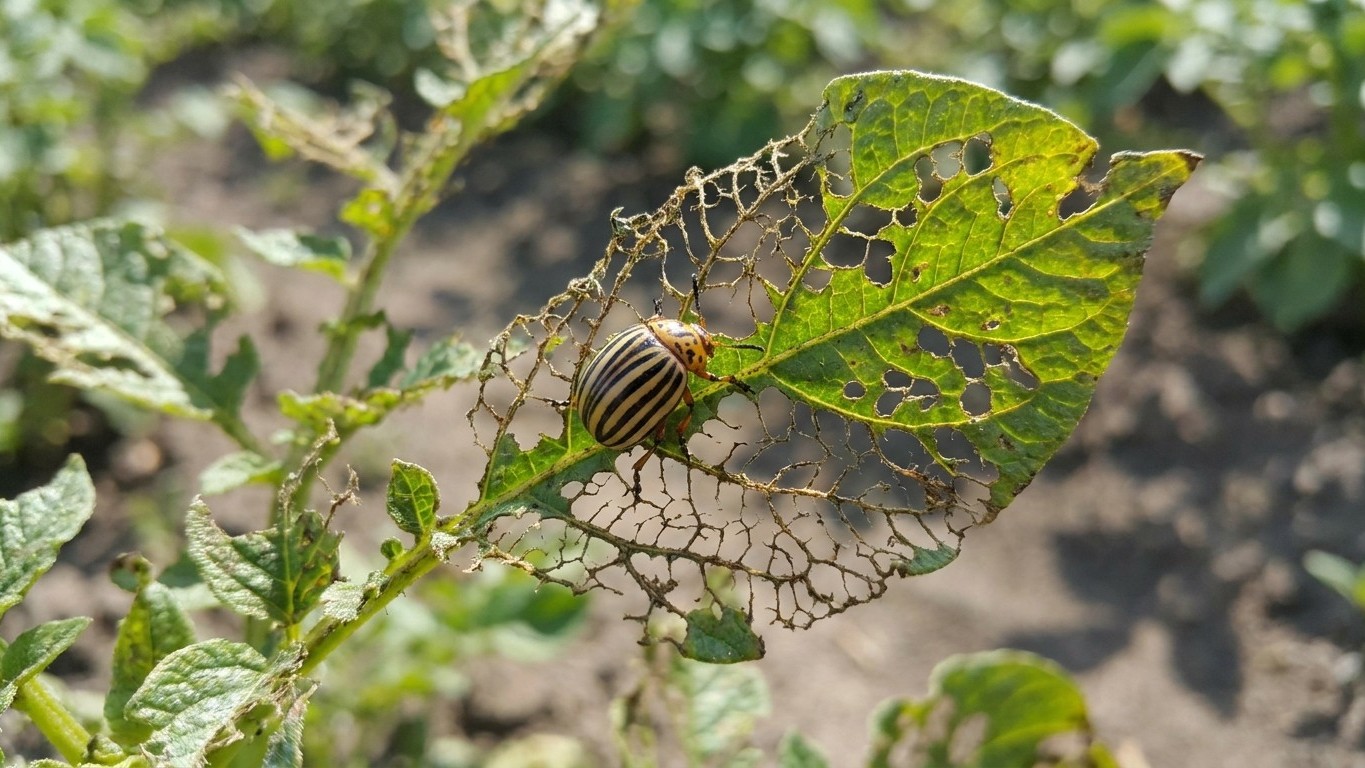

Late May through early June is when Colorado potato beetles start showing up in New Brunswick potato patches, right as the first plants push through the soil. By mid-June, adults have already laid eggs, and the larvae that follow do the real damage, stripping leaves down to the veins in a matter of days. Two generations per season is typical in New Brunswick’s climate, sometimes a partial third if September stays warm.
The New Brunswick Timeline: Egg to Adult

Overwintering adults dig out of the soil once ground temperatures climb past roughly 50°F, usually a week or two after New Brunswick’s last frost. They walk or fly short distances to find host plants, then start feeding almost immediately. Females lay clusters of 20 to 40 orange-yellow eggs on the undersides of leaves, and a single female can produce several hundred eggs over her lifetime.
Eggs hatch in four to nine days depending on temperature. The larvae go through four growth stages over roughly two to three weeks, and it’s this stage, not the adults, that eats the most foliage. A field that looks fine on a Friday can look skeletonized by the following Wednesday if larvae hit their fourth instar unchecked.
After feeding, larvae drop to the soil to pupate for another one to two weeks. New adults emerge and, in New Brunswick, there’s usually enough season left for a second generation to mate and lay eggs before fall. Those second-generation adults are the ones that overwinter, burrowing six to eight inches into the soil at the edge of fields, in windbreaks, or under garden debris.
Why New Brunswick’s Climate Suits This Pest
Colorado potato beetle doesn’t tolerate extreme heat well, and New Brunswick’s moderate summers, cool nights, and reliably moist spring soil are close to ideal. The province’s clay and loam soils in potato-growing regions like the Upper St. John River Valley also happen to be exactly the kind overwintering adults prefer for burrowing. That combination, decent rainfall plus workable soil, is part of why this pest has been a persistent management issue for New Brunswick potato growers for decades, not just an occasional nuisance.
How to Confirm It’s Colorado Potato Beetle
Adults are unmistakable once you know what to look for: about 3/8 inch long, with a rounded, hard-shelled body striped in black and cream-yellow down the wing covers. The head and thorax carry irregular black spots. Larvae look completely different, soft-bodied and reddish-orange with two rows of black spots along each side, growing from pinhead size to about half an inch.
Eggs are the easiest early warning sign if you check the underside of leaves regularly. They’re bright orange-yellow, laid in tight clusters, and stand out against the green foliage. Finding egg clusters before they hatch gives you the widest window to act, since crushing or removing eggs is far easier than dealing with a larval outbreak a week later.
One point of confusion: false potato beetle, a similar-looking species, has a faint extra stripe down the middle of its back and rarely causes economic damage. If the beetle you’re looking at has a clean, unbroken set of stripes and is actively defoliating plants, it’s almost certainly the real Colorado potato beetle.
What Actually Stops It: Control That Works in New Brunswick Conditions
No single tactic handles this pest on its own, largely because Colorado potato beetle has a well-documented history of developing resistance to insecticides, sometimes within a few seasons of a new product’s introduction. Growers and researchers in eastern Canada have tracked resistance to multiple chemical classes over the years, which is why rotation and combined tactics matter more here than with most garden pests.
Crop Rotation and Field Placement
Because overwintering adults emerge from the soil right where last year’s potatoes grew, planting new potatoes at least 200 to 300 yards from the previous year’s field cuts down significantly on the first wave of beetles finding your plants. This is easier to manage on a farm scale with multiple fields, but even home gardeners can rotate potato beds to opposite corners of a yard or use containers in a different spot each year.
Physical and Mechanical Controls
For home gardens and small plots, hand-picking adults and squashing egg clusters remains one of the most effective early-season tactics, especially in the first two weeks after beetles emerge. Floating row covers installed at planting and sealed at the edges keep migrating adults off young plants entirely, though they need to come off before flowering if pollination matters for the variety.
Straw mulch has shown some effect in university trials by making it harder for beetles to locate host plants and by supporting predatory insects that prey on eggs and larvae. It’s not a standalone fix, but it’s a low-cost layer that fits into a broader plan.
Biological and Cultural Options
Several natural enemies help suppress populations, including predatory ground beetles, ladybird beetles that feed on eggs, and parasitic wasps. Encouraging these predators means limiting broad-spectrum insecticide use, since those products kill beneficial insects along with the target pest. Bacillus thuringiensis subspecies tenebrionis, a bacterial insecticide, targets young larvae specifically and has a much smaller impact on beneficial insect populations than conventional chemical options.
Trap cropping, planting a small early block of potatoes or eggplant to draw beetles in before the main crop emerges, then treating just that trap area, is a tactic some New Brunswick growers use to concentrate the first generation where it’s easier to manage.
When Chemical Control Makes Sense
For larger plantings where hand-picking isn’t practical, targeting the newly hatched larval stage gives the best return, since young larvae are more vulnerable to insecticides than mature larvae or hardened adults. Because resistance is a real and ongoing issue in this pest, rotating between different insecticide classes each generation, rather than repeating the same product, is the approach recommended by extension services across Canada’s potato-growing regions. Growers in New Brunswick can check current provincial recommendations through the New Brunswick Department of Agriculture, Aquaculture and Fisheries for products approved and effective for the current season.
Scouting Schedule That Matches New Brunswick’s Season
Checking fields or garden beds twice a week from late May through mid-July catches both generations at their most vulnerable points. Focus scouting on field edges first, since overwintering adults typically walk in from adjacent land before spreading toward the center of a planting. A count of one adult per plant, or the presence of multiple egg clusters per plant, is generally considered the threshold where action becomes worthwhile rather than optional.
Soil temperature is a more reliable predictor of emergence timing than the calendar date. If spring runs cool, as it sometimes does in northern New Brunswick counties like Restigouche or Madawaska, emergence can lag two to three weeks behind what growers see in the Saint John River valley further south in the same year.
One detail that surprises a lot of home gardeners: adult beetles can survive being knocked into soapy water buckets for weeks if the water isn’t strong enough, since they’re capable of floating and even walking out along stems or debris. A stronger soap-to-water ratio, or adding a splash of dish detergent specifically formulated to break surface tension, makes hand-picking disposal actually stick instead of giving beetles a second chance.
Related guides
- Colorado potato beetle in Nova Scotia: When It Shows Up and What Stops It
- Colorado potato beetle in Newfoundland and Labrador: When It Shows Up and What Stops It
- Colorado potato beetle in New Jersey: When It Shows Up and What Stops It
- Colorado potato beetle in Prince Edward Island: When It Shows Up and What Stops It