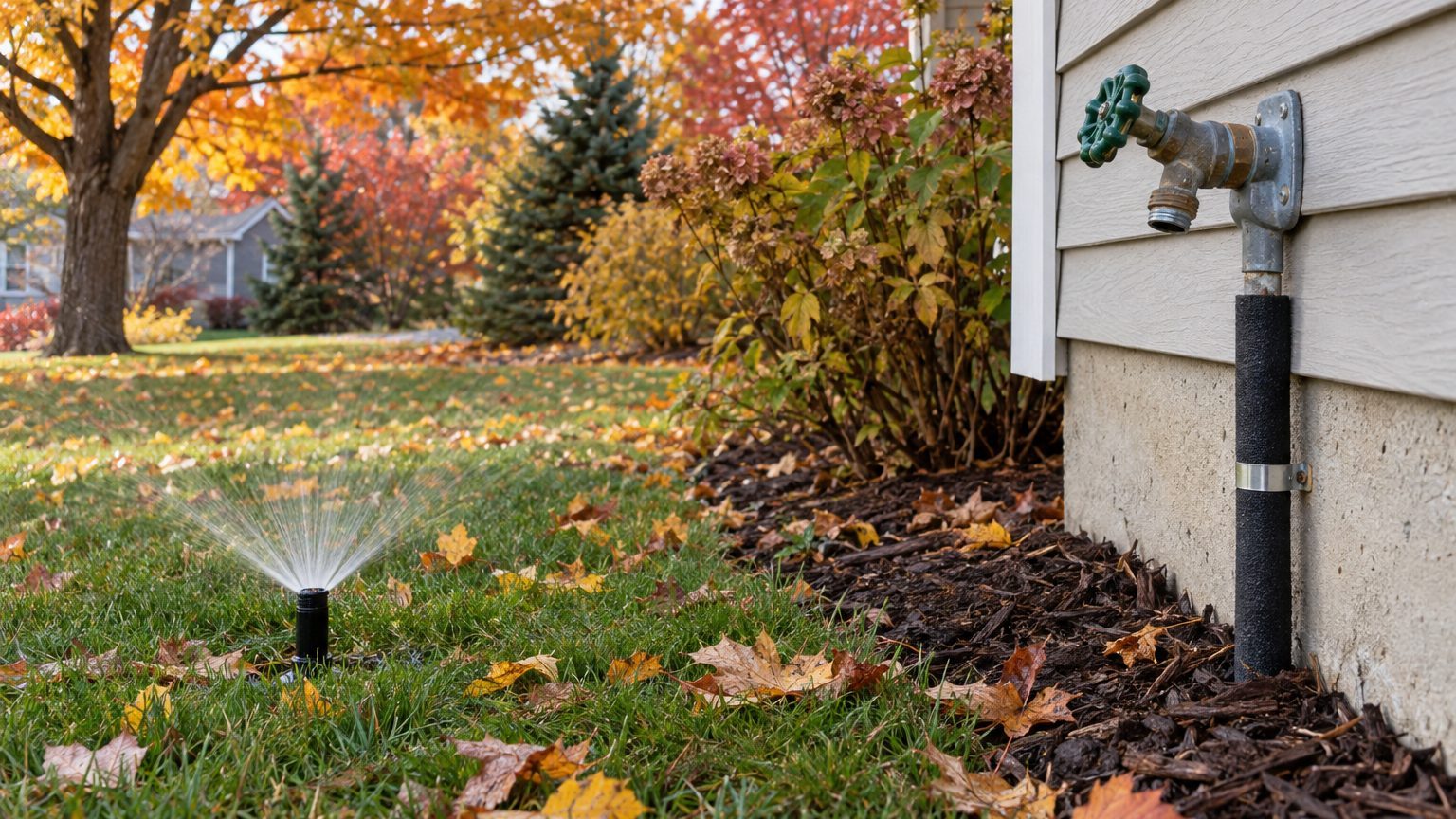

Late September into early October is the working window for emptying sprinkler lines and outdoor faucets in New Brunswick. The deadline is the first hard freeze, not a date on the calendar. Environment and Climate Change Canada’s 1981-2010 normals put the average first fall frost in Moncton on October 2, and in half of all years the frost arrives earlier. Anything still holding water when the cold settles in is at risk. For more seasonal timing across the province, see the New Brunswick guides.
When to do it in New Brunswick
Aim to have sprinkler lines and outdoor faucets emptied between late September and early October, and let the first hard freeze set your deadline, not the first light one. A light frost blackens basil and leaves the ground warm. A hard freeze is the night the temperature stays below freezing long enough to reach pipes, valve bodies and hose ends. Late September through early October is the span to write on the calendar, with colder districts at the early end of it.
The October 2 average is a midpoint, not a safe date
The figure comes from the Canadian Climate Normals 1981-2010 for the Moncton station, published by Environment and Climate Change Canada. It is a mean. In one year out of two the first frost falls later than October 2, and in the other it falls earlier. Treating that date as a deadline is a coin flip with your plumbing as the stake.
Moncton is also a single station. Northern and upland districts of the province get their first frost sooner, so fall chores there start earlier than the window above. The normals also cover 1981-2010, an older stretch than the 1991-2020 figures used for US locations. Use the average to plan, then let the overnight forecast make the final call.
Finishing early costs almost nothing. Lines drained at the end of September stay drained, and the only thing you give up is a bit of late-season watering. If you are seeding or feeding the grass, give it its last deep soak first, then shut the system down. The rest of the yard’s fall routine is covered in Winterizing a Lawn.
Why the shortcut used in mild regions does not apply
In places where winter lows hover near freezing, a quick drain or a cover over the backflow device can be enough, and a full blowout is sometimes optional. New Brunswick is not one of those places. Environment and Climate Change Canada’s normals give the Moncton coldest-month mean daily minimum as -13.9 °C. The ground freezes, shallow lines freeze with it, and parts above ground are exposed to every cold night.
Natural Resources Canada lists Moncton in Canadian plant hardiness zone 5a, based on 1991-2020 normals. That system weighs several climate variables and does not convert to a USDA zone, so do not borrow advice written for a US zone number. The practical reading is simple: winters here are serious, and the full job gets done every fall.
Sprinkler lines: drain or blow out
Why water left in the lines does the damage
Water expands as it turns to ice, and a pipe has little room to give. The splitting usually happens in the stretch between a growing ice plug and a closed valve or sealed fitting, where trapped water has nowhere to go. The weak points are threaded fittings, glued joints, valve bodies, the backflow assembly and the risers under each head. Low spots in the run and the valve manifold collect the most water, so they take the worst of it.
The damage stays hidden all winter. Nothing leaks while everything is frozen solid. The first sign comes in spring, when pressure returns and a crack suddenly has water behind it.
Three ways to empty a system
A manual drain relies on valves at the low ends of the lines. You open them and let gravity do the work. It only clears what slopes toward those valves, so any sag, dip or uphill run keeps its water.
Automatic drain valves open on their own when line pressure drops and let water escape at low points. They help, but a valve clogged with grit may not open, and they do nothing for sections of pipe that sit below the valve or for the heads themselves.
A compressed-air blowout shuts off the water supply, connects a compressor to the system’s blowout port, and pushes the water out through the heads one zone at a time. This is the method a New Brunswick winter calls for, because it clears pockets that gravity leaves behind. Wear eye protection and never stand over a head while it is under air. Stay within the pressure ratings of your components, run each zone in short bursts, and stop when the heads only mist. Airflow volume matters as much as pressure, which is why a small hobby compressor often falls short on a larger system.
The decision to write down: a compressed-air blowout, done from late September to early October, with manual or automatic drain valves treated as a first step and not the whole job.
When a professional is the sensible choice
Hire out the work if the system has no blowout port, if you do not own a compressor with enough airflow, or if the system is large with many zones. A backflow preventer is another reason to call someone, since its internal parts are delicate and some municipalities expect it to be handled by a trained person. Ask your local office if you are unsure.
Call a professional too if the system burst in a previous winter, because an older repair may have left a low pocket nobody knows about. Book the visit before the forecast turns cold, since a blowout after a hard freeze is a repair job, not maintenance.
Outdoor faucets and hoses
The sequence, using nothing but valves and your hands
Start with the hoses. Disconnect every one, along with splitters, timers and spray attachments. Drain them, coil them and store them indoors or in a shed. Then find the interior shutoff valve that feeds the outdoor tap, usually in a basement or crawl space near the wall where the faucet sits. Close the interior shutoff, then open the outdoor tap and let it drain. Leave it open all winter so any trace of remaining water has room to expand without cracking anything.
Do this in the same late September to early October window as the sprinklers. Hoses are the first casualty of an early cold night, and a faucet with a hose still attached can freeze before the pipes in the ground do. The full step-by-step is in Winterizing Outdoor Faucets Before the First Freeze.
Why a frost-free faucet still fails with a hose attached
A frost-free faucet puts its valve seat deep inside the warm side of the wall, at the end of a long stem. When you shut it off, the water in the barrel is meant to run out through the spout. A hose, even a short one, changes that. It holds water in the faucet, and a closed nozzle or a hose full of water keeps the barrel from draining. That water freezes in the part of the pipe that sits in or near the wall.
The failure is invisible until spring. When the tap is turned back on, water sprays inside the wall or ceiling cavity, often where nobody is looking. Frost-free hardware only works as designed when the hose is off and the barrel can empty. More on how these taps work is in Frost-Free Outdoor Taps.
Where your part ends
Turning valves and removing hoses is all this job needs. If the tap keeps dripping after the interior valve is closed, if no interior shutoff exists, or if the faucet seems to sit level or tilt the wrong way so it cannot drain, that is a plumber’s job. Replacing a faucet, adding a shutoff or opening a wall is not weekend work.
What goes wrong here
The cold snap that beats the calendar
Because October 2 is only a midpoint, some years the first hard freeze arrives before a single hose has been coiled. The first sign comes in spring: a faucet that drips from the spout or a sprinkler head that sprays sideways at the base. The cure is to watch the forecast from mid-September and act as soon as overnight lows start dropping toward freezing, not when you finally have a free Saturday. If a pipe does freeze before you get to it, Frozen Pipes explains what to do and what to leave alone.
The forgotten hose
One hose left on a back-yard tap is enough. It looks harmless in October, and in spring the damage shows as a cracked faucet body or water running inside the wall when you open the tap. The fix is a habit: walk the property once, front and back, and check every tap before you call the job done. Include the garage and the side of the house nobody uses.
The valve box that floods
The in-ground box that holds your zone valves collects runoff, and a box full of water gets turned into a block of ice in a hard freeze. Cracked valve bodies show up as a zone that will not shut off, a weeping joint, falling pressure or a soggy patch of lawn that stays wet even in dry weather. Prevention is cheap: check the valve box for standing water the same day you blow out the lines, clear leaves and soil from inside, and make sure surface water drains away from the lid. If the box is brimming and the valves sit underwater, call a pro before winter sets in.
Common questions
Is October 2 a safe date to winterize?
No. October 2 is the average first fall frost at the Moncton station in Environment and Climate Change Canada’s 1981-2010 normals, which means frost arrives earlier in about half of all years. Start in late September and finish before the first hard freeze. If you live in a northern or upland district, start earlier still.
Can I wait until the first snowfall?
Snow is a poor signal. A hard freeze can arrive on a clear night with no precipitation at all, and by the time snow is on the ground, lines may already be frozen. Use the overnight forecast as your trigger, not the sky.
Do automatic drain valves replace a blowout?
Not in this climate. They help clear water from low points, but they can stick, and they do not empty sagging pipe runs or the heads. With winter minimums as cold as -13.9 °C in the coldest month at Moncton, leftover pockets of water are a real risk, so a compressed-air blowout is the safer route.
What should I check in spring?
Open the interior shutoff slowly with the outdoor tap still open, then close the tap and look inside the wall area or basement ceiling for drips. For sprinklers, turn the water on gradually and walk each zone, watching for geysers at heads and wet ground around the valve box. A leak that appears now usually traces back to something left holding water the previous fall.