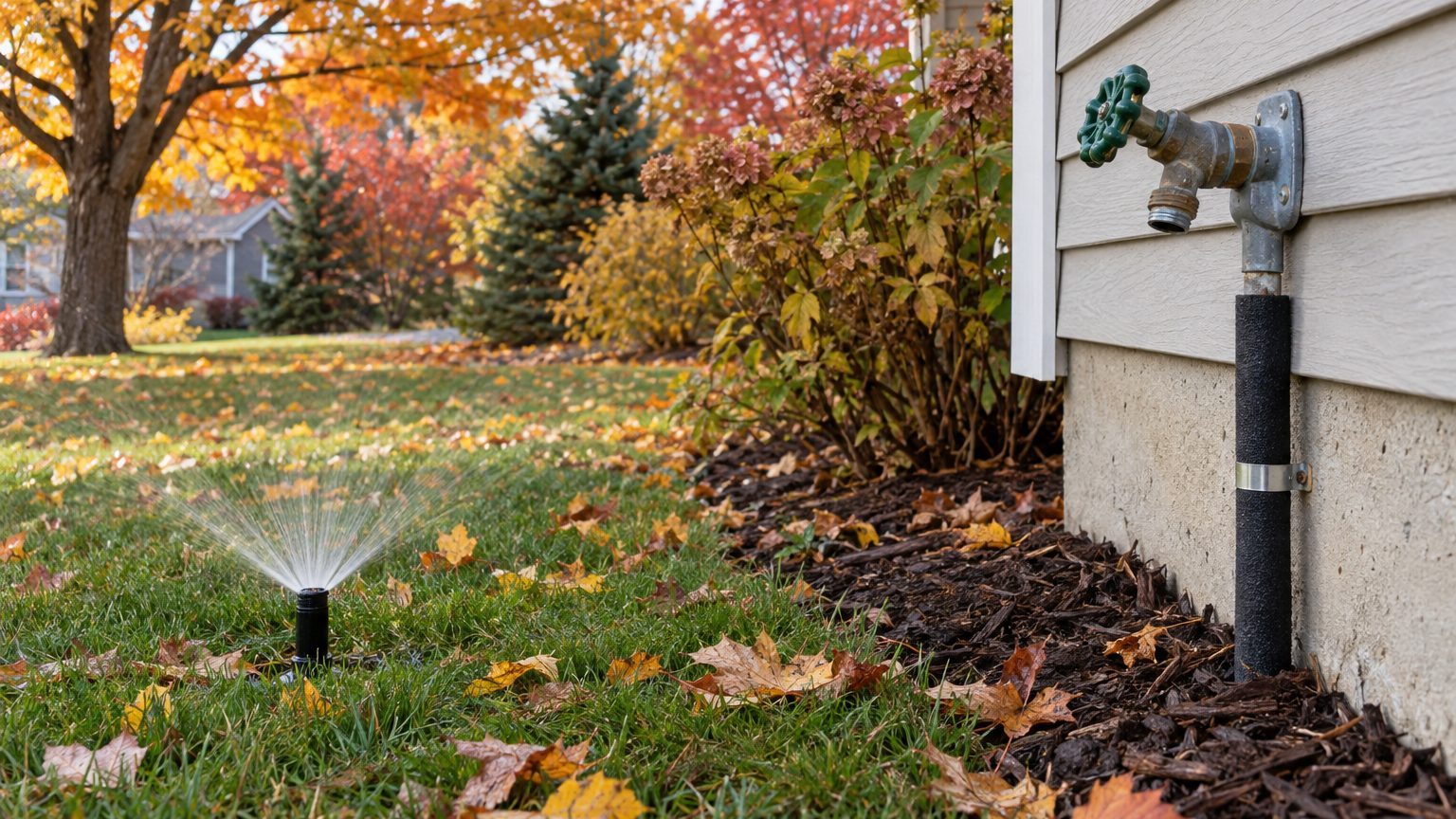

Start in October and finish before the nights turn hard. That is the short answer for a sprinkler system in Nova Scotia, and it holds for outdoor faucets and hoses too. The average first fall frost at Halifax Stanfield is October 18, so the work belongs in the weeks on either side of that date, and sooner in colder inland and northern districts. Below, the mechanism behind that timing comes first, then the three jobs in order: lines, faucets, and the failures that show up in spring.
When to do it in Nova Scotia
The working window runs from early October into the first days of November, and the rule is to finish before the first hard freeze, not after the first light one. Halifax Stanfield’s average first fall frost falls on October 18, according to Environment and Climate Change Canada’s Canadian Climate Normals for 1981-2010. Treat that date as the middle of the window, not as a safe deadline.
Why October 18 is a midpoint
An average splits the years in half. In one year out of two, the first frost arrives later than October 18, and in the other half it arrives earlier, sometimes by a wide margin. Anyone who circles the 18th on the calendar and waits for it is betting on a coin flip.
The figure also comes from a single station. A province is not one climate, and northern and upland districts get their first frost earlier than the Halifax airport does. Fall chores move earlier there, not later. One more caveat: Canadian normals cover 1981-2010, while American normals use 1991-2020, so lining this date up against a US frost chart is only approximate.
A light frost and a hard freeze are different events. A light frost blackens basil and zucchini leaves and does nothing to a buried water line. A hard freeze means the temperature stays below zero for hours, long enough to turn standing water in exposed parts into ice. Hose bibs, backflow assemblies, above-ground pipe and valve boxes go first. In practice, the first light frost is the signal to put the job on this weekend’s list, and the hard freeze is the deadline.
A full job is not optional here
Some mild-winter regions can skip a full blowout because the ground never freezes. Nova Scotia is not one of them. At the Halifax reference station, the mean daily minimum of the coldest month is -10.4 °C (Canadian Climate Normals, 1981-2010). Water left in a pipe or valve will freeze in an ordinary winter, not just a bad one.
For plant readers, Natural Resources Canada places Halifax in Canadian plant hardiness zone 6b (1991-2020 normals). That system is built on seven climate variables and does not convert to a USDA zone, and it describes what survives in the garden, not what survives in a water line.
If a cold snap shows up before you have finished, do a quick version that night. Shut off the supply, pull the hoses, open the drains, and do the full job on the next mild day. Anything that does freeze before you get to it is covered in Frozen Pipes, including how to thaw safely.
Sprinkler lines: drain or blow out
Why water left in the system splits it
Water expands as it turns to ice, and pipe, fittings and valve bodies cannot stretch to match. Ice forms plugs inside the line. The water trapped between two plugs has nowhere to go, pressure climbs, and the weakest point gives way. That is usually a threaded fitting, a valve body, a sprinkler head body or the backflow assembly above ground.
The cruel part is that nothing leaks in winter, because the ice itself is the seal. The damage shows only in spring, when you pressurize the system and water sprays from a crack you never saw. Flexible poly pipe tolerates freezing better than rigid pipe, but the fittings and valve bodies attached to it do not.
Manual drain, automatic drain, compressed air
A manual drain system has valves at the low points of each line. You open them by hand and let gravity do the work. It only works if the system was built with those valves and the pipe slopes toward them. Water can still sit in the zone valves, the backflow assembly and any dip in a line.
Automatic drain valves open on their own when line pressure falls, so water drains out at the low points. They are convenient, but a grain of grit can hold one open or shut, and they cannot reach the water sitting in a flat run or inside a valve. Many homeowners treat them as a backup, not the whole plan.
A compressed-air blowout pushes air through each zone, one at a time, and shoves the water out of the heads. It is the only method that clears the pipe, the heads and the zone valves. Air volume matters more than pressure. A small compressor can reach a high gauge reading and still not move enough air to clear a long zone. Stay within the pressure the manufacturer rates for the pipe and heads, wear eye protection, never lean over a head while air is running, and run each zone only until the water stops. Spinning dry air through a rotor head wears it.
Which one this climate calls for
With a mean coldest-month minimum of -10.4 °C, the dependable choice here is a compressed-air blowout of every zone, after the supply is shut off and the backflow assembly is drained. Manual and automatic drains are good supplements, not substitutes. After the blowout, many installers leave the backflow assembly’s handles halfway between open and closed so any last water has room to expand. Set the controller to its off or rain mode instead of unplugging it, so it keeps its schedule.
Hiring a professional makes sense in several situations:
- The system has no drain valves and you do not know where the low points are.
- You cannot get a compressor that delivers enough air volume.
- The main line is long or has several branches, and you are unsure which zones you have cleared.
- A fitting or valve split in a past winter, which suggests water is being trapped somewhere.
Book the visit before the window opens so you are not picking a date in the last week before the hard freeze. Sprinkler shutdown and lawn care often land on the same October weekends, but the lawn runs on its own calendar, covered in Winterizing a Lawn.
Outdoor faucets and hoses
The shutoff-and-drain sequence
Faucets need nothing beyond turning valves, and the order matters. Any step past that, such as replacing a faucet, cutting into a line or fixing a fitting that drips, is a plumber’s job. The sequence for each outdoor tap:
- Disconnect every hose, splitter, timer and spray attachment.
- Close the interior shutoff valve that feeds that faucet, usually in a basement or crawl space where the pipe goes through the wall.
- Open the outside faucet fully so the water in the pipe between the two valves can run out.
- Leave the outside faucet open all winter.
If you cannot find an interior shutoff, or the faucet keeps dripping with the shutoff closed, stop there and call a plumber. That tells you the valve is failing or the pipe holds water it should not. Drain the hoses themselves, coil them, and store them indoors. A hose left outside traps water that freezes, and the rubber and couplings crack.
The full process, with a few extras such as insulated covers, is in Winterizing Outdoor Faucets Before the First Freeze. A cover is a supplement. It does not replace draining.
Why a frost-free faucet still fails with a hose attached
A frost-free faucet puts its valve seat at the warm end of a long barrel that runs through the wall. The barrel tilts slightly downward, so when you shut the valve, the water left in the barrel runs out the spout. That design only works if the spout is open to air.
A hose changes that. Even with the nozzle closed, the water in the hose holds the water in the barrel, and the barrel cannot drain. The exposed part of the barrel freezes, the ice splits the pipe, and nothing shows until a thaw. Then the water runs inside the wall, often unseen for days. The faucet is built to handle cold, but not a trapped column of water.
That is why every hose comes off before the first hard freeze, frost-free faucet or not. More on how these taps work, and what a plumber would check, is in Frost-Free Outdoor Taps.
What goes wrong here
The early snap and the forgotten hose
Nova Scotia autumns can run mild into late October and then drop fast. With October 18 as the average first frost, half of all years bring it earlier, and the plan to do it next weekend loses to a cold night. In spring, the damage looks like a zone that will not hold pressure, a geyser from a split head, or a wet patch in the lawn above a cracked line. The fix is simple: start in the early part of the window, and move the job up whenever the forecast first mentions overnight freezing.
The forgotten hose is quieter. It is the one coiled behind a shed, in a garage or on a detached outbuilding’s tap. In spring, the first sign is water running down a basement wall or ceiling beneath the faucet, or a spray from the wall when the supply comes back on. Walk the whole property for hoses the same day you drain, and check every outbuilding.
The valve box that floods
Zone valves sit in an in-ground box, and that box collects rain and snowmelt. If it is full of water when a hard freeze arrives, the valves freeze in place. In spring, you might see a zone that will not shut off, one that never turns on, or a cracked valve body leaking into the soil. Blow out the valves along with the lines, check that the lid fits, and clear any standing water from the box before winter. When the supply comes back in spring, open it slowly and check the basement and the box first, before you walk the yard.
Common questions
Can I wait until after the first frost to winterize?
You can wait out a light frost, but not a hard freeze. The frost is the warning that the window is open. Because the October 18 figure is an average, half of all years bring the first frost later and half bring it earlier, so start in the early part of the window.
Is it safe to blow out my own sprinkler system?
It can be, with the right equipment and care. Use a compressor that delivers enough air volume, stay within the pressure rating of your pipe and heads, wear eye protection, and work one zone at a time. If you have any doubt about the layout or the equipment, hire a professional.
Does the Halifax date apply to the rest of the province?
Only as a starting point. The October 18 average comes from the Halifax Stanfield station, and northern and upland districts get frost earlier, so the work should move earlier there. Other regional notes are collected in the Nova Scotia guides.
When can I turn the water back on in spring?
Wait until the nights stop dropping below freezing. Then open the supply slowly, check the interior valves, the basement and each outside tap for leaks, and run the sprinkler zones one at a time before you trust the system.