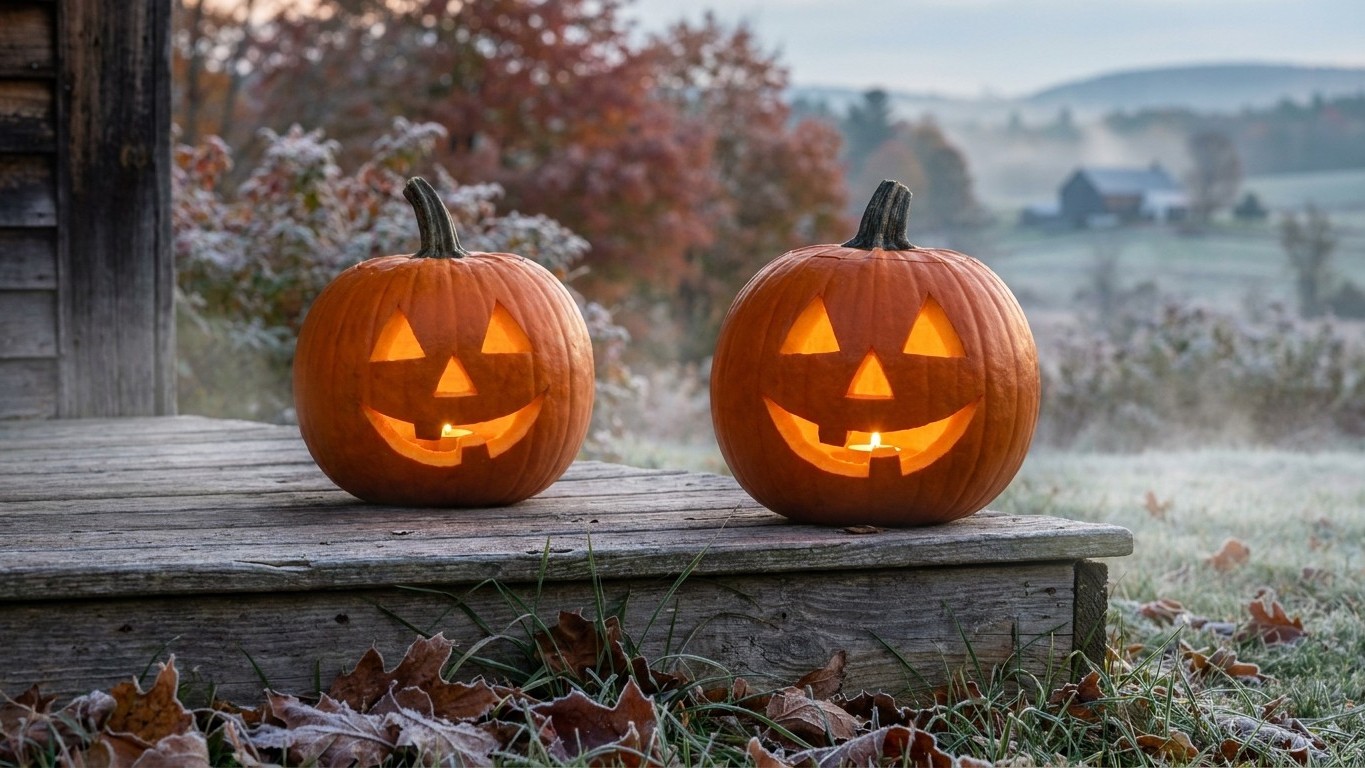

New Hampshire’s mean first fall frost lands somewhere between October 13 and October 26, arriving anywhere from around five to eighteen days before Halloween itself. That gap is what decides pumpkin timing here, whether you’re setting a jack-o’-lantern out weeks ahead or racing the calendar during Halloween week. Here’s what that frost window means for storage, spoilage, and when to actually pick up the knife.
The short answer

The mean first fall frost for this region falls around October 13 to October 26, based on the reference station used by NOAA’s Climate Normals. That’s an average, not a promise, so treat it as a planning window rather than a fixed date on the calendar. What it tells you is that frost, real frost, temperatures dipping to 32°F, typically shows up well before Halloween arrives in most years, sometimes by more than two weeks.
That matters for a pumpkin sitting outside because a hard freeze doesn’t care whether the pumpkin is whole or already carved. Exposed skin and flesh react to repeated freeze-thaw cycles by softening and collapsing faster than they would in steady, moderate cold. A pumpkin left on an unprotected porch step from early October straight through to Halloween is gambling against a frost date that, on average, arrives before the holiday even shows up on the calendar.
The practical takeaway: carve close to the day. If frost tends to arrive on the earlier side of the window, around October 13, treat that as your cue to keep the pumpkin whole and protected right up until the final week before Halloween, then carve within the last three or four days. If the season runs toward the later end, around October 26, there’s a bit more breathing room, but the same logic still applies. Carving weeks in advance in this climate isn’t working with the season, it’s working against it.
A whole pumpkin stored properly, cool, dark, between 45-50°F, can hold for three to six months, according to University of Illinois Extension. That runway disappears the moment you cut into it. So the real decision isn’t how early you can carve without spoilage, it’s how late you can wait so the carved pumpkin only has to survive a few days outside, not a few weeks.
Frost or heat: which one gets it here
The cold end
New Hampshire’s risk runs cold, not warm. The recommended whole-pumpkin storage band sits at 45-50°F, and the state’s mean first fall frost window of October 13 to October 26 puts overnight temperatures right at or below that band well before Halloween in a typical year. Once nighttime lows start touching 32°F, a pumpkin left outside unprotected can freeze at the surface, and that damage doesn’t reverse once things warm back up during the day.
The season doesn’t ease up after that first frost, either. By the coldest month, the mean daily minimum at the Manchester reference station runs 17.1°F, a figure used to describe winter hardiness rather than fall timing, but it makes the trend obvious: once frost arrives, New Hampshire’s temperatures keep sliding, not stabilizing. There’s no late-October warm spell coming to bail out a pumpkin that’s already been frozen.
The warm end
Heat simply isn’t the local hazard in late October. In warmer climates, a whole pumpkin can sit through 70-80°F afternoons for weeks, sweating and softening from trapped warmth even before frost is a factor anywhere nearby. That’s not the pattern here. By the time Halloween approaches, New Hampshire afternoons are rarely warm enough to push a stored pumpkin toward the upper end of the 45-50°F range, let alone past it.
So the entire storage strategy in this state should be built around keeping the pumpkin from freezing, not from overheating. That’s a different problem than a homeowner in a warmer region faces, and it changes where the pumpkin should sit while it waits to be carved.
Where to keep it until you carve
- Unheated attached garage. Through most of October this tends to sit close to the 45-50°F range and stays dark with the door shut, making it one of the more reliable spots once nights start cooling.
- Enclosed, unheated porch or mudroom. Good early in the season, but keep an eye on the forecast as the frost window (October 13 to October 26) approaches. If overnight lows are expected near 32°F, move the pumpkin somewhere more insulated.
- Basement stairwell or older unheated cellar. Many New Hampshire homes have a below-grade space that naturally settles into the low-to-mid 50s, a workable middle ground when outdoor temperatures start swinging.
- Keep it away from the kitchen fruit bowl. Apples, potatoes, and tomatoes give off ethylene gas as they ripen, and that gas speeds up a pumpkin’s decline. Store it somewhere separate from ripening produce entirely.
- Keep it away from direct heat. Woodstoves, radiators, and sunny windowsills all push a pumpkin well above the 45-50°F band and shorten how long it holds, whole or carved.
Checking this against your own county
The frost figures here come from a single reference weather station, and gardens away from that station, especially rural yards, valley bottoms, or anything at higher elevation, often see frost arrive earlier than the airport-based average suggests, sometimes by a week or two. Before locking in a carving date, it’s worth checking conditions closer to home.
UNH Extension tracks local frost and growing-season data specific to New Hampshire counties, and can offer guidance that reflects conditions where you actually live rather than a single statewide reference point. If you’re in a low-lying or northern part of the state, treat the October 13 date as the more likely scenario rather than October 26.
Common questions
Does New Hampshire’s hardiness zone tell me when to carve?
No. Hardiness zone data describes whether a plant survives winter cold, based on figures like the coldest month’s mean minimum temperature (17.1°F at the Manchester reference station). It says nothing about fall frost timing. For carving decisions, the first fall frost window (October 13 to October 26) is the relevant figure, not the zone number.
How long will a carved pumpkin last outside in New Hampshire?
Neither University of Illinois Extension nor Utah State University Extension publishes a preservation timeline or protocol for a carved pumpkin. That figure simply isn’t available from a research source. What extension guidance does offer is this: choose a pumpkin with 1 to 2 inches of stem left, keep it whole as long as possible in a cool, dark spot, and carve close to the day you plan to display it.
Can I carry a pumpkin by its stem?
No. The stem isn’t a handle, it’s a seal. Once it breaks off, that section of the pumpkin is exposed and spoils faster. Carry a pumpkin from underneath, supporting its full weight, and leave the stem alone.
What if frost hits my yard earlier than October 13?
It’s possible, especially at higher elevation or in low-lying rural spots where cold air settles. The statewide reference figure comes from one weather station, so checking with UNH Extension for county-level frost data gives a more accurate picture of what’s actually happening where you garden.