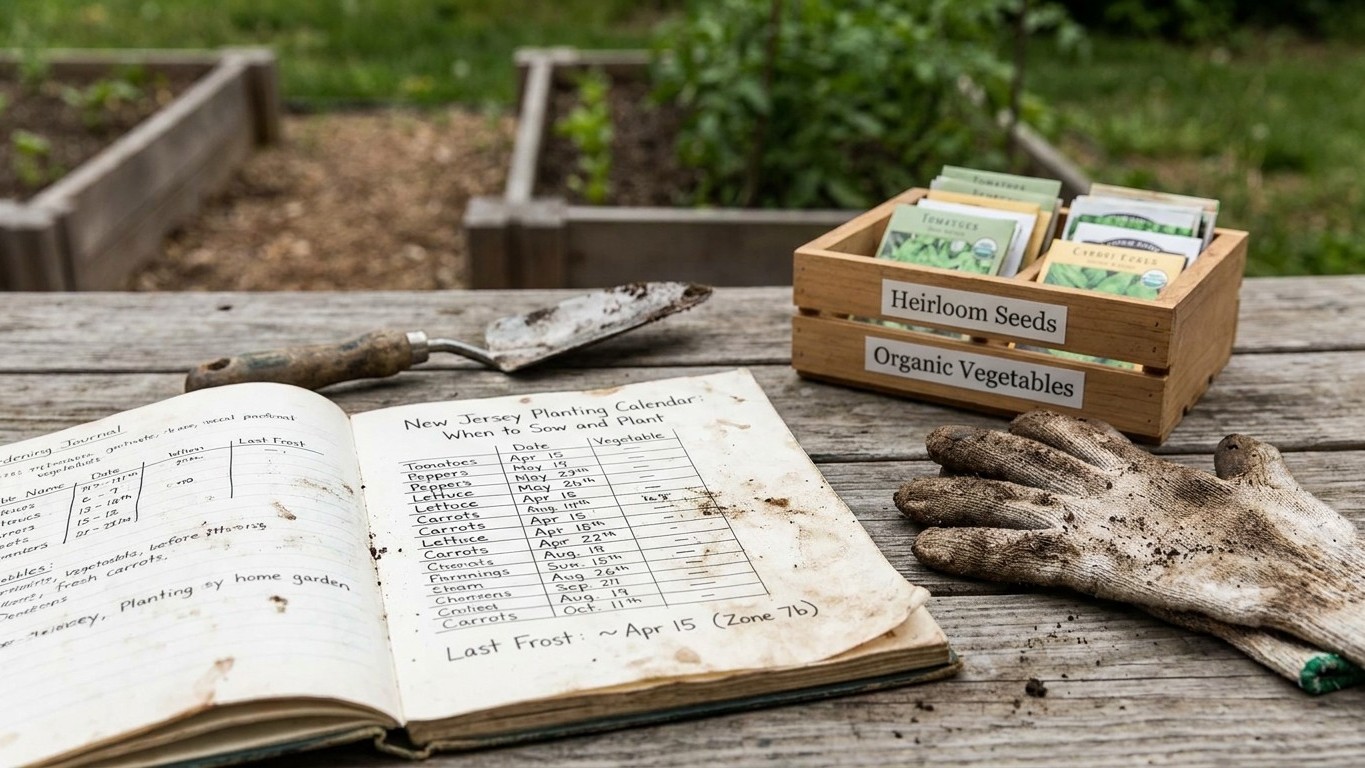

New Jersey’s frost-free window, according to NOAA’s 1991-2020 climate normals for the Newark station, runs from a last spring freeze between March 29 and April 6 to a first fall freeze between November 4 and November 16. That gives Newark roughly seven months to grow in, though a garden thirty miles inland or up in elevation will see frost hang on later in spring and arrive sooner in fall. Check your own county’s frost record against Newark’s before you set a transplant date, and lean late rather than early if you’re not right on the coast.
The frost window in New Jersey

Everything else on this calendar hangs off those two dates. NOAA’s National Centers for Environmental Information calculate them from thirty years of temperature records at Newark, using the range where a 32°F freeze has between a 30% and 70% chance of occurring. That’s why the dates come as a window and not a single day: in a given year, the last frost could land on either edge of that band, and a gardener who plants to the middle of it is gambling on an average that doesn’t guarantee anything for this particular spring.
The growing season length that falls out of these two ranges is roughly 212 to 232 days, depending on which end of the spring window and which end of the fall window you actually get in a given year. That’s close to seven months of frost-free growing at Newark itself. Further from the coast, in the Highlands of Sussex and Morris counties or up along the Kittatinny Ridge, the season runs shorter because cold air settles in valleys and elevation drops temperatures faster in fall. Along the immediate coast and down toward Cape May, the ocean moderates both ends of the season, often pushing the first fall frost later than Newark’s own date.
None of this is a promise for any single spring. The 1991-2020 normals describe the climate, not the weather. A gardener in Bergen County who plants tomatoes on April 6 because that’s the late edge of Newark’s window can still lose them to a cold snap that arrives after that date in a year when the normal doesn’t hold. Treat these figures as the frame you plan inside, and keep a frost cloth or row cover ready for the two or three weeks on either side of your planting date regardless of what the calendar says. For gardeners elsewhere in the state working out their own local variation, our New Jersey guides cover conditions county by county, and if you’re planning out the whole year, What to Plant in New Jersey in January covers the coldest stretch before this frost window even comes into play, What to Plant in New Jersey in August covers the height of the growing season on the other side of it, while What to Plant in New Jersey in December closes out the year on the other side of that same window/august/”>What to Plant in New Jersey in August covers the height of the growing season, and while What to Plant in New Jersey in October covers the stretch as that same window closes down in fall, and What to Plant in New Jersey in September covers the transition back into fall crops as that same frost window starts closing, and What to Plant in New Jersey in November covers the tail end of it as that first fall freeze closes back in, while What to Plant in New Jersey in May picks up once that frost-free window is reliably open, and What to Plant in New Jersey in March picks up as that window starts to open, and What to Plant in New Jersey in June picks up once the season is in full swing, while What to Plant in New Jersey in July looks at the peak of the season once the frost risk has fully passed, if you’re mapping out an early start, What to Plant in New Jersey in February lays out what can go in before that spring window even opens, while What to Plant in New Jersey in April picks up once that window is open.
Cool-season crops
Cool-season vegetables tolerate a light frost and actually prefer to mature before real heat sets in, so they go in the ground well ahead of the last spring frost date rather than after it. The trick is knowing which ones can take a hard freeze in seedling form and which only tolerate a light one once established.
- Peas and spinach can be direct-sown as soon as the soil can be worked, which in most years is several weeks before Newark’s last frost window opens.
- Lettuce and other leafy greens handle a light frost once they have a few true leaves, and can be started from transplant a few weeks before the last frost date.
- Brassicas like broccoli, cabbage and kale go out as hardened-off transplants roughly two to four weeks before the last frost, since young seedlings tolerate cold better than seed sown directly into cold soil.
- Root crops such as carrots, beets and radishes are direct-sown early too, since they need the cool soil to germinate evenly and don’t transplant well once started.
The reasoning behind all of this is that cool-season crops grow their edible parts, leaves, roots, unopened flower buds, before they need warmth to flower and set seed. A cabbage plant doesn’t care about frost the way a tomato does, because nothing about a cabbage’s growth cycle depends on warm soil the way a tomato’s does. What does matter is hardening seedlings off gradually if they’ve spent their first weeks indoors or in a greenhouse, since a sudden move from indoor warmth to a cold, windy garden bed will stress even a frost-tolerant transplant.
Timing these crops off the frost date rather than off a calendar month matters because Newark’s own last-frost window spans over a week, and gardens elsewhere in the state can run a week or two later still. A gardener who always plants peas “in March” because that’s what a calendar says may be planting into soil that’s still too cold and wet to germinate them evenly, while a gardener who waits for the soil itself to be workable, regardless of the date on the wall, gets a better stand.
Warm-season crops

Tomatoes, peppers, squash, beans and corn all need warm soil to germinate and grow, not just frost-free air, which is why the last frost date is the earliest possible planting time for these crops and rarely the ideal one. Cold, wet soil right after the frost date will rot seed and stunt transplants even if the air temperature never drops back to freezing. Most gardeners in New Jersey wait one to three weeks past the last frost window before setting out warm-season transplants, longer for particularly cold-sensitive crops like peppers and basil, to let the soil catch up.
Counting back from a transplant date
Tomato seed packets give a number of weeks to grow indoors before transplant, usually six to eight. If you’re aiming to set transplants out in mid-April, the later part of a reasonable planting window after Newark’s frost date, and your packet calls for six to eight weeks of indoor growth, you’re starting seed indoors sometime in late February to early March. That’s arithmetic you do yourself off the two numbers, not a date either NOAA or a seed catalogue hands you directly.
The table below shows how several tomato cultivars line up against Newark’s frost window, using each variety’s published days-to-maturity figure counted from transplant, not from seed. These figures come from the catalogue, not from any local trial, and actual timing will shift a week or so earlier or later depending on the season and how warm your soil runs.
| Variety | Days to maturity | Habit | Set out | First ripe | Margin before fall frost |
|---|---|---|---|---|---|
| Sakura | 55 | Indeterminate | Mid April | Mid June | 143 days |
| Edox | 55 | Indeterminate | Mid April | Mid June | 143 days |
| Valentine | 55 | Indeterminate | Mid April | Mid June | 143 days |
| Glacier | 55 | Determinate | Mid April | Mid June | 143 days |
| Sun Gold | 57 | Indeterminate | Mid April | Mid June | 141 days |
| Supersweet 100 | 60 | Indeterminate | Mid April | Mid June | 138 days |
| Juliet | 60 | Indeterminate | Mid April | Mid June | 138 days |
| Amalfi | 68 | Determinate | Mid April | Late June | 130 days |
| Cherokee Purple | 72 | Indeterminate | Mid April | Early July | 126 days |
| Big Beef Plus | 72 | Indeterminate | Mid April | Early July | 126 days |
| Tiren | 75 | Indeterminate | Mid April | Early July | 123 days |
| Granadero | 75 | Indeterminate | Mid April | Early July | 123 days |
| San Marzano II | 78 | Indeterminate | Mid April | Early July | 120 days |
| Celebrity Plus | 78 | Determinate | Mid April | Early July | 120 days |
Every one of those margins is generous against Newark’s fall frost window, which is the point of picking varieties with published days-to-maturity figures well under the season length rather than pushing a 90-day heirloom right up against the calendar. Squash, beans and corn follow the same logic as tomatoes: direct-sow or transplant only once soil has warmed past the point where seed rots rather than germinates, and count backward from your own region’s expected first fall frost if you’re planning a second summer-crop planting. Gardeners coming from a much longer season, Tennessee’s growing window opens weeks earlier in spring, as our Tennessee Planting Calendar shows, should expect New Jersey’s compressed warm-season window to change how many successive plantings of beans or squash actually fit.
The fall planting window
Working backward from Newark’s first fall frost, between November 4 and November 16 per NOAA’s normals, tells you the latest reasonable sowing date for a fall crop. Take a crop’s days-to-maturity figure, add a couple of weeks of margin because growth slows as daylight shortens in September and October, and count back from the earlier end of that frost window rather than the later one. A crop that needs 60 days to mature and gets planted 60 days before the earliest expected frost date is cutting it close if that year’s frost lands early.
What actually improves after frost
Several crops get better, not worse, after a light frost, which changes how you plan the tail end of the season:
- Kale and collards convert starches to sugars after a frost, which is why gardeners often say fall kale tastes sweeter than summer kale.
- Carrots and parsnips left in the ground through a light frost do the same thing, sweetening in place before harvest.
- Brussels sprouts are frequently left standing until after the first frost specifically because the flavor improves.
- Spinach sown for a fall crop tolerates a light frost outright and can often be harvested well past the first frost date under a simple row cover.
This is the opposite of how warm-season crops behave, and it’s worth planning your fall garden around deliberately rather than treating frost purely as an ending. A gardener who pulls all the greens the week before the expected frost date is often leaving flavor and a few more weeks of harvest on the table. The same NOAA normals that set the spring planting calendar apply here too: Newark’s first fall frost window is the reference point, and gardens further inland or at elevation should expect that window to arrive on the earlier side of it.
Reading a planting calendar properly
A state-wide planting calendar, including this one, is a starting point built from one weather station’s thirty-year average, not an instruction written for your specific yard. NOAA’s Newark figures are measured at an airport, which sits in an urban heat pocket that runs warmer than the surrounding suburbs in both directions of the frost season. A garden in a low-lying rural spot in Hunterdon or Sussex County can see frost settle in weeks before Newark does in fall, and linger weeks after Newark clears in spring, simply because cold air drains downhill and pools there overnight.
What actually varies, and why
Elevation is the biggest factor after latitude. The Highlands and Kittatinny Ridge areas in the northwest run measurably colder than the Piedmont or the coastal plain, and that difference shows up directly in how late spring frost lingers. Large water bodies moderate temperature nearby, which is part of why the immediate coast and areas near the Delaware Bay often see a milder frost pattern than inland spots at the same latitude. Urban heat islands work the other direction, keeping city gardens a bit warmer than surrounding open country. None of these effects are things a single NOAA station can capture, because they’re local by definition.
The fix isn’t a better calendar. It’s watching your own garden over a season or two: note the date of your last actual frost each spring, keep a simple soil thermometer on hand, and compare what you observe against Newark’s normals so you know your own offset. Gardeners just across the Hudson dealing with the same problem can see how New York’s county-by-county frost variation plays out in our New York Planting Calendar, which faces an almost identical spread between coastal and inland dates.
Local help
For frost dates and soil test results specific to your own county, the Rutgers Cooperative Extension maintains county offices across the state that track local conditions in more detail than any statewide station can. Rutgers NJAES also runs soil testing labs, which is the single most useful thing a home gardener can do before committing a season’s worth of seed to a bed whose actual pH and nutrient levels are unknown. Their county agents can tell you how your specific township tends to run relative to the Newark normals used throughout this calendar.
Common questions
Is it too late to plant tomatoes in New Jersey if I missed the mid-April window?
No, tomato transplants can go in through May in most of the state and still mature well before the fall frost, especially with a shorter-season variety like Sakura or Glacier at 55 days from transplant. The bigger risk with a late planting is cool soil slowing early growth, not running out of season.
Do I really need to wait past the last frost date to plant peppers?
Yes, and longer than tomatoes. Peppers are more cold-sensitive than tomatoes and grow slowly in cool soil even when the air temperature is safely above freezing, so most gardeners wait one to two weeks past the point they’d risk a tomato transplant.
Why does my garden always frost later than what the weather app says for my town?
Weather apps usually report the nearest official station, often an airport, which can sit in a warmer pocket than a low-lying yard nearby. Cold air drains downhill and pools in low spots overnight, so a garden in a valley or near a creek will often see frost when a station a few miles away doesn’t.
Can I direct-sow tomato seed outdoors in New Jersey instead of using transplants?
It’s technically possible but not practical for most of the state. Newark’s growing season, even at its longest around 232 days per NOAA’s normals, gives most tomato varieties enough time only if they go in as an already-started transplant rather than seed sown straight into the ground after frost.
What happens if a hard frost hits after I’ve already put out warm-season transplants?
A hard freeze will kill unprotected tomato, pepper and squash transplants outright, while a light frost may only damage leaf tips if you can cover the plants overnight. Keep row cover or old sheets on hand through the two or three weeks after your planting date as insurance against the years when the frost window runs later than usual.
Related guides
- New York Planting Calendar: When to Sow and Plant, Frost Dates Included
- Pennsylvania Planting Calendar: When to Sow and Plant, Frost Dates Included
- Rhode Island Planting Calendar: When to Sow and Plant, Frost Dates Included