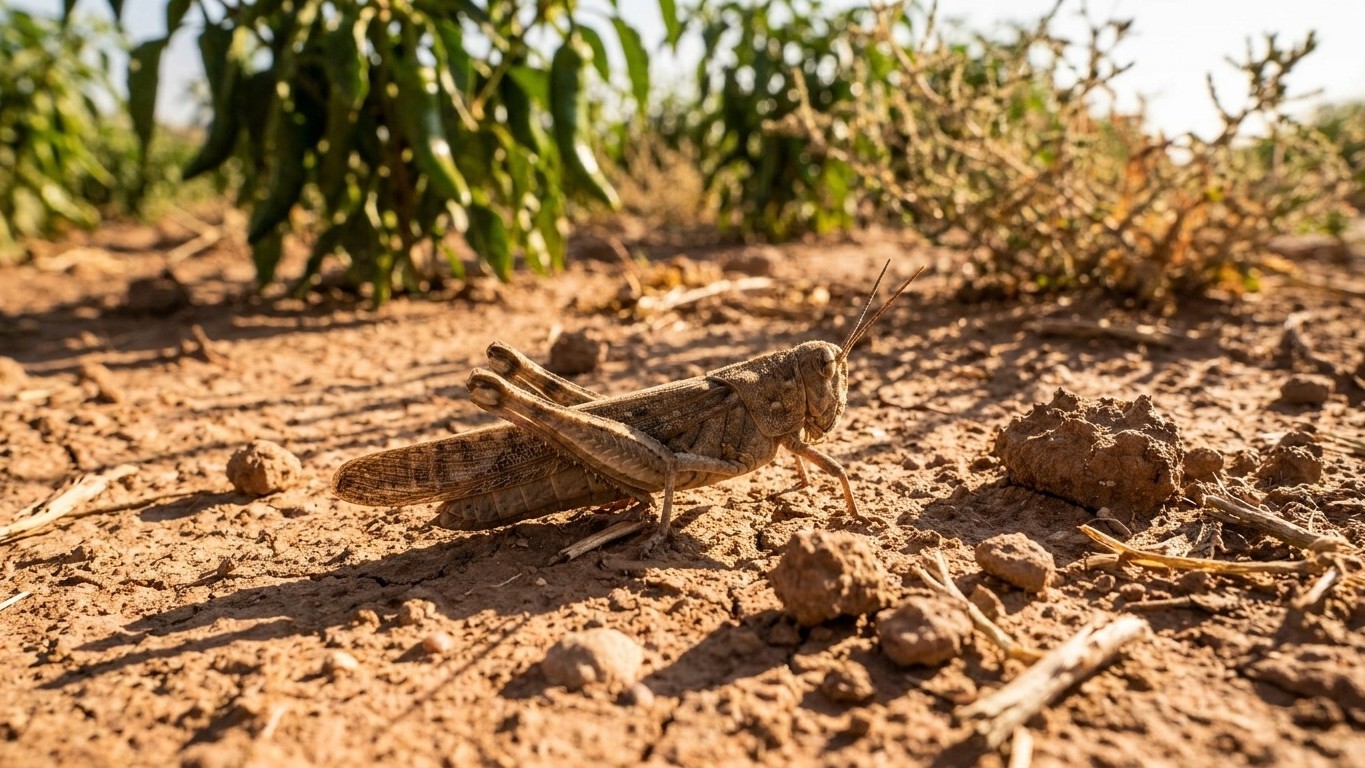

Grasshoppers become a real problem across New Mexico from late May through early October, with the sharpest spikes hitting rangeland and gardens in July and August after a wet spring followed by hot, dry summer stretches. Nothing stops them outright once numbers explode, but early monitoring, habitat management, and timed treatments (applied while nymphs are still small, before mid-June) cut populations dramatically before they reach crop-destroying levels.
The New Mexico Grasshopper Calendar

Grasshoppers in New Mexico follow a predictable rhythm tied to soil temperature, not the calendar date. Eggs laid the previous August or September sit in undisturbed soil through winter, packed into pods a couple inches deep. Once soil temps hold above roughly 60 degrees Fahrenheit for a stretch, usually mid-to-late April in the southern part of the state and into May farther north and at higher elevation, the eggs hatch.
Those first nymphs are small, wingless, and easy to miss. That’s exactly the problem. By the time homeowners in Albuquerque or ranchers near Roswell notice grasshoppers jumping across a lawn or chewing on chile plants, the insects have usually already molted through several growth stages and gained wings. A grasshopper with wings is a grasshopper that can travel a quarter mile or more in a single day, which is why outbreaks seem to appear overnight even though the buildup took two months.
Peak damage in most of New Mexico lands between mid-June and late August. Alfalfa growers in the Pecos Valley and chile farmers in Doña Ana County both watch this window closely, since a single field can go from lightly grazed to stripped bare in under two weeks during a heavy year. Activity tapers off with the first hard frost, typically October in the high desert and later in the Rio Grande Valley, when adults die off and the next generation’s eggs go into the ground.
Which Species Are Actually Causing the Trouble
Not every grasshopper in the yard is a threat. New Mexico hosts more than a hundred species, but a handful drive the outbreaks that make headlines and ruin crops.
The Migratory Grasshopper
This is the species most often responsible for the big rangeland outbreaks east of the Rio Grande. It’s a strong flier, feeds on grasses first, and moves in loose swarms when populations peak, which is how entire sections of grazing land can be defoliated in a matter of days.
The Differential Grasshopper
Larger and yellowish with black herringbone markings on the hind legs, this one prefers broadleaf plants over grass. That makes it the bigger worry for backyard vegetable gardens and for crops like cotton and soybeans grown in the southeastern part of the state.
The Twostriped and Red-Legged Grasshoppers
Both show up in mixed populations alongside the two species above. The twostriped grasshopper tends to favor lush, irrigated areas, so lawns and garden beds near a sprinkler system or drip line often see more of them than dry, unmanaged land nearby.
Identifying the species matters less for a homeowner than recognizing the pattern: small brownish or greenish nymphs in May and June, larger winged adults by July, and a sudden jump in numbers whenever the previous fall was warm and dry enough to protect egg pods from freeze kill.
Why New Mexico Sees Boom-and-Bust Cycles
Grasshopper outbreaks aren’t random. They follow a weather pattern that New Mexico State University Extension entomologists have tracked for decades: two or three consecutive dry years followed by a wetter spring tend to trigger the worst outbreaks, not drought alone and not rain alone.
Dry falls protect egg pods from the fungal diseases and parasites that normally keep populations in check, since those pathogens need moisture to spread through the soil. Then a wet spring boosts the growth of tender young plants that newly hatched nymphs need to survive their first vulnerable weeks. Put those two conditions back to back and you get the population explosions that hit western rangeland states, New Mexico included, roughly every seven to ten years.
Overgrazed rangeland compounds the problem. Bare, compacted soil with sparse vegetation actually favors grasshopper egg-laying, since females prefer firm, exposed ground over thick grass cover. That means land already stressed by drought and heavy grazing becomes a breeding ground for the very insects that will then strip whatever vegetation is left, a feedback loop that ranchers across eastern and southern New Mexico know all too well.
What Actually Stops Grasshoppers
No single method eliminates a serious grasshopper outbreak. Control works best as a layered approach, and timing matters more than almost any other factor.
Timing the Treatment Window
The single most effective thing a landowner can do is act while nymphs are still in their first three growth stages, generally through late May and into early June depending on elevation. At that point they’re concentrated in smaller areas near egg-laying sites and haven’t yet developed wings, so both chemical and biological controls go further and cost less per acre. Wait until adults are flying and the same treatment might only knock back a fraction of the population, since winged grasshoppers simply relocate to untreated ground.
Biological and Cultural Options
For homeowners and smaller acreages, a few practical steps make a measurable difference:
- Keep grass mowed short in early spring to reduce the tender growth nymphs prefer, then let it grow once the hatch window passes
- Till or lightly disturb bare soil in fall where egg pods are suspected, since exposure to freezing temperatures kills a large share of eggs
- Encourage natural predators like birds, and avoid broad-spectrum insecticides that also kill the parasitic wasps and flies that attack grasshopper eggs and nymphs
- Use row covers on vulnerable vegetable beds during peak nymph activity in June, since young grasshoppers can’t chew through the fabric
Bran-based baits mixed with a targeted insecticide are a longstanding tool on rangeland and larger properties, since grasshoppers are drawn to the bran and the treatment stays contained rather than drifting onto forage crops or pollinator habitat.
Coordinated Rangeland Programs
For ranchers and large landowners, the USDA’s Animal and Plant Health Inspection Service runs a rangeland grasshopper suppression program in partnership with state agriculture departments, including in New Mexico, that treats large blocks of federal and adjacent private land when survey data shows densities crossing economic thresholds, generally eight or more grasshoppers per square yard on rangeland. Individual property owners can request survey information through their county extension office to know whether their land falls inside a treatment zone before a full-blown outbreak hits.
Protecting Home Gardens and Small Farms
A vegetable garden doesn’t need a rangeland-scale response, but it does need a plan built around the same timing principle. Chile peppers, tomatoes, and beans, all common in New Mexico backyard gardens, are broadleaf plants that differential grasshoppers target first once nearby grasses dry out in midsummer. That’s often the trigger point: a lawn or field that browns off in July sends grasshoppers hunting for the greenest, most tender plants around, which tends to be the irrigated garden bed.
Physical barriers work well at small scale. Fine mesh netting or floating row cover over young transplants blocks nymphs during their most destructive early weeks, and it can come off once plants are mature enough to tolerate some feeding. Diatomaceous earth dusted on leaves offers modest protection by irritating the insects’ exoskeletons, though it needs reapplication after watering or rain.
Kaolin clay sprays, sold as a crop protectant, coat leaves in a fine white film that seems to disrupt grasshopper feeding behavior and has seen growing use among small-scale New Mexico growers as an alternative to conventional insecticides. It’s not a total solution, but combined with border trap crops (a strip of alfalfa or sorghum planted around the garden perimeter to draw grasshoppers away from the main crop) it can meaningfully reduce losses without heavy chemical use.
Anyone watching bare patches of land turn brown by early July, whether it’s a hayfield outside Clovis or a fallow lot on the edge of a Santa Fe subdivision, is looking at prime grasshopper habitat for the following spring. Checking that ground for egg pods in September, a simple matter of digging a few inches into firm, exposed soil, gives a much better read on next year’s risk than waiting to see how many grasshoppers show up in June.
Related guides
- Grasshoppers in Arizona: When It Shows Up and What Stops It
- Grasshoppers in Utah: When It Shows Up and What Stops It
- Grasshoppers in Oklahoma: When It Shows Up and What Stops It
- Grasshoppers in Saskatchewan: When It Shows Up and What Stops It
- Thrips in New Mexico
- Bagrada bug in New Mexico
- Lygus bugs in New Mexico
- Grasshoppers in Alberta: When It Shows Up and What Stops It