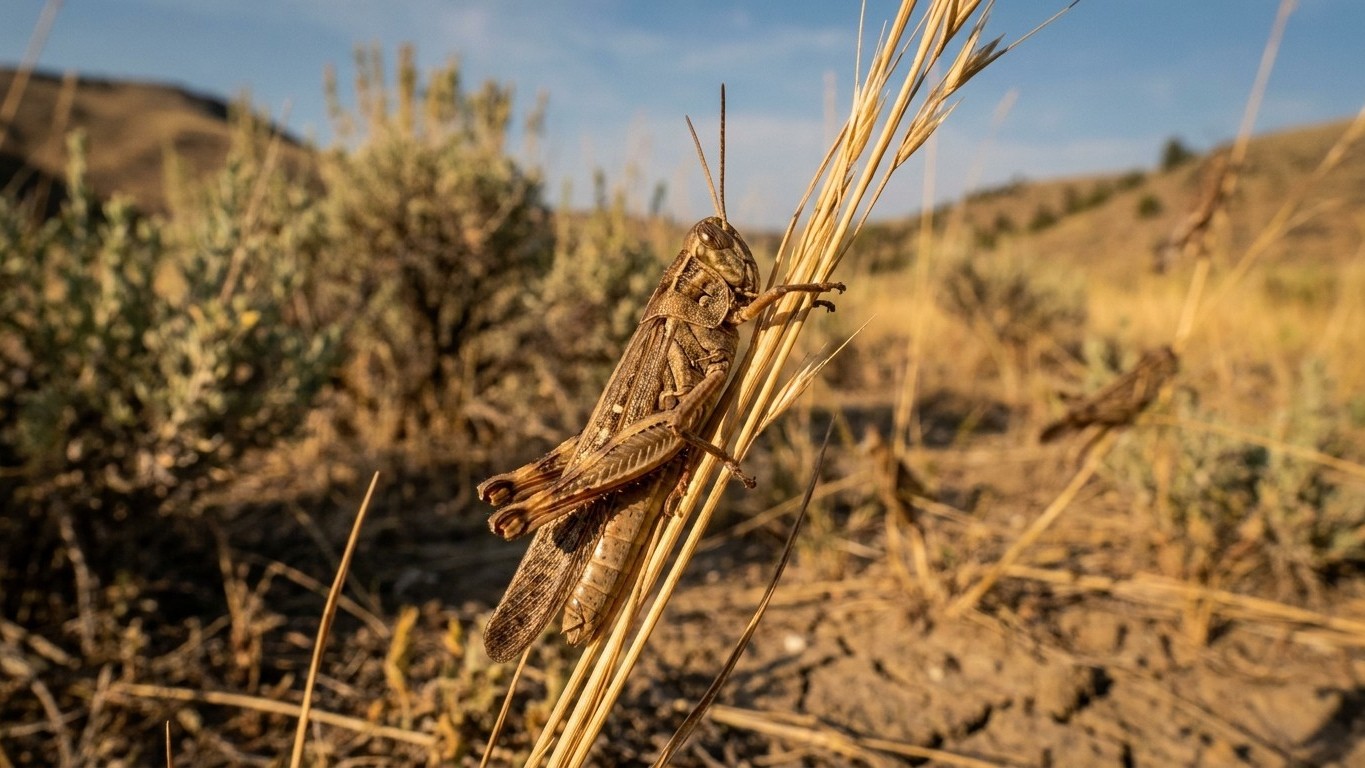

Grasshoppers turn up across Utah every year between May and September, with the heaviest activity from late June through August when rangeland grasses dry out and nymphs finish molting into adults. What actually stops a bad year isn’t a single spray or trap: it’s a mix of timing, weather, and coordinated treatment on the rangeland where most outbreaks start in Utah.
When Grasshoppers Show Up in Utah

Eggs laid the previous fall sit in the soil through winter, and hatching depends almost entirely on soil temperature. In most of Utah’s valleys and foothills, that means nymphs start emerging in April or early May once the ground holds steady warmth for several consecutive days. A cold, wet spring pushes hatching back by two or three weeks. A warm, dry one can bring nymphs out earlier and in bigger numbers, since dry soil warms faster and holds less moisture that would otherwise kill overwintering eggs.
By June, nymphs have gone through several molts and started covering ground, feeding on grasses and forbs along field edges, irrigation canals, and undeveloped lots. Adults appear by July in a typical year, and that’s when the visible swarms show up: on fence lines, porches, and garden beds in areas bordering open rangeland. Activity tapers off with the first hard frost, usually October in the valleys, though high-elevation areas can see it end sooner.
The pattern isn’t uniform across the state. Box Elder, Tooele, and parts of Emery and San Juan counties have a longer history of large outbreaks tied to grazed rangeland, while the Wasatch Front sees smaller, more localized pressure driven by vacant lots and canal banks rather than open range.
Why Utah Sees Recurring Outbreaks
Utah’s climate does a lot of the work. Roughly two-thirds of the state is classified as arid or semi-arid rangeland, and grasshoppers thrive in exactly that setting: sparse vegetation, sandy or loamy soil for egg-laying, and long dry stretches that favor survival over disease. Several consecutive drought years tend to precede the worst outbreaks, since dry conditions reduce the fungal pathogens that normally keep grasshopper populations in check.
The state’s grasshopper problem also overlaps with Mormon cricket activity, a flightless katydid often mistaken for a grasshopper because of similar feeding habits and timing. Both are managed under the same federal program because they hit the same rangeland at the same time of year and respond to similar control strategies. The U.S. Department of Agriculture’s Animal and Plant Health Inspection Service runs an annual survey across the Intermountain West, including Utah, tracking nymph density per square yard to flag areas headed toward economic-threshold outbreaks before they peak. Landowners and grazing permittees can request treatment through that program when counts justify it.
Ranch economics are part of why this matters beyond backyard nuisance. A dense grasshopper population can strip a pasture of forage that cattle need, and that pressure has pushed Utah, alongside Nevada, Idaho, and Wyoming, to be one of the states most frequently included in federal rangeland suppression efforts. Details on how that program works are public through USDA APHIS’s rangeland grasshopper and Mormon cricket program.
What Actually Stops Grasshoppers
Nothing eliminates grasshoppers outright in a state built on the exact terrain they favor. But three things reliably knock populations down, and understanding them explains why some years feel manageable and others don’t.
Weather does more than any product
A cold, wet spring is the single biggest population check available, since it delays hatching and drowns a share of eggs before they mature. Conversely, a wet spring after a dry fall can also boost fungal pathogens like Entomophaga grylli, which spreads through grasshopper populations in humid conditions and can wipe out large numbers within a couple of weeks. Neither of these is something a homeowner can control, but they explain the year-to-year swings better than anything applied after the fact.
Timing treatment to the nymph stage
Whether it’s a rangeland bait program or a backyard application, the window that matters most is the third and fourth nymph instar, roughly late May to mid-June depending on elevation. Nymphs at that stage haven’t developed wings, move less, and are more susceptible to both insecticides and baits than winged adults that can simply fly to the next field. Waiting until adults show up in July means treating a much harder target with a much bigger appetite already spent.
Reduced Agent-Area Treatments (RAATs)
On the rangeland side, Utah’s suppression efforts frequently use a strategy called Reduced Agent-Area Treatment, where insecticide is applied in alternating swaths rather than blanket coverage. This cuts chemical use by roughly half while still achieving comparable population control, because grasshoppers move between treated and untreated strips and pick up a lethal dose either way. It’s also gentler on beneficial insects and pollinators along field margins, which matters in a state where alfalfa and other pollinator-dependent crops sit close to treated range.
Protecting a Home Garden or Yard
Homeowners bordering open land or agricultural fields deal with a different scale of problem than ranchers, and the fixes look different too. Floating row covers over vegetable beds physically block nymphs and adults without any chemical involved, and they’re most effective if installed before the June population surge rather than after damage is already visible. Garden edges kept mowed short and free of tall grass remove the shaded, moist microhabitat grasshoppers use for shelter during the hottest part of the day.
For yards seeing heavier pressure, baits formulated with carbaryl bran applied directly to the ground work well because grasshoppers are drawn to the bait and it doesn’t require spraying foliage that pollinators visit. Baits also break down faster in sunlight than residual sprays, which limits exposure to beneficial insects working the same yard. Applying early in the morning, when grasshoppers are still sluggish from overnight cool temperatures, improves how much bait actually gets eaten before it degrades.
A few natural predators help too, though not enough on their own to solve a serious infestation. Birds, particularly killdeer and various sparrows, along with spiders and some ground beetles, take a steady toll on nymphs. Chickens, where local ordinances allow them, are effective at clearing grasshoppers from a fenced yard, since a small flock can work through a surprising number in a single afternoon.
What a Bad Year Looks Like in Utah
Population counts in the tens per square yard signal the kind of outbreak that pushes ranchers to request federal treatment, and Utah has hit that threshold in multiple counties over the past decade, generally tied to multi-year drought stretches. For a homeowner, the more useful measure is simpler: if grasshoppers are visible on every third or fourth plant along a fence line by mid-June, that’s early enough to act before the population peaks in midsummer. Waiting until August, when adults have already laid the next generation’s eggs, means dealing with this year’s damage while setting up next year’s hatch.
Related guides
- Grasshoppers in Idaho: When It Shows Up and What Stops It
- Grasshoppers in Wyoming: When It Shows Up and What Stops It
- Grasshoppers in Alberta: When It Shows Up and What Stops It
- Grasshoppers in Arizona: When It Shows Up and What Stops It
- Cabbage looper in Utah
- Corn earworm in Utah
- Grasshoppers in Iowa: When It Shows Up and What Stops It