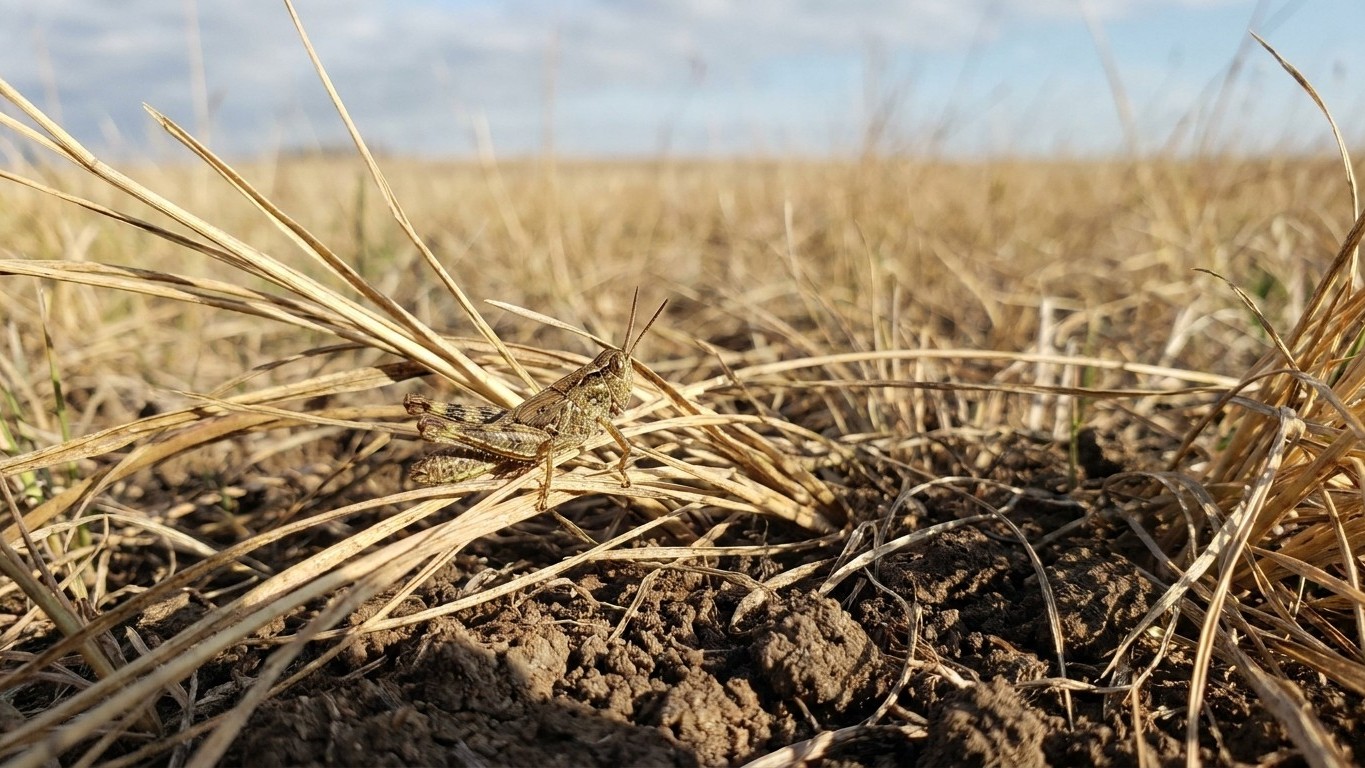

Grasshoppers show up in Alberta every year without exception, but the size of the problem swings wildly from one season to the next. Eggs laid in the soil the previous August hatch in May once the ground warms past roughly 60°F, nymphs feed through June, and by mid-July the adults are winged, mobile, and capable of stripping a hayfield or garden bed in days. What actually stops them isn’t a single tactic. It’s a combination of cold, wet weather, natural predators and disease, and, when those fail, timed insecticide or bait applications while the insects are still young and concentrated near field edges.
When Grasshoppers Show Up in Alberta

The Alberta grasshopper calendar runs on soil temperature, not the calendar date. Eggs overwinter a few inches below the surface, and hatching typically begins in the southern part of the province (the Palliser Triangle around Medicine Hat and Lethbridge) in early to mid-May, then moves north into the Peace Country by late May or early June. That north-south lag of two to three weeks matters if you’re trying to time a response.
Once hatched, nymphs go through five to six molts (instars) over four to six weeks before becoming winged adults. This is the window when grasshoppers are most vulnerable to control, because they’re wingless, clustered near hatching sites, and haven’t yet dispersed into crops or lawns. By early July in the south and late July farther north, most populations have reached the adult stage. Adults feed heavily through August, mate, and females begin laying eggs in undisturbed soil, roadsides, and field margins by late August into September, which sets up next year’s population before the current one dies off with the first hard frost.
Three species drive most of the damage reports in the province: the migratory grasshopper (Melanoplus sanguinipes), the two-striped grasshopper (Melanoplus bivittatus), and the clearwinged grasshopper (Camnula pellucida). Each has slightly different hatch timing and habitat preference, which is part of why outbreaks can be patchy, heavy in one municipal district and nearly absent thirty miles away.
Why Some Years Are Worse Than Others
Grasshopper outbreaks in Alberta track dry, warm conditions almost exactly. A hot, dry spring lets more eggs survive winter, speeds up nymph development, and reduces the fungal and viral disease that normally thins populations. Southeastern Alberta, with its lower rainfall and sandy, well-drained soils, has historically been the province’s hot spot, followed by drought years in the central parkland. A single wet, cool spring can knock a building outbreak down by 50% or more, because young nymphs are far less tolerant of cold, damp conditions than adults are.
Alberta Agriculture and Irrigation runs an annual grasshopper survey each August, counting adults per square yard in stubble fields and roadside ditches across the province, and publishes forecast maps the following spring. Landowners in the Special Areas, the County of Newell, and other southeastern districts use these maps to decide whether early-season scouting and control are worth the investment before nymphs hatch.
What Actually Stops a Grasshopper Outbreak
Weather does most of the heavy lifting. A cold, wet May can delay hatching, drown early nymphs, and encourage the spread of Entomophaga grylli, a fungal pathogen that kills grasshoppers en masse and is easy to spot in the field: infected adults climb to the top of grass stems and die gripping the plant, a behavior sometimes called “summit disease.” In outbreak years, this fungus alone can end a population crash within a couple of weeks once humidity stays high.
Natural predators contribute too, though more slowly. Ground beetles, robber flies, and blister beetle larvae feed on eggs and young nymphs, while birds such as kestrels, meadowlarks, and various sparrows take a steady toll on adults through the summer. Parasitic wasps and flies (Sarcophagidae) lay eggs on or in adult grasshoppers, and in some years these parasites infect a large share of a local population, though the effect usually shows up a season or two after the peak rather than stopping a current outbreak in its tracks.
Cultural and Mechanical Controls
For homeowners, acreage owners, and small-scale growers, timing and habitat management do more good than any spray. Because females lay eggs in undisturbed soil, especially in ditches, field margins, shelterbelt edges, and unmowed roadsides, mowing or lightly tilling those strips in late summer disrupts egg-laying sites for the following year. Fall or early spring tillage in known hatching areas physically destroys a portion of the egg pods before they hatch.
Trap strips work on the same logic in reverse: leaving a narrow band of green, unharvested vegetation along a field edge concentrates newly hatched nymphs there, since they can’t yet fly to find food elsewhere. That strip can then be treated or mowed short, taking out a large share of the local population before it disperses into the main crop or garden.
Biological and Chemical Options
Where populations exceed the damage threshold, typically eight to twelve nymphs per square yard along field margins according to provincial guidelines, targeted treatment while grasshoppers are still in the second or third instar gives the best return. Nymphs are smaller, more concentrated, and haven’t yet developed the tolerance adults show to many insecticides.
Options generally fall into three groups:
- Bait formulations containing carbaryl mixed with bran, applied to field edges or hot spots, which grasshoppers ingest directly and which limit exposure to pollinators compared to broadcast sprays.
- Insect growth regulators such as diflubenzuron, effective mainly on nymphs since they work by disrupting molting rather than killing on contact.
- Contact insecticides (various pyrethroids and organophosphates registered for grasshopper control in Canada), used as a broadcast treatment when infestations are heavy and widespread rather than confined to margins.
A biological bait based on the protozoan Nosema locustae is also registered for grasshopper suppression; it works slowly, over one to two seasons, by infecting grasshoppers that then spread the pathogen to others, and it’s better suited to long-term rangeland management than to stopping a current-year outbreak on a garden or small acreage.
Practical Timing for Homeowners and Acreage Owners
Anyone dealing with grasshopper pressure on a home garden, shelterbelt, or small acreage in Alberta gets the most value out of two windows: scouting in early June to catch nymphs before they disperse, and managing egg-laying habitat in late August and September before females finish laying for the year. Waiting until adults are swarming a vegetable patch in late July means dealing with a mobile, harder-to-control, and already-damaging population rather than preventing it.
Checking the province’s annual forecast map before spring gives a reasonable heads-up on whether a given municipal district or county is heading into a low, moderate, or severe year, which is useful information before investing in bait, netting for raised beds, or extra fencing around vulnerable plantings. In moderate or severe forecast zones, a walk through field margins and unmowed grass in early June, counting nymphs per square yard, remains the most reliable way to decide whether action is needed before damage becomes visible on the plants themselves.
Alberta’s grasshopper cycles tend to run in multi-year waves rather than random spikes, meaning a bad year is often followed by one or two more before weather or disease brings numbers back down, which is worth keeping in mind when deciding how much to invest in prevention versus reactive control for the season ahead.
Related guides
- Grasshoppers in British Columbia: When It Shows Up and What Stops It
- Grasshoppers in Saskatchewan: When It Shows Up and What Stops It
- Grasshoppers in Arizona: When It Shows Up and What Stops It
- Grasshoppers in Colorado: When It Shows Up and What Stops It
- Grasshoppers in New Mexico: When It Shows Up and What Stops It