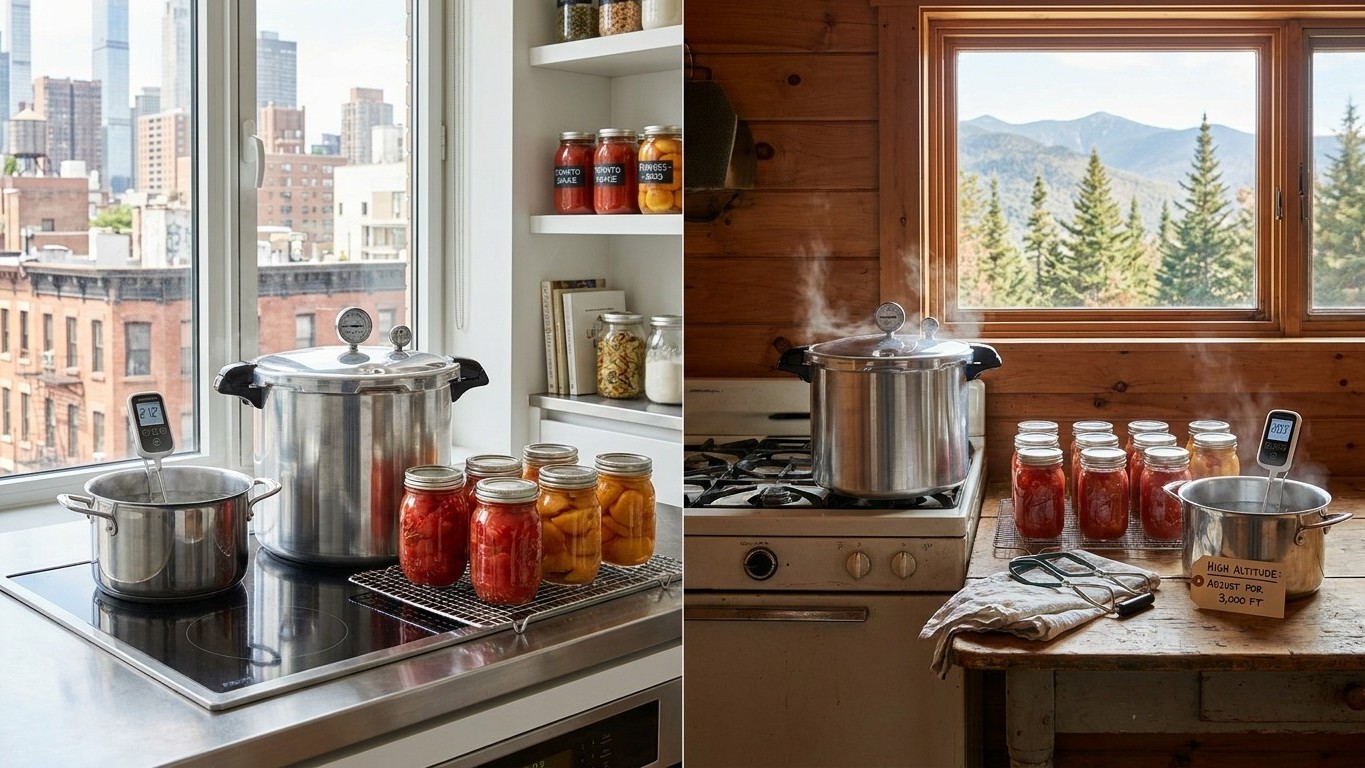

New York City sits at 33 feet above sea level, and at that elevation, published USDA boiling references put the boiling point of water somewhere in the 208°F to 212°F range for the lowest elevation band. For a canner working in or near the city, that’s close enough to sea level that standard processing times apply without adjustment. Someone canning at 6,000 feet in the Adirondacks is working with an entirely different set of numbers.
The short answer

Thirty-three feet is the elevation of New York City, used here as the state’s reference point because New York doesn’t have a single altitude any more than it has a single climate. A canner in Buffalo, one in the Catskills, and one on Long Island are all working at different heights above sea level, and each of those heights can shift how their canner behaves. The 33-foot figure names New York City specifically, not the state as a whole, and that distinction matters more than it sounds like it should.
At 33 feet, the published boiling range brackets between 208°F and 212°F, which places NYC squarely inside the lowest elevation band the USDA uses in its canning guidance. For a home canner working at or near that elevation, this is functionally sea level. The boiling point of water there is close enough to the standard 212°F that the tested processing times printed in canning recipes, written and verified at sea level, apply as written. No extra minutes, no extra pounds of pressure.
That’s the case for most of the five boroughs and a good stretch of the coastal lowlands. But New York state climbs fast once you leave the coast. The Adirondacks push well into the thousands of feet, the Catskills aren’t far behind, and even rolling inland counties can sit high enough that a recipe timed for sea level no longer delivers a safe process. This is why a state-level article about altitude canning can only go so far using one city’s number. It can tell you what “low elevation” looks like and why it matters, but it can’t tell an individual reader in Herkimer County or up near Lake Placid what their own adjustment should be.
Why this figure, and not a state average
There’s no such thing as a meaningful “average elevation” for canning purposes, because canning adjustments follow bands, not averages. A county straddling two elevation bands doesn’t split the difference. Every canner needs their own specific elevation, checked against the band it falls into, and that’s a personal lookup, not a statewide one. The reference city gives a baseline for comparison. It doesn’t replace the reader’s own number.
Why a lower boil is a weaker process
Water boils at a lower temperature as elevation rises. That’s the entire mechanism, and it’s worth sitting with because it explains everything that follows. At sea level, water boils at 212°F. Climb to 10,000 feet, and it boils at 194°F. The air pressure pressing down on the water’s surface drops as you go up, and water needs less added heat energy to turn to vapor when there’s less atmospheric pressure holding it in the liquid state. The water is still boiling. It’s just boiling at a lower temperature.
For a canner, that difference is not cosmetic. A boiling-water canner relies on sustained heat to destroy molds, yeasts, and enzymes in high-acid foods like most fruits, pickles, and jams. A pressure canner relies on sustained heat and elevated pressure to reach temperatures high enough to destroy Clostridium botulinum spores in low-acid foods like most vegetables, meats, and stocks. Both methods depend on hitting and holding a specific temperature for a specific length of time. When the boiling point itself drops, the temperature inside that jar during processing drops with it, even though the water is boiling just as vigorously as it would at sea level.
This is where a common assumption trips people up. Cranking up the heat under a canner at altitude doesn’t fix anything, because boiling water cannot get hotter than its boiling point no matter how hard it boils. A rolling, aggressive boil at 194°F is still 194°F. It looks more intense. It isn’t hotter. The only two ways to compensate for a lower boiling point are to extend the time the jars spend in a boiling-water canner, or to increase the pressure inside a pressure canner so that the water inside it is forced to boil at a higher temperature despite the elevation. Both of these fixes are built into tested recipes as elevation adjustments, and both depend entirely on the canner knowing their own elevation.
Finding your own elevation
- Locate your specific address or the nearest cross streets to where you’ll actually be canning, since a summer place in the mountains and a home downstate can sit in different bands entirely.
- Go to the National Center for Home Food Preservation’s “Find Your Elevation” page, built for exactly this purpose, and enter your location to get a number in feet above sea level.
- Compare that number against the elevation bands listed in your specific tested recipe or in the USDA Complete Guide to Home Canning, since the adjustment is tied to a band, not to a precise foot count.
- Write that elevation down somewhere you’ll see it every canning season, whether that’s a note taped inside a cabinet or a line in a recipe binder, because it doesn’t change and you shouldn’t need to look it up twice.
- Recheck it if you can somewhere new, especially if you move from a lowland property to a mountain one or start canning at a relative’s or a shared kitchen at a different elevation.
What goes wrong
- A jar that seals perfectly but was never safe. A vacuum seal forming on the lid tells you the jar cooled and sealed. It tells you nothing about whether the contents reached a temperature high enough to destroy spores during processing. At altitude, an unadjusted process can produce a picture-perfect seal on a jar that never got hot enough for long enough. The remedy is to trust the elevation adjustment in the tested recipe over the appearance of the finished jar, every time.
- A recipe pulled from a sea-level source. Family recipes, older cookbooks, and many recipe blogs are written and tested at or near sea level, with no altitude guidance built in. Using one of these as written above roughly 1,000 feet without adding the appropriate adjustment leaves the process under-timed. The fix is to source recipes from the USDA or NCHFP specifically, since those come with elevation-based adjustment tables attached.
- A pressure gauge read as though elevation doesn’t exist. Both dial-gauge and weighted-gauge pressure canners need the pressure setting adjusted upward as elevation increases, and the two gauge types are adjusted differently. Setting a canner to the sea-level pressure listed on a recipe, without checking the elevation-specific pressure for your gauge type, undercooks the load even though the canner is technically running. The remedy is to check both your canner’s gauge type and your elevation against the NCHFP’s pressure tables before starting.
Where the exact adjustment comes from
This page won’t hand you a processing time or a canner pressure, and that’s deliberate. The right adjustment depends on the specific food, the recipe’s acidity, the jar size, and the canning method, all layered on top of your elevation. That combination belongs to a tested recipe, not to a general article about altitude.
The National Center for Home Food Preservation publishes elevation adjustment tables alongside its tested recipes, matched to both boiling-water and pressure canning methods, and that’s the source to use once you know your own elevation from their “Find Your Elevation” page. The reason this level of precision matters isn’t abstract. Botulinum toxin has no taste and no smell. A jar that’s under-processed because the elevation adjustment was skipped or guessed at will look, smell, and taste exactly like a safe one, right up until it isn’t.
Common questions
Does New York City’s 33-foot elevation apply to the whole state?
No. It’s the reference elevation for New York City specifically, used as a baseline. Elevation varies enormously across the state, and each canner needs to check their own location, not assume the city’s figure applies to them.
If I’m canning near sea level, do I need to do anything differently?
At an elevation like NYC’s 33 feet, standard sea-level processing times generally apply as written in tested recipes, since it falls within the lowest published elevation band. Confirm this against your specific recipe’s adjustment table rather than assuming.
Why doesn’t boiling water harder at altitude fix the problem?
Because boiling water can’t exceed its boiling point regardless of how vigorously it boils. At a lower atmospheric pressure, that boiling point is already capped at a lower temperature, so a harder boil looks more dramatic without adding heat.
Where do I find the actual time or pressure adjustment for my elevation?
The National Center for Home Food Preservation publishes elevation adjustment tables tied to specific tested recipes and canning methods. Find your elevation through their dedicated page first, then match it to the adjustment table for the exact food you’re canning.