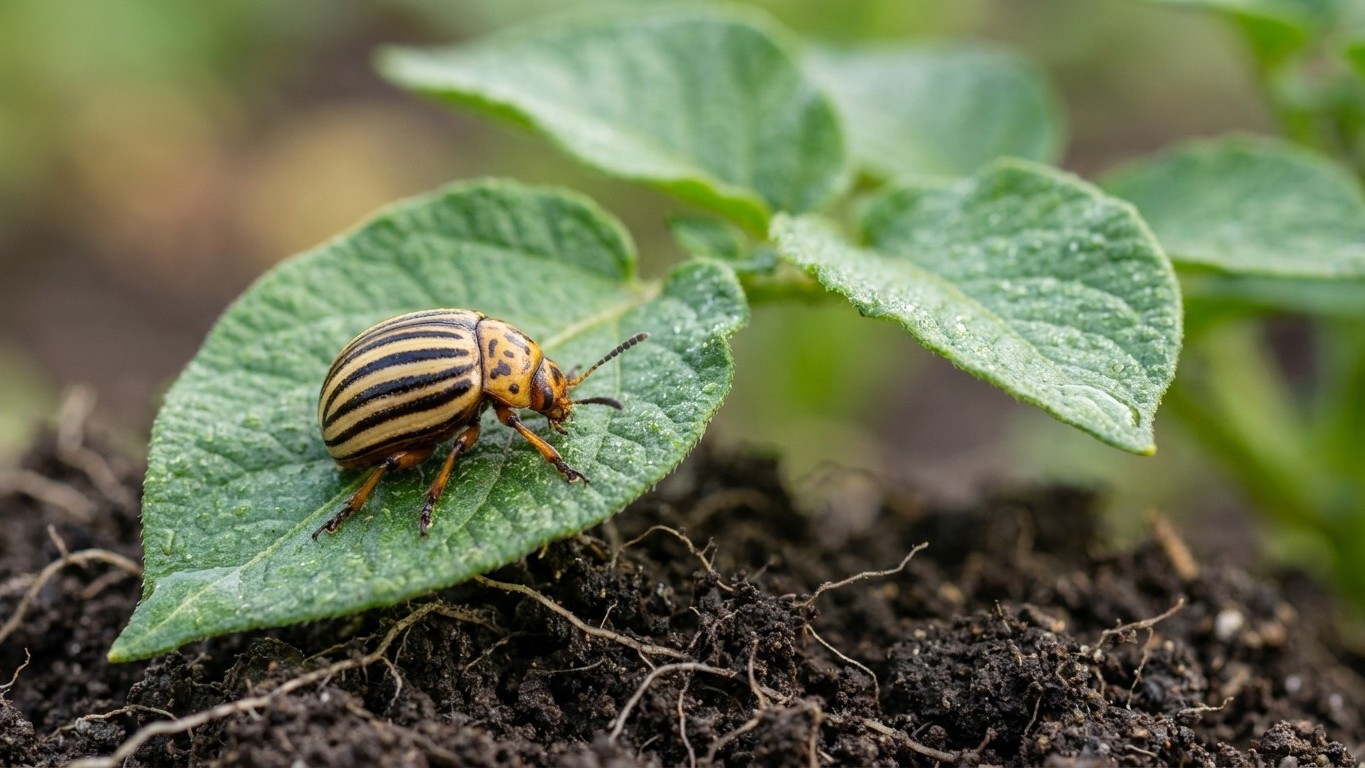

Colorado potato beetles wake up across New York when soil temperatures in the top few inches climb past 50°F, which usually happens between late April on Long Island and late May in the North Country. That single number, more than any date on a calendar, tells growers and home gardeners when to start checking their potato and tomato patches for the striped adults crawling out of the ground.
This isn’t a pest that sneaks up on anyone. It’s loud, obvious, and famous for shrugging off chemicals that kill almost everything else. Understanding its timing in New York, and what actually works against it, saves a garden or a field a lot of grief.
When Colorado Potato Beetles Show Up in New York

Timing follows the soil, not the sun. Overwintering adults burrow six to eight inches into the ground the previous fall and stay dormant until spring warmth reaches them. On Long Island and in the lower Hudson Valley, that threshold typically arrives in late April. In the Capital Region, Finger Lakes, and Western New York, expect emergence closer to mid-May. Growers in the Adirondacks and St. Lawrence Valley often don’t see the first adults until late May or even early June.
Once soil hits that magic 50°F mark, adults tunnel to the surface and head straight for the nearest nightshade family plant: potatoes first, but also tomatoes, eggplants, and peppers. They don’t fly far on their first outing. Most emerge within a few hundred yards of last year’s potato patch, which is exactly why crop rotation works so well as a first line of defense.
Feeding starts within days. Mating follows almost immediately, and females begin laying clusters of bright yellow-orange eggs on the undersides of leaves before the first week of activity is over.
Two Generations a Year, Sometimes a Third
New York generally sees two full generations of Colorado potato beetle each season. The first generation runs from spring emergence through July, when new adults appear and start the cycle again. A second generation follows through August. In warmer downstate areas with long growing seasons, a partial third generation sometimes squeezes in before fall, though it rarely reaches full maturity before frost.
By September, adults from the final generation stop feeding, mate one last time, and dig back into the soil to overwinter. That fall dig-in is a window worth watching, since destroying crop residue and tilling potato ground in autumn disrupts the population before it ever gets a chance to settle in for winter.
How to Identify Each Life Stage
Confusion with other beetles is rare once you’ve seen one, but knowing what to look for at every stage helps catch an infestation before it explodes.
- Adults: about 3/8 inch long, oval-shaped, with a yellow-orange body and five bold black stripes running down each wing cover.
- Eggs: bright yellow-orange, laid in tight clusters of 10 to 30 on the undersides of leaves.
- Larvae: humpbacked and soft-bodied, starting brick-red and fading to orange as they grow, with two rows of black spots along each side.
- Pupae: found underground, a stage most people never see since it happens entirely in the soil.
Larvae do the most damage of any stage. A single generation of larvae can strip a young potato plant down to bare stems in under two weeks if left unchecked, which is faster than most gardeners expect from an insect that size.
Why This Beetle Is So Hard to Kill
Colorado potato beetle didn’t start out as a potato pest. It originally fed on buffalo bur, a wild nightshade relative native to the Rocky Mountain foothills. When settlers planted potatoes across the Great Plains in the mid-1800s, the beetle switched hosts and spread east, reaching the Atlantic coast by the mid-1870s. New York has been dealing with it for roughly 150 years.
What makes it a legend among entomologists is its resistance record. Within a few years of DDT’s introduction as a farm insecticide, resistant Colorado potato beetle populations turned up in Long Island potato fields in the early 1950s, one of the first documented cases of insecticide resistance in any agricultural pest anywhere in the country. Since then, the beetle has developed resistance to organophosphates, carbamates, pyrethroids, and, more recently, to some neonicotinoid products in parts of the Northeast.
That track record matters for anyone reaching for a spray bottle today. A product that worked great five years ago in a neighbor’s garden might do almost nothing this season if local populations have adapted. Rotating between different chemical classes, rather than leaning on the same active ingredient every year, is the only way to keep any product useful long term.
What Actually Stops Colorado Potato Beetle in New York
No single tactic wins against this beetle. The pest programs that hold up over multiple seasons combine several approaches instead of betting everything on one spray.
Cultural Controls Come First
Crop rotation is the single most effective tool available to home gardeners and small farms alike. Since overwintering adults emerge close to where they spent the previous fall, moving potato and tomato plantings at least a few hundred feet from last year’s location cuts the number of beetles that find the new crop by a significant margin. Straw mulch around plants also slows adult movement and makes it harder for beetles to locate host plants by scent.
Handpicking remains surprisingly effective for backyard gardens. Checking the undersides of leaves twice a week during peak emergence, crushing egg clusters, and dropping adults and larvae into soapy water keeps small infestations from ever becoming large ones. It’s tedious, but it costs nothing and doesn’t risk building resistance.
Biological and Physical Options
Floating row covers installed at planting time and sealed at the edges block early-season adults from reaching young plants entirely, though they need to come off before flowering if the crop requires pollination. Trap cropping, planting a small early-emerging patch of potatoes at the field edge to draw beetles away from the main crop, gives growers a concentrated target to treat or destroy before the pest spreads further.
Natural predators help too. Ladybird beetles, lacewings, and predatory stink bugs like the spined soldier bug feed on Colorado potato beetle eggs and young larvae. Broad-spectrum insecticides wipe out these allies along with the pest, which is one more reason targeted products beat blanket sprays.
When Chemical Control Makes Sense
For larger plantings facing heavy pressure, products based on Bacillus thuringiensis subspecies tenebrionis target Colorado potato beetle larvae specifically while leaving most beneficial insects unharmed. Spinosad-based products offer another option with a lower resistance risk than older chemical classes, though the New York State Integrated Pest Management Program at Cornell recommends alternating modes of action between applications rather than repeating the same product season after season, precisely because of this pest’s resistance history.
Timing matters as much as product choice. Treating during the young larval stage, before larvae reach their final, most damage-heavy instar, gets far better results than waiting until visible defoliation prompts action. The New York State IPM Program at Cornell tracks regional emergence and resistance patterns each season for growers who want current, location-specific guidance beyond general timing windows (nysipm.cornell.edu).
A Regional Note Worth Remembering
Potato-growing regions with long histories of intensive cultivation, particularly parts of Long Island and the Elba muck lands in Genesee County, tend to carry more resistant beetle populations than areas where potatoes are grown less frequently. Gardeners moving into a new property with a history of commercial potato production might find that beetles there respond less predictably to standard treatments than textbook advice suggests, which is one more argument for combining cultural controls with any chemical option rather than relying on spray alone.
Related guides
- Colorado potato beetle in Vermont: When It Shows Up and What Stops It
- Colorado potato beetle in Massachusetts: When It Shows Up and What Stops It
- Colorado potato beetle in North Dakota: When It Shows Up and What Stops It
- Colorado potato beetle in Nova Scotia: When It Shows Up and What Stops It
- Colorado potato beetle in New Jersey: When It Shows Up and What Stops It
- Colorado potato beetle in Wyoming: When It Shows Up and What Stops It