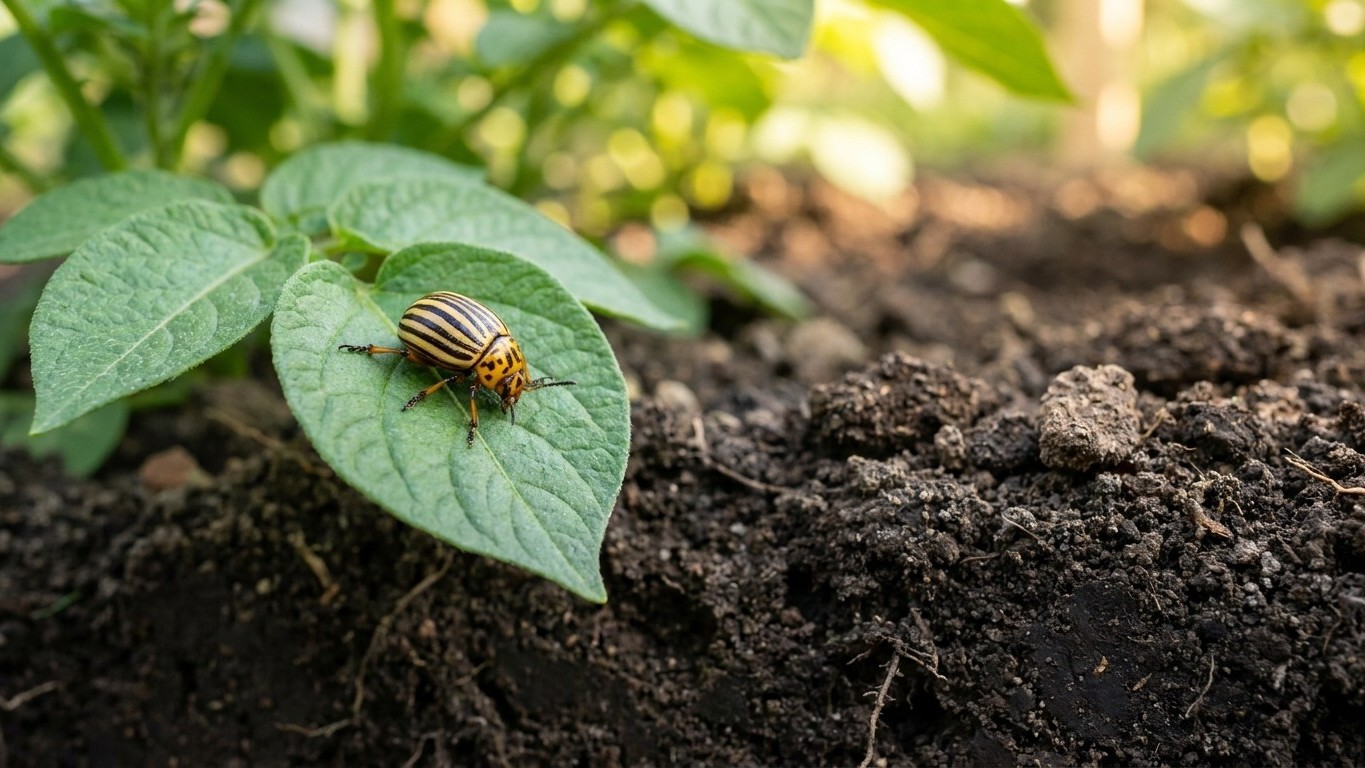

Colorado potato beetles wake up in Vermont soil once temperatures climb past 50°F for several consecutive days, which typically lands somewhere between late April and mid-May depending on where you garden. Stopping them means breaking their walk from last year’s potato bed to this year’s, and that single tactic, distance, does more work than any spray you’ll find at the garden center.
Vermont’s Colorado potato beetle Timeline

These beetles don’t fly in from somewhere else each spring. They spend winter buried six to eight inches deep in the exact soil where last season’s potato patch stood, tucked in below the frost line. When the ground warms, adults dig out and start walking, not flying, toward the nearest food source. In the Champlain Valley, that emergence often starts in late April. Up in the Northeast Kingdom, where soil warms slower, beetles might not surface until the second or third week of May.
Once they’re out, the clock runs fast. Females can lay 300 to 500 eggs over a few weeks, and Vermont’s growing season is long enough for two full generations most years, sometimes a partial third if August stays warm. First-generation larvae do their damage in June, stripping leaves down to bare stems on unprotected plants within days. Second-generation adults emerge in late July or August and can keep feeding right up until frost.
That two-generation pattern is why a garden that looked fine in early July can look shredded by mid-August. Gardeners who only check plants once a month miss the window where control actually works.
Identifying the Pest at Each Life Stage
Confusing this beetle with something harmless costs a lot of gardeners their potato crop. Here’s what to look for at each stage:
- Adults: about 3/8 inch long, rounded and yellow-orange with five bold black stripes down each wing cover. They look almost cartoonish, and they’re easy to spot on top of leaves.
- Eggs: bright orange-yellow, laid in tight clusters of 10 to 30 on the undersides of leaves. This is the easiest stage to catch and destroy before damage starts.
- Larvae: humpbacked, soft-bodied grubs that start dark red and fade to orange as they grow, with two rows of black spots along each side. These do the most feeding damage of any stage.
- Pupae: hidden in the soil, rarely seen unless you’re digging near the base of plants.
A common mix-up in home gardens is confusing CPB adults with the beneficial spotted or striped lady beetles that share a similar orange-and-black color scheme. Look at the pattern: ladybugs have dots, not straight vertical stripes. Killing a ladybug population by mistake removes one of your best natural allies against aphids and beetle eggs.
Where Vermont Sees the Heaviest Pressure
Not every county deals with the same intensity. Commercial potato and vegetable production is concentrated in the Champlain Valley, particularly Addison and Chittenden counties, where sandy loam soils and a longer frost-free window support both large-scale growing and heavier beetle populations. The Connecticut River Valley on the state’s eastern edge sees similar pressure thanks to its own warmer microclimate and long history of vegetable farming.
Higher-elevation gardens in the Northeast Kingdom or the Green Mountains generally see beetles arrive later and in smaller numbers, simply because cold soil delays emergence and shortens the window for a second generation to fully mature. That’s a small silver lining if you’re gardening at altitude, but it’s not immunity. Any spot that grew potatoes, tomatoes, or eggplant last year is carrying overwintering beetles in the soil right now.
Wild nightshade relatives matter here too. Horsenettle and bittersweet nightshade, both common along Vermont field edges, hedgerows, and unmown ditches, serve as backup host plants. A garden with no history of potatoes can still get hit hard if it sits near an overgrown fence line where these weeds grow unchecked.
What Actually Stops Colorado Potato Beetles
This insect has a well-documented reputation for shrugging off insecticides. Colorado potato beetle populations across the Northeast have developed resistance to multiple chemical classes over the decades, including several organophosphates and pyrethroids, which is exactly why rotation planning and physical controls carry more weight here than they do for most garden pests.
Crop rotation and distance
Since adults walk rather than fly to find food, moving your potato or eggplant bed even 200 to 300 feet from last year’s location forces overwintering beetles to cross a much bigger gap to find a meal. Many won’t make it, especially if that gap includes lawn, gravel, or a driveway rather than bare soil or mulch. This single change, more than any spray, is what most Vermont extension guidance points to first.
Physical barriers and hand removal
Floating row covers installed at planting and kept sealed at the edges with soil or clips block adults from ever reaching the plants during that critical early emergence window in May. Covers need to come off once flowering starts if the crop needs pollination, but by then the worst of the first generation has often already passed.
Hand-checking the undersides of leaves once or twice a week during May and June, then crushing egg clusters between your fingers or dropping larvae into a jar of soapy water, remains one of the most effective tactics for a home garden. It sounds tedious, but a 20-plant potato patch takes maybe ten minutes to scout thoroughly, and catching eggs before they hatch eliminates the entire feeding stage before it starts.
Biological and low-toxicity options
Bacillus thuringiensis subsp. tenebrionis (sold as Bt-tenebrionis or Bt san diego) targets young larvae specifically and does minimal harm to bees, ladybugs, or other beneficial insects, but it works only on the small larval stage, not adults or eggs, and needs reapplication after rain. Spinosad-based products offer broader activity against larvae and some adults, though they carry more risk to bees if applied while plants are flowering, so evening application after bees have left the area matters.
Ground beetles and certain parasitic wasps prey on Colorado potato beetle eggs and small larvae naturally, and a diverse planting with flowering herbs nearby (dill, cilantro, yarrow) tends to support more of these predators. Straw mulch around potato plants has shown some benefit too, since it makes it harder for beetles to move between plants and gives ground beetles more cover to hunt from.
What tends not to work well
Insecticidal soap has limited effect on this beetle compared to soft-bodied pests like aphids, since CPB larvae and adults have tougher exoskeletons. Broad-spectrum synthetic pyrethroids often show reduced effectiveness in areas with a long history of potato production, a direct result of the resistance built up over repeated seasons of the same chemical class.
Building a Season-Long Watch Schedule
Timing your checks around Vermont’s specific emergence pattern beats a generic monthly glance. Start scouting the last week of April in the Champlain Valley, or the second week of May at higher elevations, focusing on the edges of the bed closest to where potatoes grew the previous year. That’s where overwintering adults surface first.
Keep checking weekly through June, since this is when first-generation eggs hatch into larvae capable of doing real leaf damage. A short break in pressure often shows up in early to mid-July as that generation pupates in the soil, but don’t relax scouting entirely, since second-generation adults emerge from late July into August and can lay another full round of eggs before frost ends the season.
Clean-up matters as much as in-season vigilance. Removing potato vines and volunteer plants promptly after harvest, rather than leaving them to decompose in place through fall, reduces the amount of late-season feeding and egg-laying that feeds next year’s overwintering population. Tilling the old bed lightly in fall can also expose some pupae to predators and cold, though it won’t eliminate the population sitting deeper in the soil profile.
Vermont’s short but intense growing season gives this beetle exactly two generations to work with most years. Gardeners who rotate their planting site, scout weekly during May and June, and lean on Bt-tenebrionis or hand removal rather than broad insecticides tend to lose the least amount of crop, and they avoid feeding the resistance problem that’s made this particular beetle such a stubborn one across the whole Northeast.
Related guides
- Colorado potato beetle in Massachusetts: When It Shows Up and What Stops It
- Colorado potato beetle in New York: When It Shows Up and What Stops It
- Colorado potato beetle in Virginia: When It Shows Up and What Stops It
- Colorado potato beetle in Washington: When It Shows Up and What Stops It
- Colorado potato beetle in Minnesota: When It Shows Up and What Stops It
- Colorado potato beetle in Maryland: When It Shows Up and What Stops It