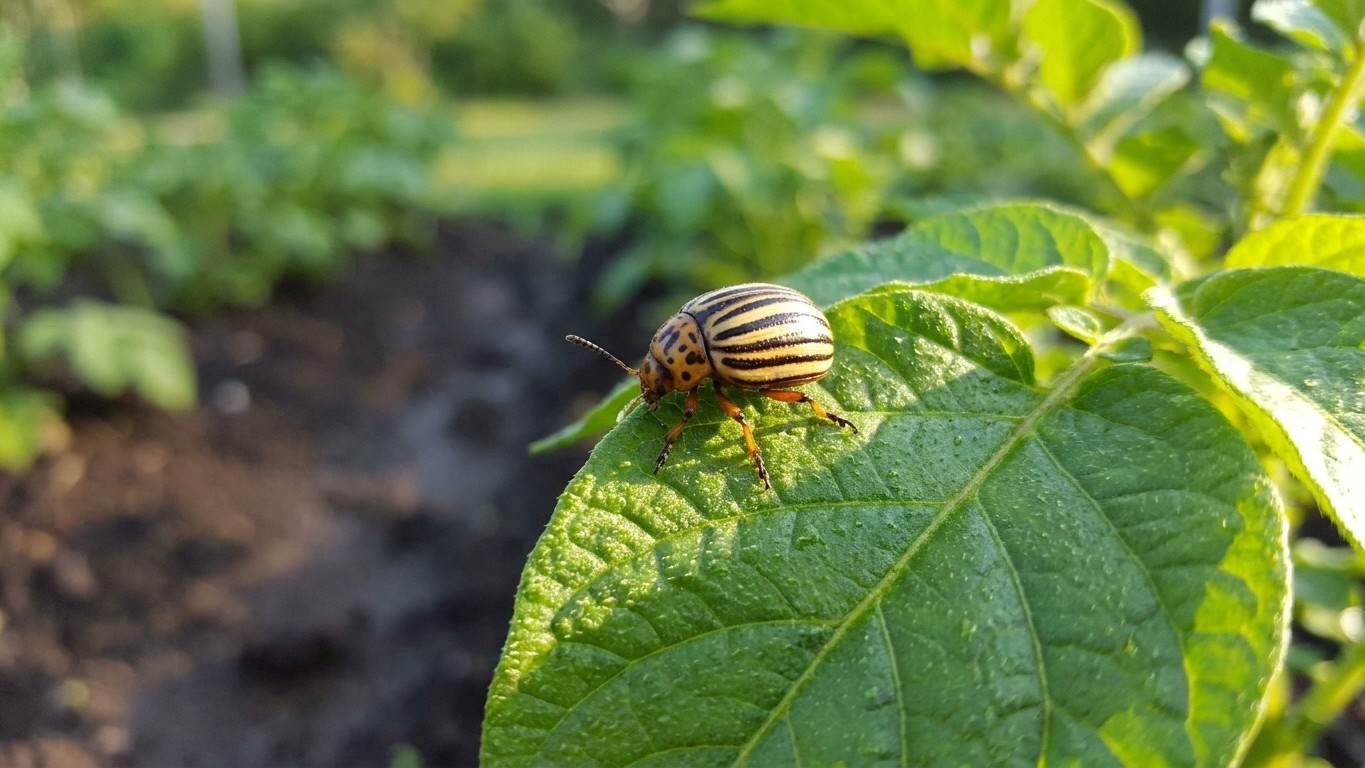

Colorado potato beetles typically appear in Nova Scotia gardens and fields from late May through mid-June, once soil temperatures climb past roughly 50°F. The Maritime climate delays their emergence compared to warmer growing regions, and most Nova Scotia properties see only one full generation per season, sometimes a partial second wave if summer stays warm into September. Stopping them comes down to breaking their life cycle early: rotating nightshade crops, removing overwintering adults by hand, and using targeted biological or chemical controls before larvae reach their most destructive stage.
This beetle isn’t a random visitor. It’s one of the most persistent potato pests in eastern Canada, and Nova Scotia’s cooler, damp spring weather actually works in growers’ favor by slowing its buildup compared to Ontario or the northeastern United States. Still, once it establishes in a garden bed, it doesn’t leave on its own.
When the Beetle Actually Shows Up in Nova Scotia

Adult Colorado potato beetles spend the winter buried eight to twelve inches deep in soil, usually at the edge of last year’s potato patch or nearby field margins. They wait out the cold as adults, not eggs, which means they’re ready to move the moment the ground warms enough to dig out.
In most of Nova Scotia, that digging-out period lines up with late May into early June, a few weeks behind what growers in southern Ontario or Maine typically experience. Soil temperature drives the timing more than the calendar does. A cool, wet spring in the Annapolis Valley can push emergence into mid-June, while a warmer year along the South Shore might see beetles active by the third week of May.
Once out, adults walk or fly short distances to find host plants. Potatoes are the primary target, but tomatoes, eggplant, and even some nightshade weeds like horse nettle will do. Females start laying eggs within a week or two of emerging, usually in tight clusters of ten to thirty on the underside of leaves. Each female can lay several hundred eggs over her lifetime, which is why a handful of overwintering adults can turn into a serious infestation by midsummer.
One Generation, Sometimes Two
Larvae hatch within a week to ten days and feed for roughly three weeks before dropping to the soil to pupate. In Nova Scotia’s shorter growing season, this full cycle from egg to new adult typically takes five to six weeks. That timing usually produces one complete generation by late July or August. In warmer years, or in sheltered microclimates like a south-facing garden bed against a building, a partial second generation can emerge in late summer, though it rarely reaches the scale of the first.
This matters for timing control measures. The first generation does the most damage because it arrives on plants that are still young and vulnerable. Missing that early window, even by a week or two, tends to cost growers more yield than dealing with any later, smaller wave.
Spotting the Different Life Stages
Recognizing what stage you’re dealing with changes how you respond. Adults are roughly three-eighths of an inch long, with a rounded yellow-orange body marked by ten black stripes running lengthwise, which is where the “ten-lined” part of their scientific name comes from. They’re often mistaken for other striped beetles, but the stripe count and rounded shape are distinctive.
Eggs are bright orange-yellow, football-shaped, and laid in tight clusters, almost always on the underside of leaves near the plant’s growing tip. Larvae start out dark red and grow progressively more orange as they molt through four growth stages, with two rows of black spots along each side. By their final stage, larvae are plump and humpbacked, and they’re the ones responsible for most of the leaf damage since they eat almost continuously.
Damage itself is easy to spot even before you find the insects. Leaves develop irregular holes that expand quickly, and in bad infestations, an entire potato plant can be reduced to bare stems within days. Younger plants hit hard early in the season often never recover their full yield potential, even if the beetles are eventually controlled.
What Actually Stops It
No single method wipes out Colorado potato beetle populations for good. Growers who manage it successfully in Nova Scotia usually combine several tactics rather than relying on one.
Crop rotation ranks among the most effective and least expensive strategies. Overwintering adults emerge close to where they pupated the previous fall, so moving potatoes, tomatoes, and eggplant to a different part of the garden or field each year, ideally at least 200 yards away, forces beetles to travel farther to find food. That extra distance means fewer survive to establish a new population, and it buys extra time for natural predators to catch up.
Hand-picking still works well for home gardens and small plots. Checking the undersides of leaves every few days starting in late May, then crushing egg clusters and dropping adults or larvae into a bucket of soapy water, can keep small infestations from spreading. It’s tedious but has zero cost and no risk of resistance building up, which is a real problem with this particular pest.
Row covers placed over young plants right after planting block adults from reaching the crop during that critical early window. They need to come off before flowering to allow pollination, but by then plants are usually sturdy enough to tolerate some feeding.
Biological and Targeted Chemical Options
Bacillus thuringiensis subspecies tenebrionis, often sold under products labeled for Colorado potato beetle, targets young larvae specifically and leaves most beneficial insects unharmed. It works best applied when larvae are still small, since older larvae are more resistant to it. Spinosad-based products offer another option with a lower impact on pollinators compared to broad-spectrum insecticides.
Natural predators help more than most gardeners realize. Ground beetles, ladybird beetles, and certain parasitic wasps all feed on Colorado potato beetle eggs and young larvae. Avoiding unnecessary broad-spectrum insecticide use protects these predators and keeps the pest’s population from rebounding harder the following season, which is exactly what tends to happen when beneficial insects get wiped out alongside the target pest.
Resistance is worth flagging directly. Colorado potato beetle has developed resistance to numerous insecticide classes across North America over the decades, partly because growers historically leaned on the same chemical repeatedly. Rotating between different modes of action, and not spraying on a fixed schedule but only when beetle counts justify it, slows that resistance buildup considerably.
Practical Timing for Nova Scotia Gardens
Because emergence in Nova Scotia lags a few weeks behind warmer regions, the most useful scouting window starts in the last week of May. Checking plants twice a week through mid-June catches the first wave of adults before they’ve laid many eggs. That single habit, done consistently for three or four weeks, prevents more damage than almost any spray applied later in the season after larvae have already spread across multiple plants.
Mulching with straw around potato plants can also disrupt the beetle’s movement between the soil and plant base, though it works best paired with rotation rather than as a standalone fix. Some growers in the Maritimes have experimented with trap crops, planting a small block of potatoes earlier than the main crop to lure emerging adults away, then treating that trap block heavily while leaving the main planting largely untouched. It’s a strategy borrowed from commercial operations, but it scales down reasonably well for larger home gardens too.
One detail that surprises a lot of gardeners: adult beetles can fly several miles when food runs short, which means even a well-managed potato patch can get reinfested from a neglected garden or abandoned field down the road. Talking to neighbors about timing their own control efforts isn’t just neighborly, it’s one of the few ways to actually shrink the regional population rather than just shuffling it around.