
Colorado potato beetles typically appear in Wyoming gardens and potato fields between late May and mid-June, once soil temperatures climb past the mid-50s Fahrenheit and overwintering adults dig their way out of the ground. The short growing season across most of the state usually limits the beetle to a single generation per year, though warmer pockets like the Big Horn Basin can sometimes squeeze out a partial second wave before frost. Stopping them comes down to a handful of tactics that actually work: crop rotation, floating row covers timed to emergence, hand-removal of egg clusters, and targeted use of Bt-based sprays rather than broad-spectrum insecticides the beetle has already learned to shrug off.
Where This Beetle Shows Up in Wyoming

Despite the name, the Colorado potato beetle isn’t a stranger passing through from a neighboring state. It’s native to the intermountain West, originally feeding on buffalo bur and other wild nightshades long before settlers planted the first potato rows in the Rockies. Wyoming sits inside its historic range, which means the insect doesn’t need to migrate in from anywhere. It’s already here, waiting in the soil.
Commercial potato acreage in Wyoming concentrates in the Big Horn Basin, particularly around Park County, where irrigation and a slightly longer frost-free window support production. Home gardens across Cheyenne, Laramie, Sheridan, and the Wind River Valley see the beetle too, though at higher elevations the growing season compresses everything into a tighter window. A garden at 7,000 feet might not see beetle activity until well into June, while a lower valley plot could have adults chewing leaves by Memorial Day.
Elevation isn’t the only variable. Soil type matters because overwintering adults burrow six to eight inches down in loose, well-drained ground to survive winter. Fields with heavy clay or compacted soil sometimes show delayed or patchier emergence simply because the beetles struggled to burrow deep enough the previous fall.
How to Identify It at Each Stage
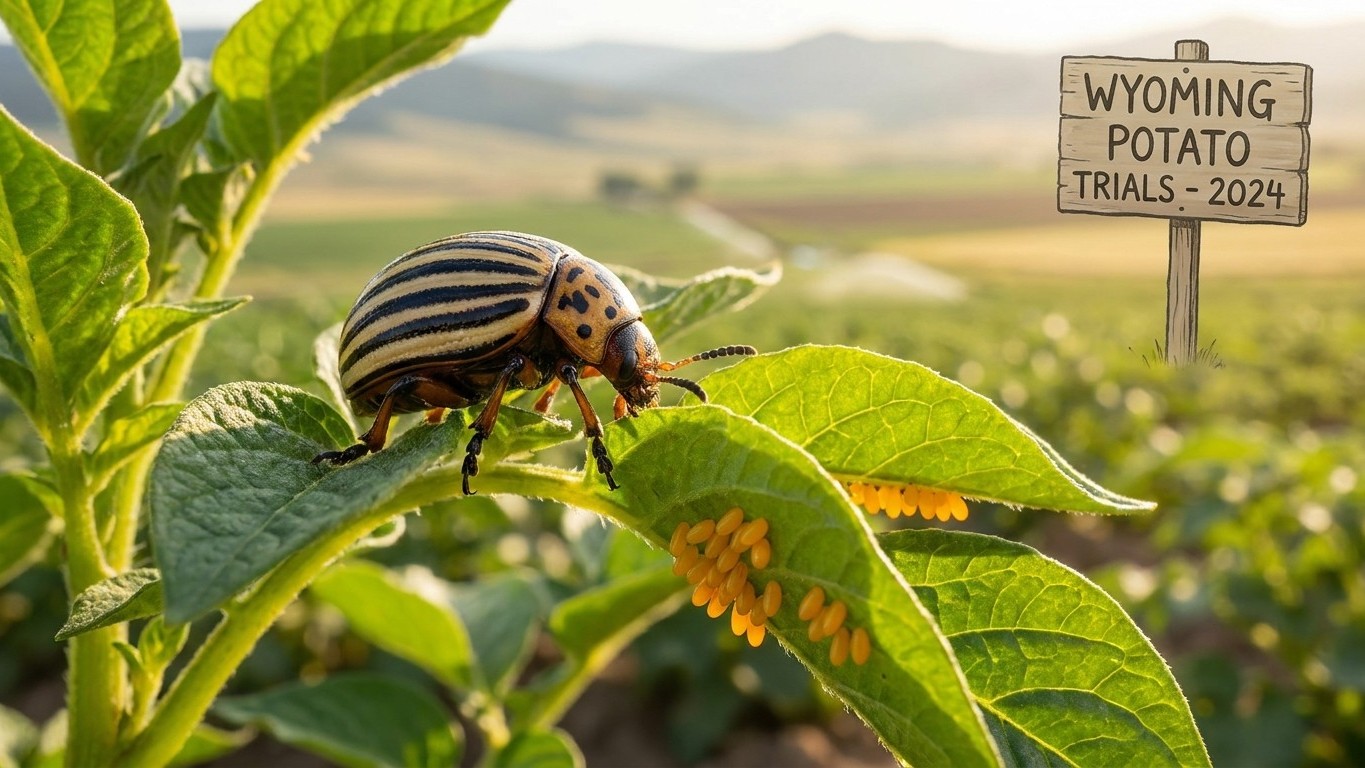
Adult beetles are hard to miss once you know what to look for: about three-eighths of an inch long, with a rounded, hard-shelled body striped in bold black and creamy yellow, ten stripes across the wing covers to be exact. The head carries a scattering of small black dots on an orange background. They look almost cartoonish, which is part of why so many first-time gardeners assume they’re harmless.
Eggs are the next thing to watch for, and they’re easy to spot if you flip leaves over. Females lay tight clusters of 20 to 40 bright orange-yellow eggs on the undersides of leaves, standing on end like tiny footballs. A single female can lay anywhere from 300 to 800 eggs over her lifetime, which explains how a handful of overwintered adults can turn into a full-blown infestation within a few weeks.
Larvae go through four growth stages, starting as tiny reddish grubs and developing a humpbacked shape with two rows of black spots along each side as they mature. This is the stage that does the most damage. A mature larva can eat several times its body weight in foliage before dropping to the soil to pupate, and a heavy larval population can strip a potato plant down to bare stems in under a week.
Why the Short Growing Season Changes the Math
In warmer potato states, this beetle often cranks out two or three generations a season, which compounds the damage as each wave overlaps with the next. Wyoming’s compressed frost-free period, often 90 to 120 days depending on region, usually limits the insect to one full generation, occasionally a partial second in the Big Horn Basin’s warmer years. That’s actually good news for Wyoming growers: it narrows the window when intervention matters most. Miss that first emergence and egg-laying period, though, and the single generation can still do plenty of damage before frost shuts things down.
What Actually Stops the Colorado Potato Beetle
Crop rotation is the cheapest and most effective long-term tool, and it works because of how the beetle overwinters. Adults burrow into the soil right where last year’s potato patch stood, then emerge the following spring within walking distance of that same spot. Moving potatoes, tomatoes, eggplant, or peppers to a different part of the garden, ideally at least 100 to 200 feet away, forces emerging beetles to search farther for a host plant. Studies from potato-growing regions have shown rotation alone can delay and reduce colonization significantly, buying growers time to catch the beetle before populations build.
Floating row covers, installed right after planting and before adult emergence, physically block beetles from reaching young plants during the vulnerable seedling stage. The covers need to come off once plants flower so pollinators can do their job, but by then the plants are usually sturdy enough to tolerate some feeding. Timing the cover removal to when soil temperatures have already passed the beetle’s peak emergence window in your specific elevation band matters more than following a generic calendar date.
Hand-picking remains surprisingly effective for home gardens and small plots. Checking the undersides of leaves every few days during May and June, crushing egg clusters and removing adults by hand, can keep a small planting under control without a single spray. It’s tedious, but for a backyard row of potatoes it’s often all that’s needed.
Biological control plays a role too, though it’s rarely enough on its own. Ladybugs, lacewings, and predatory stink bugs all feed on beetle eggs and young larvae, and a garden that avoids broad-spectrum insecticides tends to build up these natural predators over a few seasons. Wiping them out with an unnecessary spray often makes the beetle problem worse the following year because the predators take longer to rebound than the beetle does.
The Insecticide Resistance Problem
Here’s where Colorado potato beetle earns its reputation among entomologists as one of the toughest insects to manage chemically. It has developed resistance to more insecticide classes than almost any other agricultural pest on record, dating back to resistance against DDT in the 1950s and continuing through organophosphates, carbamates, pyrethroids, and even some neonicotinoids in various regions. Populations don’t always carry the same resistance profile from field to field, but the pattern is consistent enough that relying on a single chemical mode of action year after year is a losing strategy almost anywhere the beetle is established.
Products based on Bacillus thuringiensis var. tenebrionis (often labeled Bt-tenebrionis) target the beetle specifically without harming most beneficial insects, and they work best applied when larvae are small, in the first or second instar. Spinosad-based products offer another option with a different mode of action, useful for rotating sprays and slowing resistance buildup. Neem-based products can suppress feeding and development, though they tend to work more slowly and need reapplication after rain.
Straw mulch has shown up in several university trials as a low-cost way to disrupt beetle movement. A thick layer around potato plants seems to confuse walking adults trying to locate host plants after emerging from soil, delaying colonization by days to weeks in some studies. It’s not a standalone fix, but combined with rotation and row covers it adds another layer of friction the beetle has to work through.
Building a Realistic Control Plan for a Wyoming Garden or Field
A practical approach starts before planting even happens. Rotating the potato bed to a new location, ideally one that wasn’t home to any nightshade family crop the previous year, cuts down the number of adults that find the new planting easily. Once seed potatoes go in the ground, row covers go on immediately and stay until flowering begins, covering the exact window when overwintered adults are most active and hungry.
Weekly leaf checks during the first month after emergence let a grower catch egg clusters before they hatch. Crushing eggs by hand takes seconds per cluster and eliminates dozens of future larvae in one motion. If populations get ahead of hand-removal, a Bt-tenebrionis spray applied to young larvae stops the worst feeding damage without knocking back the ladybugs and lacewings doing free pest control nearby.
End-of-season sanitation matters more than most gardeners realize. Tilling the soil after harvest disrupts the spots where adults are trying to burrow down for winter, and removing plant debris takes away shelter that would otherwise shield beetles through the cold months. None of these steps alone eliminates the beetle completely, since it’s a native species with a permanent presence in Wyoming’s ecosystem. But layered together, rotation, covers, hand-picking, targeted biological sprays, and fall cleanup, they keep populations low enough that potato and tomato plants can produce a normal harvest instead of getting stripped to stems by July.
Related guides
- Colorado potato beetle in South Dakota: When It Shows Up and What Stops It
- Colorado potato beetle in Idaho: When It Shows Up and What Stops It
- Colorado potato beetle in British Columbia: When It Shows Up and What Stops It
- Colorado potato beetle in Connecticut: When It Shows Up and What Stops It
- Aphids in Wyoming
- Garden slug in Wyoming
- Potato psyllid in Wyoming
- Colorado potato beetle in New Jersey: When It Shows Up and What Stops It