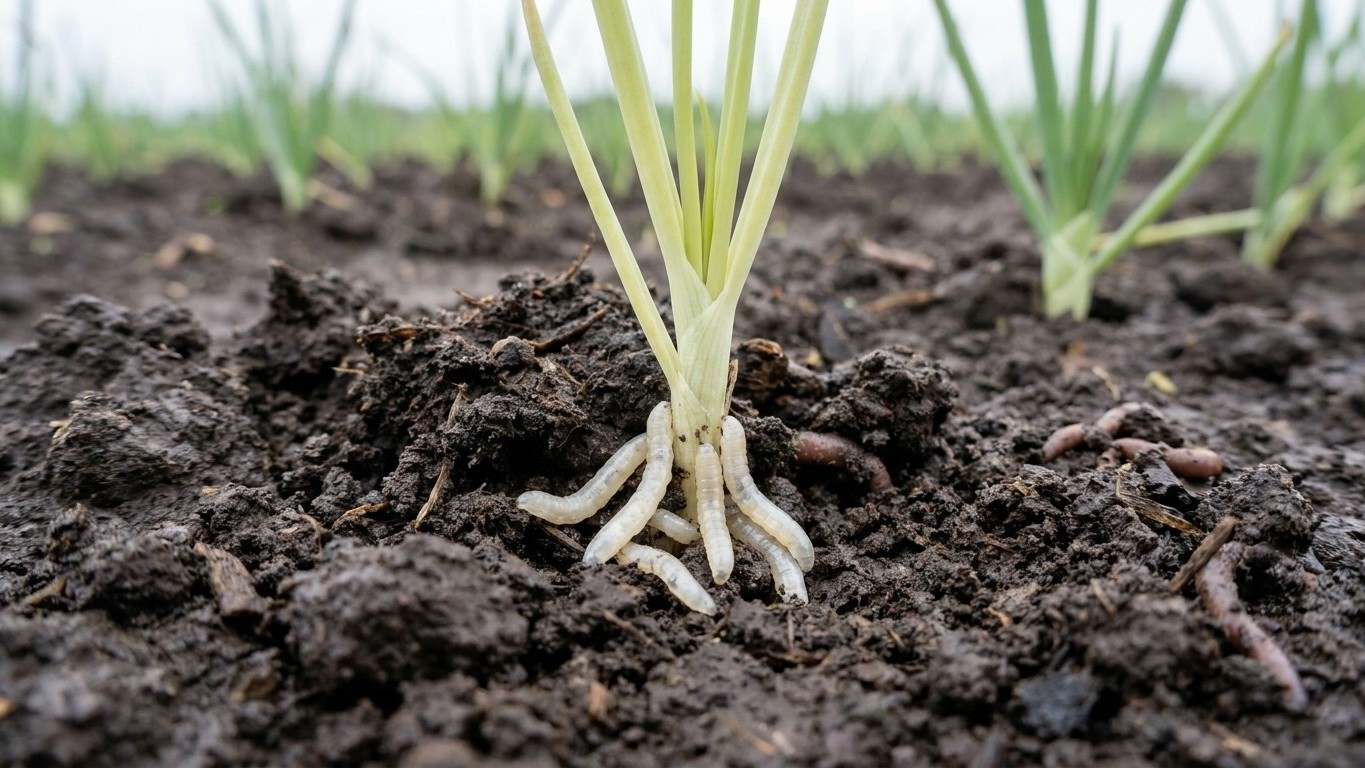

Onion maggot shows up every spring in New York’s muck and mineral onion fields, usually as soon as soil temperatures climb into the low 40s, and it keeps coming back for two more generations through early fall. The fly targets seedlings and young transplants first, then moves into bulbing onions later in the season. Growers in the state’s two major onion belts, the Elba muck lands in Genesee and Orleans counties and the black dirt region of Orange County, deal with it as a recurring calendar event rather than a random outbreak.
Where It Turns Up in New York

Onion maggot (Delia antiqua) is tied to two things: onion crops and organic-rich soil. That’s exactly what New York offers in its commercial onion districts. The Elba muck, a roughly 7,000-acre block of drained wetland soil in western New York, has grown onions continuously for generations, and that history is part of the problem. Muck soil holds moisture and organic matter, which is ideal for onions but also ideal for maggot pupae overwintering just below the surface.
Orange County’s black dirt region, another historic muck-soil growing area south of the Catskills, sees the same pressure. Both regions report the pest as a top-tier onion problem year after year, tracked closely by Cornell Vegetable Program specialists who monitor fly emergence and issue grower advisories through the season.
Backyard and small-scale growers outside these commercial belts aren’t immune, but risk drops off sharply away from muck soil and continuous onion plantings. A home garden that rotates onions to a new bed each year, away from cull piles or compost with onion scraps, rarely sees damaging populations.
The Three-Generation Pattern
New York typically sees three onion maggot generations per season, though the first is by far the most destructive because it hits seedlings and young transplants that have no size to spare. Adult flies emerge from overwintered pupae starting in late April into May, once accumulated degree days (base 40°F) reach the threshold Cornell entomologists use for the first-generation biofix. A second generation follows in July, and a third can appear in late August into September, feeding on bulbs that are sizing up for harvest.
Each generation’s timing shifts a bit with the year’s temperatures. A cold, slow spring pushes first-generation emergence later; a warm one pulls it forward by a week or more. Growers who plant by the calendar instead of by degree-day tracking end up exposing the most vulnerable seedling stage to peak fly activity almost by accident.
How to Confirm It’s Onion Maggot
Damage symptoms alone can be confused with other early-season problems, so confirming the culprit matters before deciding on a response. A few signs point specifically to onion maggot:
- Wilting, yellowing seedlings that pull out of the soil with little resistance, roots already chewed away
- Small, legless white larvae (up to about a third of an inch) clustered at the base of the bulb or stem when you dig up a wilted plant
- Rows with patchy, uneven stands, since flies lay eggs near existing plants and larvae move to neighboring seedlings once one host is used up
- Soft, rotting bulbs later in the season, sometimes with a foul smell from secondary bacterial soft rot that moves in through maggot feeding tunnels
Yellow sticky traps set at plant height, checked twice a week starting in mid-April, give commercial growers a hard number instead of a guess. Once trap counts start climbing, that’s the signal to tighten scouting and, if needed, apply a soil insecticide before eggs hatch. Cornell’s regional onion IPM scouting reports, published through the growing season, list current trap counts from Elba and other monitored sites, which gives growers outside those exact fields a reasonable read on regional pressure.
What Actually Stops Onion Maggot
No single tactic knocks this pest out completely in a muck-soil system with decades of onion history. Control in New York relies on layering cultural practices with targeted chemical timing, and skipping the cultural side tends to make the chemical side less effective over time.
Sanitation and Rotation
Cull piles are the single biggest self-inflicted wound in onion maggot management. Leftover bulbs dumped at the field edge after grading or harvest become a breeding ground, and flies that develop there move straight into the next planting. Growers who haul culls off-site or bury them deep, rather than leaving them exposed near the field, cut off a major overwintering source.
Volunteer onions, the ones that sprout from missed bulbs or seed left in the soil, do the same thing on a smaller scale. Tilling under old onion beds promptly after harvest, instead of leaving debris through fall, removes another overwintering site before pupae settle in for winter.
Rotation matters even in muck fields where onions have grown for generations, because moving the crop even a few hundred feet from the previous year’s planting forces newly emerged flies to search farther for a host, and some portion of that population fails to find one in time to lay eggs on young seedlings.
Degree-Day Timing for Sprays
Cornell’s onion maggot degree-day model, based on a 40°F threshold starting from a set biofix date, predicts fly emergence and egg-laying windows closely enough that growers can time soil-applied insecticides to when they’ll actually intercept the pest, instead of applying on a fixed calendar date that may miss the window entirely. Insecticide options for onion maggot in commercial New York production have shifted over the past decade as older products lost registration and resistance concerns grew; current recommendations run through Cornell Cooperative Extension’s annual vegetable production guidelines, which list labeled products by generation and application method for the current season.
Seed treatments applied before planting protect the earliest, most vulnerable seedling stage against first-generation flies, which is the highest-value window to defend given how much damage that generation causes relative to the other two.
Delayed Planting and Variety Choice
Pushing planting a week or two later than the earliest possible date can shift the most vulnerable seedling stage past the peak of first-generation fly activity, though this trades off against a shorter growing season and later harvest, a real cost for commercial growers working tight margins on a bulk crop. Some onion cultivars show modest tolerance differences, though none offer strong resistance on their own; variety choice works better as one piece of a layered plan than as a standalone fix.
What This Means for Small Growers
Home gardeners and small-plot growers in New York face a different risk profile than the commercial muck fields, and most of the heavy chemical timing that Cornell recommends for Elba or Orange County growers isn’t necessary at garden scale. Rotating onions away from last year’s bed, cleaning up bulb debris after harvest instead of composting it on-site, and covering young seedlings with floating row cover through the first-generation flight window (roughly early May into June in most of the state) handle the bulk of the risk without any insecticide at all.
Row cover works because the fly has to physically land on soil near the plant to lay eggs; a lightweight cover excludes it entirely during the highest-risk seedling stage, then comes off once plants are established enough to tolerate some root loss without collapsing. That single practice, more than any spray, is what turns onion maggot from a recurring garden problem into a non-issue for most backyard growers in the state.