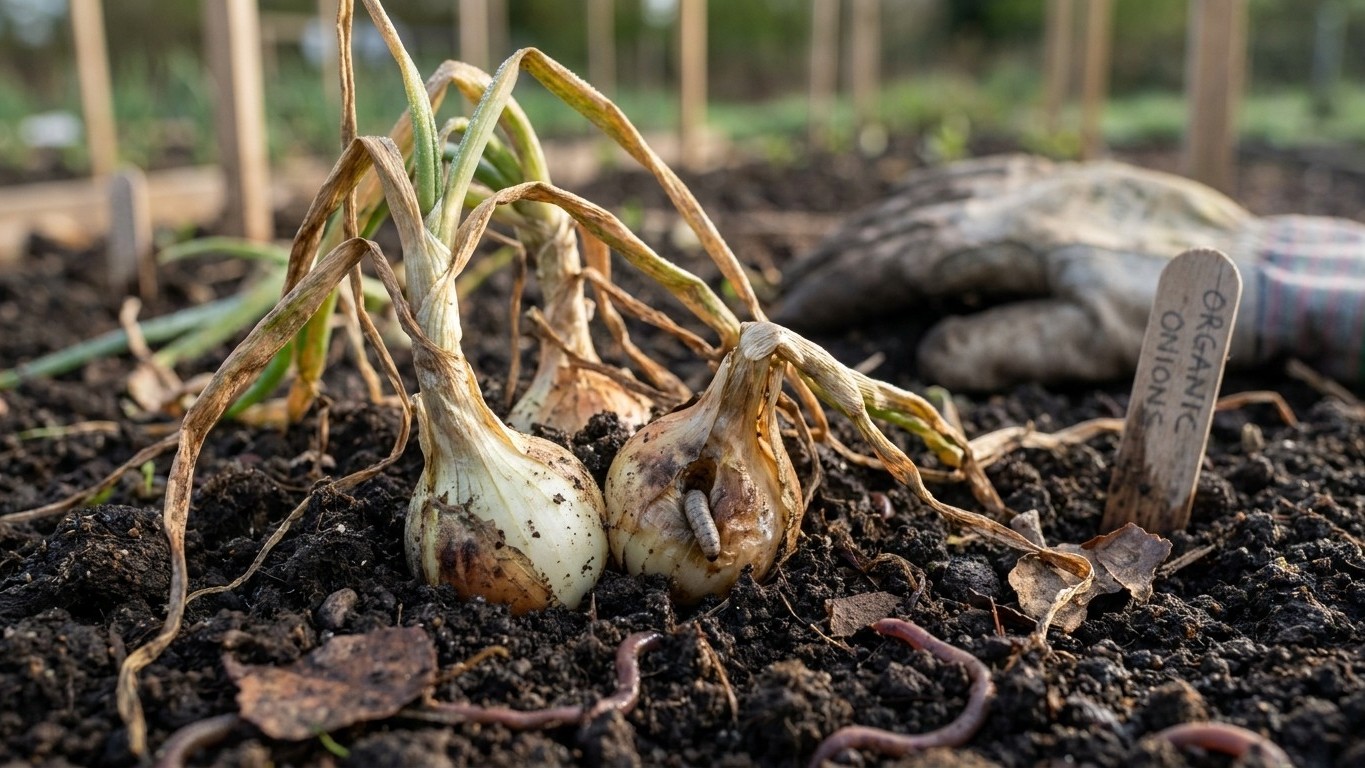

Onion maggot larvae start tunneling into Ontario onion beds as soon as soil temperatures climb past roughly 50°F in spring, usually in late April or early May, and the damage shows up fast: wilted seedlings, rotting bulbs, and rows that look thinner every week. Three overlapping generations hit through the growing season, with the second flight in July causing the most economic damage to bulbing onions. Row covers before egg-laying begins, seed treatments, and strict sanitation after harvest are what actually keep populations down.
What Onion Maggot Is and Why Ontario Growers Deal With It Every Year

Onion maggot (Delia antiqua) is a fly in the same family as cabbage maggot and seedcorn maggot. The adult looks like a small, grayish housefly, about a quarter-inch long, and it’s easy to miss until the damage is already underway. The larva, a legless white maggot up to a third of an inch, is the part that does the real work: it tunnels into the base of onion seedlings or bores straight into developing bulbs, hollowing them out and letting soft rot bacteria move in behind it.
Ontario’s onion-growing regions, particularly the Holland Marsh and other muck soils west of Toronto, sit in a climate band that supports two to three full generations of this pest per season. That’s a longer window of risk than growers in cooler parts of the country deal with, and it’s why onion maggot ranks as one of the top early-season threats for commercial and backyard onion patches alike in the province. Growers in northern border states like Michigan, New York, and Ohio face nearly identical timing, since the pest tracks soil temperature and degree-day accumulation rather than a fixed calendar date.
Timing: When Onion Maggot Shows Up in Ontario
Adult flies emerge from overwintering pupae in the soil once accumulated heat reaches a threshold researchers track using growing degree days. In practical terms, that first flight tends to line up with dandelion bloom and the early flowering of silver maple, a rough biological calendar that’s held up for decades. First-generation adults typically appear between late April and mid-May in southern Ontario, a bit later in the eastern and northern parts of the province.
Females lay eggs at the base of onion plants within days of mating, and the maggots that hatch feed for two to three weeks before pupating in the soil. That first generation causes the most seedling loss, since young transplants and direct-seeded onions have little tissue to spare. A second generation follows in July, and in warmer years or milder microclimates a partial third generation can show up in late summer, feeding on maturing bulbs right before harvest.
Here’s the part growers underestimate most: damage from the first generation often doesn’t announce itself until plants start wilting in clusters, days after the maggots have already done their work below the soil line. By the time you see the wilt, treatment options for that batch of plants are limited.
Reading the Damage Correctly
Seedling stage damage looks like patchy wilting and yellowing, often in a line following the planting row, since flies lay eggs near multiple adjacent plants. Pull an affected seedling and you’ll usually find the stem base soft, discolored, and sometimes hollowed. In bulbing onions, the giveaway is a bulb that feels soft or shows brown, water-soaked tunnels when cut open, frequently accompanied by a sour smell from secondary bacterial rot. Confusing this with onion smut or basal rot is common, so cutting open a few suspect bulbs is the fastest way to confirm which problem you’re actually managing.
Cultural and Physical Controls That Actually Reduce Populations
Crop rotation matters more for onion maggot than for many other pests, because pupae overwinter in the soil exactly where last year’s crop grew. Moving onions, garlic, leeks, and shallots to a different section of the yard or field each year, ideally with at least a three-year gap before returning to the same ground, cuts down the number of flies that emerge right where new seedlings go in.
Delaying planting by a week or two past the earliest safe date can help some gardeners dodge the peak of the first fly emergence, though commercial growers rarely have that flexibility. Using transplants instead of direct-seeded onions gives plants a head start, since older, larger stems are less attractive and more resistant to maggot feeding than tender seedlings just breaking the surface.
Floating row covers, put in place before adult flies start laying eggs, physically block females from reaching the plants. This works well for home gardens and small plots but needs covers sealed tightly at the edges, since even a small gap defeats the purpose. Removing and destroying onion debris after harvest, rather than leaving thinnings or discarded bulbs in the field, takes away the food source that lets late-season maggots build up numbers before winter.
A few additional practices that reduce pressure without any spraying:
- Avoid over-thinning onions late in the season, since fresh cuts and bruised tissue attract egg-laying females
- Space plants slightly wider than usual to reduce the humid microclimate maggots and rot favor
- Harvest promptly once bulbs mature instead of leaving them in the ground past their prime
- Remove volunteer onions and cull piles that can host overwintering pupae
Biological and Chemical Options Worth Knowing
Beneficial nematodes applied to the soil around seedlings have shown some success against onion maggot larvae in trials, targeting them below the surface where sprays can’t reach. Results vary with soil moisture and temperature, so this works best as one layer of protection rather than a stand-alone fix.
Insecticide seed treatments remain the backbone of commercial onion maggot control in Ontario, applied before planting to protect the vulnerable seedling stage during the critical first weeks after germination. Home gardeners generally don’t have access to the same seed treatments used commercially, which is exactly why cultural controls like row covers and rotation carry more weight for backyard plots.
Diatomaceous earth worked into the soil surface around onion bases can deter egg-laying adults and irritate young larvae trying to move through the soil, though it needs reapplication after rain or heavy watering. It’s a low-cost option that fits well alongside row covers rather than replacing them.
Predatory ground beetles and rove beetles naturally feed on onion maggot eggs and larvae, and maintaining some undisturbed soil habitat at field edges, like a strip of permanent groundcover, supports these populations over multiple seasons. This is a slower fix, more about long-term pressure reduction than solving a current infestation.
What to Do If You’re Already Seeing Damage
Once wilting shows up in a row, pulling and destroying the affected plants immediately stops maggots inside them from completing development and pupating nearby for the next generation. Composting infested plants at home isn’t a great idea unless your pile runs hot enough to kill pupae, since a cool compost heap can just relocate the problem.
For bulbs already showing tunnel damage at harvest, sorting them out before storage prevents soft rot from spreading to healthy onions sitting nearby in the same bin or bag. A single rotting bulb in storage can take down several neighbors within a couple of weeks if the batch isn’t checked.
Growers who’ve dealt with repeat infestations often find that layering two or three of these tactics, rotation plus row covers plus prompt cleanup, does more than relying on any single method. Onion maggot doesn’t respond well to a one-time fix, but a garden or field that gets rotated, covered early, and cleaned up thoroughly after harvest tends to see the pressure drop noticeably within two or three seasons.
Related guides
- Onion maggot in Manitoba: When It Shows Up and What Stops It
- Onion maggot in Quebec: When It Shows Up and What Stops It
- Onion maggot in Pennsylvania: When It Shows Up and What Stops It
- Onion maggot in British Columbia: When It Shows Up and What Stops It
- Onion maggot in Idaho: When It Shows Up and What Stops It