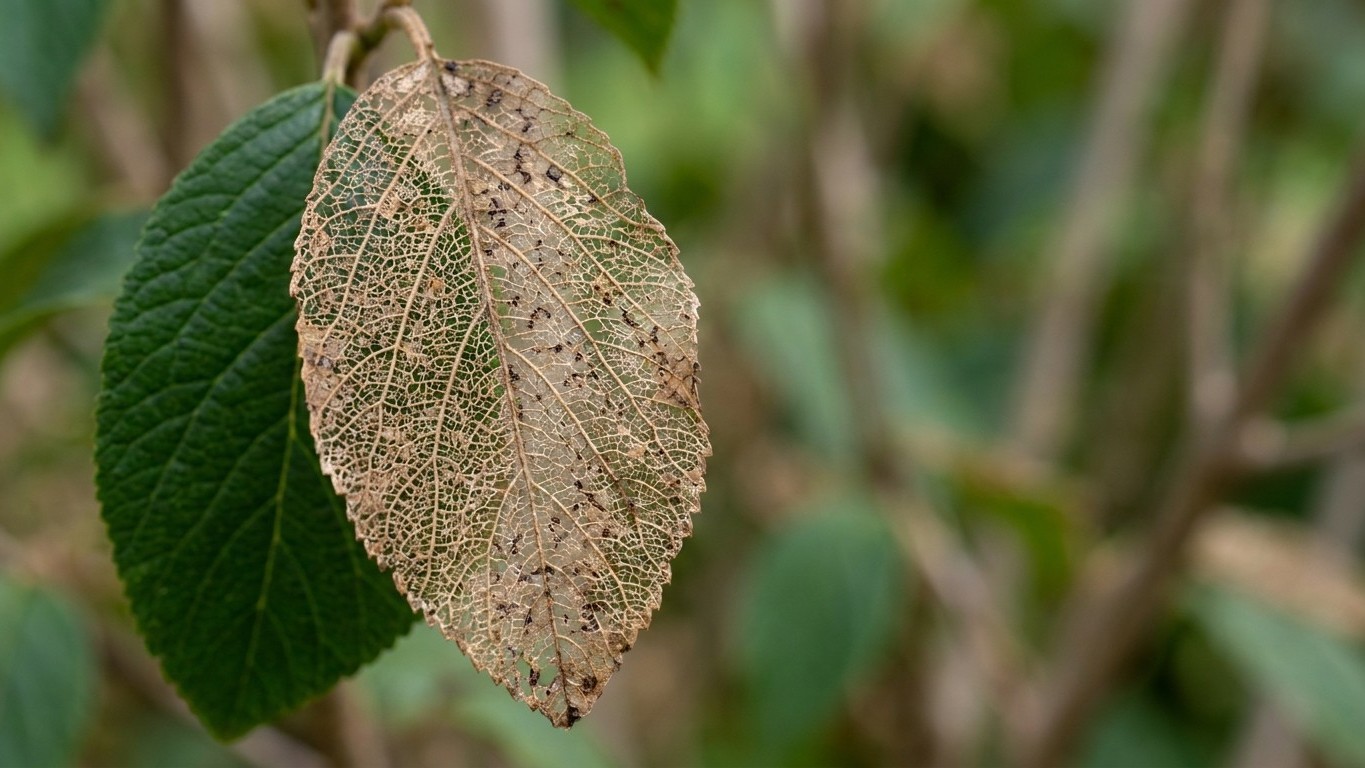

Viburnum leaf beetle season in New York runs on two clocks: late April through June, when overwintered eggs hatch into leaf-shredding larvae, and again in July, when the surviving adults emerge to finish the job and lay next year’s eggs. Homeowners from Buffalo to the Hudson Valley have watched the same shrub go from full and green to lace-thin and brown in a single growing season, and the beetle has now been confirmed in most counties across the state. Knowing the calendar matters more than knowing the bug’s Latin name, because the window for stopping it without chemicals is short and closes fast.
Where and When It Shows Up in New York

Viburnum leaf beetle (Pyrrhalta viburni) is not native to North America. It arrived in Ontario in the 1940s, spent decades as a Canadian problem, and finally crossed into New York in the late 1990s. Cornell entomologists picked up the trail almost immediately, tracking its county-by-county spread through a long-running citizen science project that mapped sightings as the beetle pushed south and east from the St. Lawrence Valley.
Nearly thirty years later, the insect has settled into most of upstate New York and made steady inroads into the Hudson Valley, the Capital Region, and Long Island. It moves slowly compared to something wind-borne like spotted lanternfly, but it moves reliably, riding on nursery stock and, once established, spreading on its own through adult flight.
Timing shifts by region. In the North Country and the Adirondacks, where spring arrives late, egg hatch typically lags a week or two behind the Hudson Valley and New York City suburbs. That gap matters if you’re trying to catch larvae early: a homeowner in Plattsburgh checking twigs in mid-April is likely still fine, while someone in Westchester County should already be looking.
The Two-Stage Attack: Larvae and Adults
What makes this beetle harder to manage than a lot of leaf-feeding insects is that it damages plants twice in one season, in two different forms.
Eggs overwinter in small pits that adult females chew into the current season’s twig growth, usually in a neat row, then cap with a dark, waxy plug that looks almost like a tiny scab. Each female can lay several hundred eggs across a shrub before winter sets in. When they hatch in spring, the larvae are yellowish-green, marked with black spots, and they feed in groups on the underside of leaves. They skeletonize foliage, eating everything but the veins, so a heavily infested branch looks like it’s been hit with a blowtorch from below.
After three to four weeks of feeding, larvae drop to the soil to pupate. Roughly two to three weeks later, adults emerge, brown and about a quarter-inch long, and they go right back to work chewing irregular holes through leaves for the rest of the summer. By September, females are back to notching twigs for next year’s eggs, and the cycle resets.
The compounding damage is the real threat. A single season of heavy larval feeding rarely kills a mature shrub outright, but two or three consecutive years of defoliation drain the plant’s energy reserves. Cornell’s long-term monitoring has documented viburnums going from healthy to dead within three years when infestations go unmanaged, particularly on already-stressed plants growing in poor soil or deep shade.
How to Spot an Infestation Before It’s Obvious
The giveaway sign in late winter or early spring, before any leaves have emerged, is the twig itself. Look for rows of small brown pits along the previous year’s growth, usually six to eight in a line, each about the size of a pinhead. That’s the egg-laying pattern, and it’s visible from November through April, well before larvae ever hatch.
Which Viburnums Are at Risk in New York Landscapes
Not every viburnum in a New York yard is equally vulnerable, and that distinction shapes a lot of the practical decision-making around this pest. Species differ widely in how much leaf tissue and bitter compounds they produce, and the beetle’s larvae simply do better on some hosts than others.
Highly susceptible species commonly planted in New York include:
- European cranberrybush (Viburnum opulus)
- Arrowwood viburnum (Viburnum dentatum)
- Rafinesque viburnum (Viburnum rafinesqueanum)
- Sargent viburnum (Viburnum sargentii)
- Wayfaring tree (Viburnum lantana)
Species that tend to hold up much better, either because larvae struggle to feed on them or because adults avoid laying eggs there, include Koreanspice viburnum (Viburnum carlesii), doublefile viburnum (Viburnum plicatum), and leatherleaf viburnum (Viburnum rhytidophyllum). American cranberrybush (Viburnum opulus var. americanum), despite its close relation to the highly susceptible European variety, also shows meaningfully less damage in field observations.
This matters for anyone replacing a dead shrub or planning a new hedge row. Swapping a heavily damaged arrowwood for a doublefile viburnum in the same spot often solves the recurring problem without giving up the look of a flowering shrub border.
What Actually Stops Viburnum Leaf Beetle
Control works best when it’s timed to the life cycle rather than applied reactively after leaves are already skeletonized. Three windows matter, and missing all three means waiting out another season of damage.
Winter and Early Spring: Prune Out the Eggs
The single most effective, lowest-cost step is cutting out egg-infested twigs between late fall and early April, before hatch. Because the egg sites are visible as those small pitted rows, a homeowner can walk the shrub with pruners in January and remove a meaningful chunk of next spring’s larval population before it ever exists. This won’t eliminate an infestation on its own in heavily populated shrubs, but on light to moderate infestations it can hold numbers down for years without a single spray.
Spring: Target the Larvae
Once eggs hatch, typically late April in the Hudson Valley and downstate, into May across central and western New York, and pushing into late May or early June in the Adirondacks and North Country, larvae are the most vulnerable stage. They’re soft-bodied, exposed on leaf undersides, and susceptible to horticultural oil and insecticidal soap sprayed with good coverage on both sides of the foliage. These options carry low risk to bees and other pollinators, which matters since viburnums often flower right around this window.
For heavier infestations, systemic insecticides containing imidacloprid, applied as a soil drench in spring, can move through the plant’s vascular system and control both larvae and the adults that feed later in summer. Because these products are absorbed into tissue including flowers, timing and label directions matter for protecting pollinators, and treating well before bloom reduces that risk.
Summer: Manage the Adults
Adults emerging in July are tougher and more mobile than larvae, and they can fly in from neighboring properties even after a yard’s own population has been knocked back. Contact insecticides labeled for adult beetles can help on high-value specimen shrubs, but for most home landscapes, the bigger payoff comes from staying ahead of the fall egg-laying period. Adults that survive the summer will be back on twigs by September, starting the whole cycle over.
Natural predators help too, though not enough to rely on alone in New York’s current beetle population. Some lady beetle species and predatory bugs will feed on larvae, and researchers have noted modest parasitism in parts of the beetle’s range, but nothing has emerged as a reliable biological check the way it has for some other invasive insects.
Tracking the Spread Across New York
Cornell University’s viburnum leaf beetle program has run one of the longer-standing citizen science tracking efforts for an invasive insect in the state, asking gardeners to report sightings and submit twig samples for confirmation. That crowd-sourced data built the county distribution maps still referenced by extension offices today, and it’s a useful resource for anyone wondering whether the beetle has already reached their specific area or is still a few seasons away. Details on the monitoring project and current findings are available through Cornell’s horticulture department at hort.cornell.edu/vlb.
For homeowners near the leading edge of the infestation, upstate counties bordering already-established populations, the practical move is to start winter twig inspections now rather than waiting for visible leaf damage. Catching the first egg-laying twigs on a young shrub is far easier than trying to save a viburnum that’s already lost three seasons of leaves to a beetle most people never see coming.