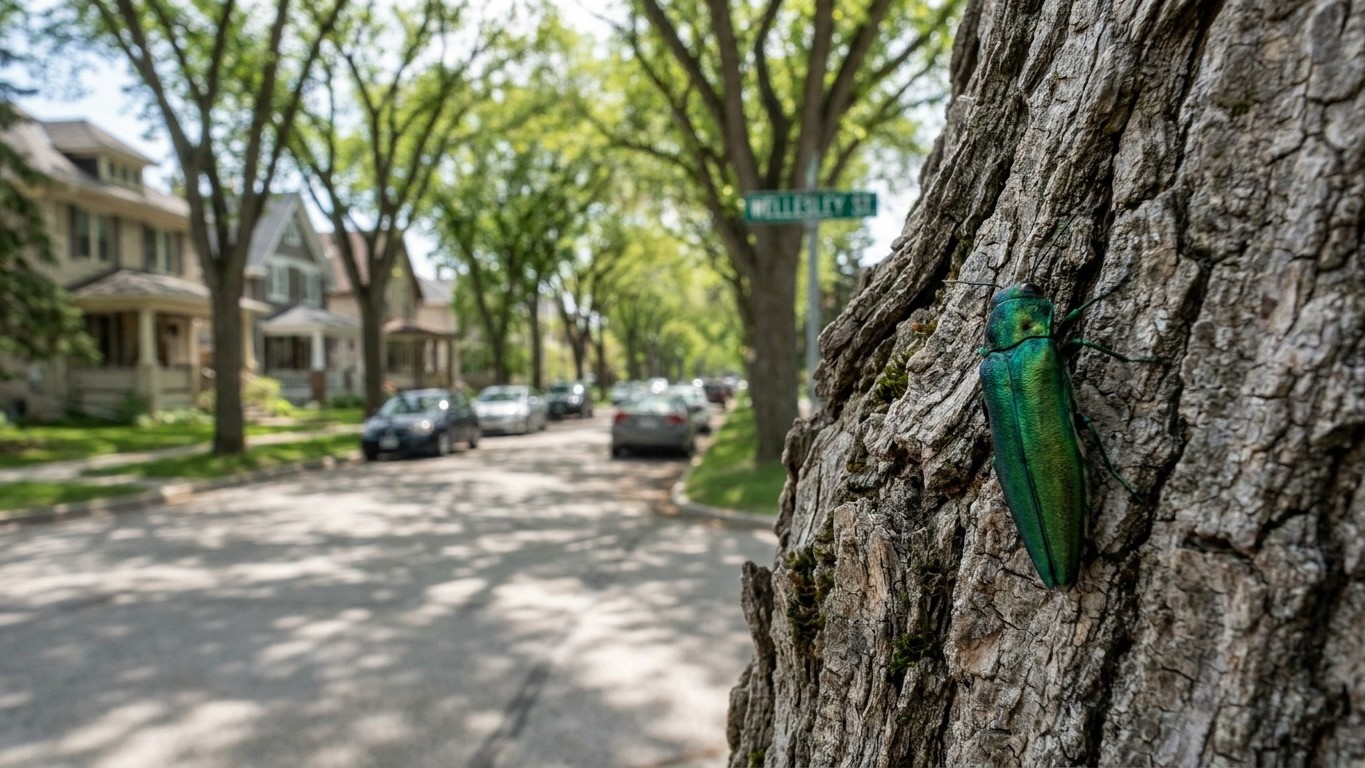

Emerald ash borer has been confirmed in Manitoba since 2017, with Winnipeg as the epicenter of the infestation. The beetle spreads slowly on its own, maybe a mile or two a year through natural flight, but it travels fast and far in firewood and nursery stock. That’s the whole battle in one sentence: contain the wood, catch the damage early, and treat or remove trees before the larvae finish them off. Nothing else on the market truly “stops” this insect once it’s established in a tree.
Winnipeg Is Ground Zero, and the Reason Is the City’s Own History

The first confirmed detection in Manitoba came out of a Winnipeg neighborhood near the Red River, and the timing wasn’t random. Winnipeg spent decades losing American elms to Dutch elm disease, and when city foresters looked for a tough, fast-growing replacement in the 1970s and 80s, green ash was the obvious pick. It tolerates prairie winters, road salt, and clay soil better than almost anything else available at the time. That decision left the city with a boulevard canopy where ash makes up a serious chunk of the older residential streets, especially in neighborhoods that rebuilt their tree cover after the elm losses.
That history is exactly why the infestation matters so much here. A pest that mostly kills one genus of tree does the most damage in a city that leaned on that genus to fix a previous tree disaster. Manitoba isn’t just dealing with a new insect; it’s watching a second wave of the same vulnerability that wiped out its elms, just with a different bug and a different tree species.
How the Beetle Actually Kills a Tree, and What to Look For
Adult emerald ash borers are small, metallic green, and easy to miss. Most homeowners never spot the beetle itself. What gives an infestation away is the damage the larvae leave behind, and that damage builds slowly before it becomes obvious.
The larvae live under the bark, feeding on the cambium layer, the thin band of tissue that moves water and nutrients between the roots and the canopy. As they tunnel, they carve S-shaped galleries that girdle branches and eventually the trunk. A tree can look mostly fine for the first year or two of an infestation, then decline fast once the damage cuts off enough of that internal plumbing. A few signs tend to show up in sequence:
- Canopy thinning that starts at the very top of the tree and works downward
- Sprouts growing directly from the trunk or base (called epicormic shoots), a sign the tree is trying to compensate for lost canopy
- Bark splitting vertically, sometimes revealing the S-shaped tunnels underneath
- Small, D-shaped exit holes in the bark, roughly the width of a grain of rice
- Patches of bark stripped away by woodpeckers hunting for larvae, sometimes called “blonding”
Once a tree shows heavy canopy dieback, meaning more than half the crown is gone, treatment options stop being effective. At that point removal is really the only path left, and Manitoba’s winter wind loads make a dead ash a real hazard over a driveway or a sidewalk.
The Life Cycle Runs on a Cooler Clock Here Than in Warmer States
In warmer parts of the beetle’s range, it completes one generation per year. In colder climates, including Manitoba, the larval stage can stretch across two winters before the insect emerges as an adult, because the cold slows their development. Adults typically emerge from late May into July, mate, and the females lay eggs in bark crevices through the summer. That longer, colder cycle doesn’t make the beetle less dangerous, it just means an infestation can sit quietly under the bark for longer before visible symptoms show up, which is part of why early detection is so hard.
There was a hope, early on, that Manitoba’s brutal winters might do some of the killing for free. Research on the insect’s cold tolerance found that larvae start dying off in significant numbers only at extreme sustained temperatures, and the insulation of bark and snow cover protects them from a lot of that exposure. In practice, the beetle has kept expanding in Winnipeg despite the cold, so nobody is counting on a hard freeze to solve this.
Quarantine Rules Exist Because Firewood Moves the Beetle Farther Than the Beetle Moves Itself
The Canadian Food Inspection Agency maintains a regulated area covering Winnipeg and the surrounding region once emerald ash borer is confirmed there, restricting the movement of ash wood, branches, and firewood out of that zone. The logic is straightforward. An adult beetle might fly a mile or so in a season looking for a new host tree. A pickup truck loaded with firewood can move an infested log two hundred miles in an afternoon, larvae and all, and that’s how most new infestations get their start far from the original outbreak.
For anyone camping or cottaging in Manitoba, that means buying firewood locally at the destination rather than hauling it from home, and never bringing wood back from a regulated area. It also affects landscapers, arborists, and firewood sellers operating near Winnipeg, who need to know whether their supply falls inside the current regulated boundary before they move material. Violating a federal quarantine order under the Plant Protection Act carries real penalties, not just a warning.
What Actually Slows or Stops an Infestation
There’s no way to eradicate emerald ash borer once it’s established in a region. The realistic goal is management: protecting individual high-value trees, removing the ones that are too far gone, and rebuilding the urban forest so it isn’t so dependent on one species again.
Systemic insecticide injections are the main tool for saving a tree that’s still in decent shape. Products containing emamectin benzoate, applied by a certified arborist directly into the trunk, move through the tree’s vascular system and kill larvae as they feed. This works best on trees caught early, before more than 30 percent of the canopy has thinned, and it needs to be repeated roughly every two years for as long as the tree needs protecting, which in an active infestation zone can mean indefinitely. It’s not cheap, and it’s not a one-time fix, so most homeowners reserve it for large, healthy shade trees worth the ongoing cost rather than every ash on the property.
Removal is the other half of the equation, and timing matters more than people expect. Cutting down an infested tree before the current generation of adults emerges, generally before late May, keeps that batch of beetles from spreading to neighboring trees. Waiting until a tree is obviously dead and skeletal means the beetles inside have likely already flown off to start new infestations elsewhere. Wood from removed ash trees should be chipped, burned on site, or otherwise processed according to local disposal rules rather than stacked as firewood and moved anywhere.
Municipal foresters in Winnipeg and other affected Manitoba communities have also started diversifying new plantings, deliberately avoiding another monoculture replacement the way ash itself once replaced elm. Species like hackberry, bur oak, and various maples are showing up more often on new boulevard plantings specifically to spread the risk across more genera, so a single future pest can’t take out such a large share of the canopy at once.
Monitoring rounds out the strategy on the detection side. Purple prism traps hung in tree canopies, along with visual branch sampling by trained crews, help pinpoint how far the infestation has spread each year and where new regulated boundaries might need to shift. Homeowners can do a simpler version of this themselves by checking their own ash trees each spring and early summer for thinning crowns or bark damage, since a tree flagged in its first year of symptoms still has a real shot at treatment, while one flagged in its third or fourth year usually doesn’t.
One detail that surprises a lot of homeowners: a tree can lose most of its canopy to emerald ash borer and still send up vigorous-looking sprouts from the base for a season or two, giving a false impression of recovery. Those sprouts are the tree using its last stored energy reserves, not a sign the infestation has cleared, and they typically die back within another year or two once the root system runs out of what it needs to keep pushing new growth.
Related guides
- Emerald ash borer in Saskatchewan: When It Shows Up and What Stops It
- Emerald ash borer in Ontario: When It Shows Up and What Stops It
- Emerald ash borer in Michigan: When It Shows Up and What Stops It
- Emerald ash borer in New Brunswick: When It Shows Up and What Stops It
- Swede midge in Manitoba
- Emerald ash borer in Nova Scotia: When It Shows Up and What Stops It