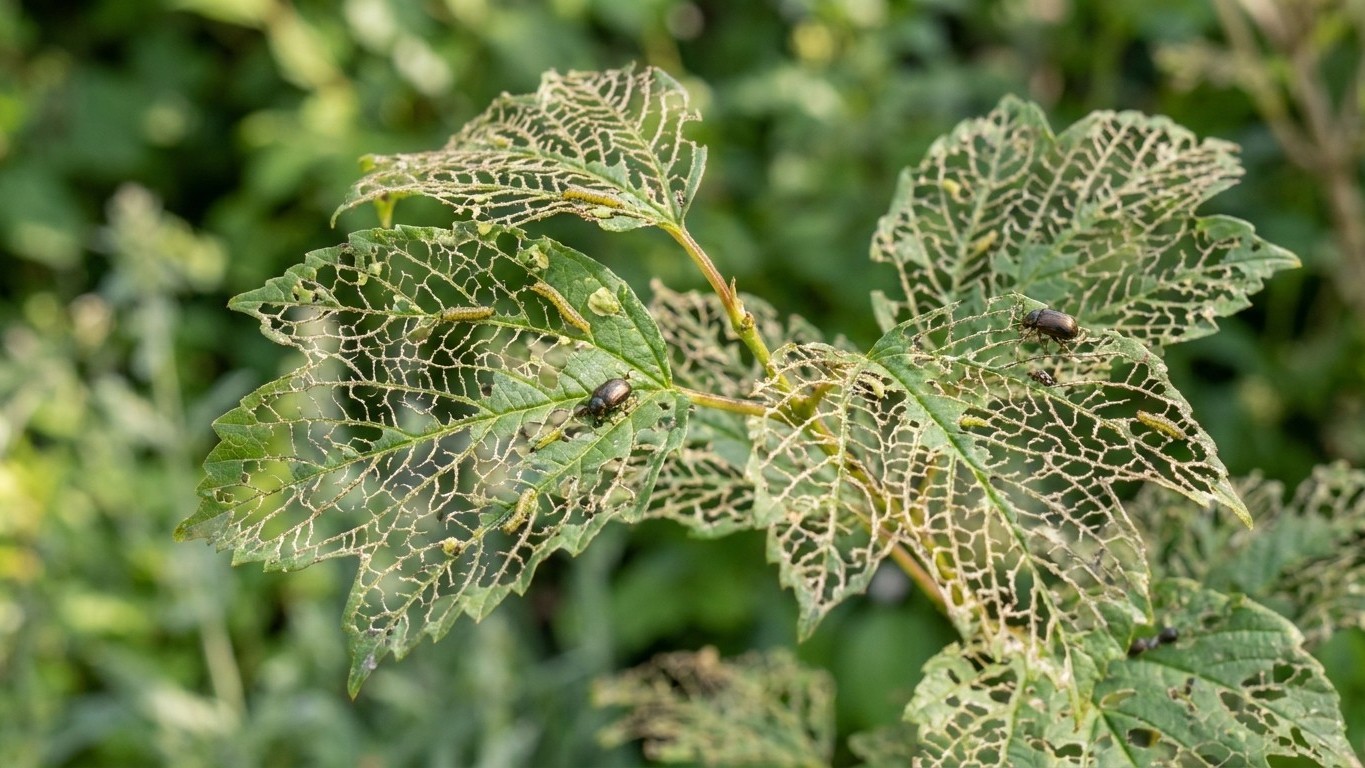

Viburnum leaf beetle shows up in Ontario in two distinct waves each year: hungry larvae skeletonizing leaves from late April through June, and adult beetles chewing fresh holes from July into September. The insect (Pyrrhalta viburni) has been established in southern Ontario since the late 1990s, and it doesn’t slow down on its own. Shrubs that get hit hard for two or three seasons in a row often die back to bare stems. Stopping it means catching the eggs before they hatch, checking leaves weekly during the growing season, and swapping out the most vulnerable viburnum species for ones the beetle mostly ignores.
Where Viburnum Leaf Beetle Established in Ontario

The beetle arrived in North America from Europe and was first confirmed in the Toronto area in 1997, spreading through Peel, York, and Durham regions within a few years. From there it moved along the Great Lakes corridor and into the Ottawa Valley, and it’s now considered widespread across southern and eastern Ontario. Cornell University’s entomology program, which has tracked the pest’s North American spread since it crossed into New York State, maintains one of the most detailed public records of its range and biology (Cornell University Viburnum Leaf Beetle Citizen Science Program).
Cottage country and rural properties with mature hedgerows tend to see slower buildup than urban and suburban plantings, mostly because dense monoculture hedges of susceptible viburnum give the beetle an easier population boost. A single infested shrub at a garden center or in a neighbor’s yard is enough to seed a whole block within two or three seasons, since adults fly readily in late summer looking for new host plants.
The Ontario Timeline: When Each Life Stage Appears
Understanding the calendar matters more than almost anything else with this pest, because the treatment window for larvae is short and easy to miss.
Late Winter Through Early Spring
Eggs overwinter inside small pits chewed into the undersides of pencil-thin twigs, usually on the previous year’s growth. Each pit holds several eggs capped with a mix of chewed bark and excrement, which gives the twig a slightly bumpy, dark-speckled look. This is the single easiest control window of the whole year, because the eggs are sitting still and visible before any leaves emerge.
Late April Into June
Larvae hatch as buds break and begin feeding immediately, skeletonizing leaves from the underside first. They molt through three stages over roughly four to five weeks, growing from pinhead size to about a third of an inch, and a heavy infestation can strip a shrub down to its veins within days. By early to mid-June, mature larvae drop to the soil to pupate just below the surface.
July Through September
Adults emerge from the soil roughly two to three weeks after pupation, usually by early to mid-July in southern Ontario. They resume feeding on leaves, chewing irregular holes rather than skeletonizing them, and mate through late summer. Females chew fresh egg-laying pits into new twigs from August into October, restarting the cycle before the first hard frost.
Spotting Damage Before It’s Too Late
Leaf skeletonization from larvae looks almost lace-like, with the leaf veins left intact while the tissue between them disappears. That’s different from adult feeding, which leaves ragged, irregular holes scattered across the leaf surface, and different again from the more uniform notching left by weevils or the powdery coating left by mildew. If you’re not sure which pest you’re dealing with, flip a few leaves over in early May: viburnum leaf beetle larvae are yellowish-green with black spots and cluster along leaf undersides and midribs.
A shrub that loses most of its leaves in spring usually pushes out a second flush by midsummer, which can mask the real damage until adults arrive and strip that regrowth too. Two consecutive years of near-total defoliation is generally the tipping point where root reserves run out and branches start dying back permanently. That’s the practical reason to intervene at the egg or early larval stage rather than waiting to see how bad the summer gets.
What Actually Stops It: A Three-Part Approach
No single tactic wipes out an established population, but combining pruning, monitoring, and targeted treatment keeps damage below the threshold where shrubs actually decline.
Winter Pruning of Egg Sites
From November through March, while shrubs are bare, walk the plant and look for twigs with rows of small dark bumps. Cutting out and destroying those twigs, either by burning where permitted or bagging for disposal, removes eggs before they ever hatch. On a small or moderately infested shrub, this alone can cut the following spring’s larval population dramatically, since a single female can lay eggs in dozens of pits across a season.
Spring Monitoring and Physical Control
Check leaf undersides weekly starting in late April. Early-stage larvae are small enough that a strong jet of water or a gloved hand can knock a meaningful number off a small shrub before populations explode. For anyone tracking the pest’s spread for research purposes, Ontario’s Invading Species Awareness Program collects sighting reports through its provincial hotline and website, which helps map how far the beetle has moved into new municipalities (Ontario Invading Species Awareness Program).
Targeted Insecticide Timing
If larval numbers are heavy enough that hand removal isn’t keeping pace, insecticidal soap or a product containing spinosad applied directly to larvae in May tends to work with the least collateral damage to pollinators, since neither product leaves long-lasting residue. Timing matters more than product choice here: treating after larvae have already pupated and dropped to the soil does nothing, and treating too early misses eggs entirely since they’re protected inside the twig. Always follow label directions and provincial pesticide regulations, which in Ontario restrict cosmetic pesticide use on many properties.
Natural Predators Help, But Not Fast Enough
Lady beetles, lacewings, and some parasitic wasps will feed on viburnum leaf beetle larvae and eggs, and mature landscapes with diverse plantings tend to build up these predator populations over a few years. The problem is timing: predator populations usually build up in response to prey abundance, which means they lag a season or two behind an outbreak rather than preventing one. Encouraging predator habitat, through reduced pesticide use elsewhere in the yard and a mix of flowering plants, is a reasonable long-term strategy but not something to rely on for an active infestation.
Choosing Viburnum That Shrugs It Off
Not every viburnum species is equally attractive to this beetle, and that gap in susceptibility is the most durable long-term fix available to homeowners. American cranberrybush (Viburnum trilobum) and European cranberrybush (Viburnum opulus) rank among the most heavily damaged species in field trials, while doublefile viburnum (Viburnum plicatum), Koreanspice viburnum (Viburnum carlesii), and leatherleaf viburnum (Viburnum rhytidophyllum) consistently show light to negligible feeding damage.
For anyone replacing a badly damaged shrub, this means the replacement decision matters as much as the treatment plan for the plant that’s already struggling. A hedge built entirely from a susceptible species will need active management indefinitely, while mixing in resistant varieties, or replacing susceptible plants outright, reduces the long-term workload considerably. Garden centers across Ontario increasingly label viburnum stock by susceptibility, though it’s worth asking directly if the tag doesn’t specify the species clearly, since common names can overlap between resistant and vulnerable types.
Homeowners dealing with a single infested shrub near a property line should also flag it to neighbors before the next egg-laying season starts in August. Adults fly readily between yards, and a shrub cleared of eggs in March can get reinfested by September if the beetle is still breeding a few properties over.