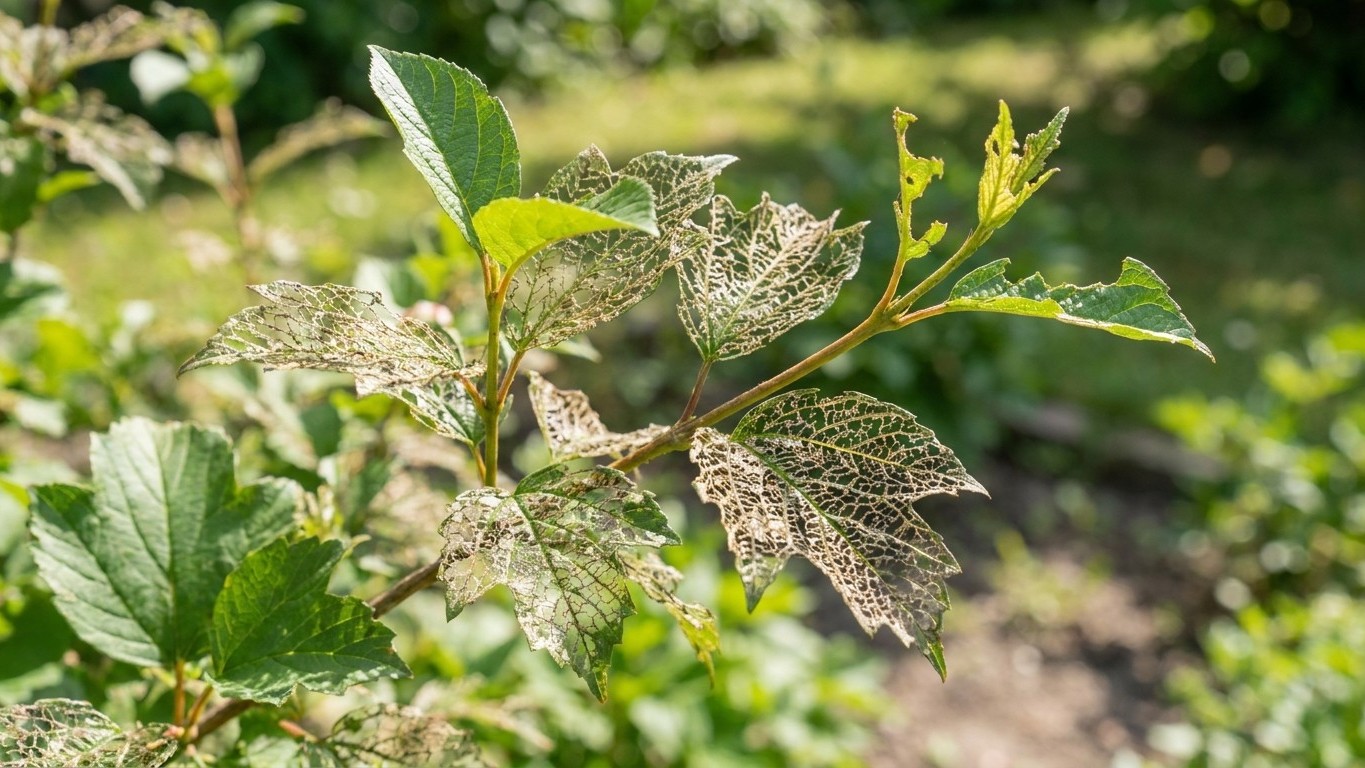

Viburnum leaf beetle shows up on a predictable calendar in Quebec: eggs overwinter in twig cavities, larvae hatch in May, adults emerge by mid-July, and by September the females are back to laying eggs for next year’s cycle. Stopping it means acting during two narrow windows, fall/winter pruning to remove egg sites and late spring treatment while larvae are small and exposed. Miss both, and a mature viburnum hedge can go from healthy to skeleton in two seasons.
When the Beetle Shows Up in Quebec

Pyrrhalta viburni, the scientific name for viburnum leaf beetle, was first confirmed in the Montreal region in the early 2000s. It arrived from Europe through the same pathway as many invasive insects, likely on nursery stock, and found the province’s climate perfectly suited to its life cycle. Quebec’s cold winters don’t slow it down much because the eggs are built to survive freezing temperatures tucked inside chewed-out cavities in viburnum twigs.
The timeline runs like this: eggs laid in late summer and early fall sit dormant through winter. Around early to mid-May, once soil and air temperatures climb, tiny larvae chew their way out and start feeding immediately. By June, those larvae have grown enough to drop to the soil and pupate. Adults emerge from the ground in July, feed for several more weeks, then mate and lay a fresh batch of eggs from late August into October. One generation per year, but it’s an aggressive one, since both the larval stage and the adult stage feed heavily on the same plant.
Homeowners in the Montérégie, the Laurentians, and Estrie regions have reported the heaviest pressure, since these areas combine established beetle populations with the dense residential and rural plantings of native viburnum species the insect prefers. Urban Montreal neighborhoods with mature viburnum hedges planted decades ago were among the first to see visible damage.
How to Identify the Damage Before It Spreads
Skeletonized leaves are the giveaway. Larvae feed on the undersides of leaves first, leaving a lace-like pattern of veins with the green tissue stripped away. As they mature, they move to the upper leaf surface and eat through everything but the toughest veins, so a heavily infested shrub looks scorched from a distance even though nothing is actually burned.
Adults leave a different signature: irregular, elongated holes chewed straight through the leaf blade, sometimes clustered near the leaf margins. If you see both skeletonized foliage in late May and ragged holes appearing in July, that’s the same insect at two life stages, not two separate problems.
Egg-laying damage is the one most people miss because it’s easy to overlook on bare winter branches. Females chew small pits into the underside of pencil-thick twigs, usually near the tips, then cap each pit with a mix of chewed wood and excrement. Under a hand lens, these caps look like rows of small brown bumps running along the twig, often six to eight eggs per cavity and multiple cavities per twig on a heavily used shrub.
Which Viburnums Are at Risk
Not every viburnum in a Quebec yard is equally vulnerable. Susceptibility varies enough that species choice alone changes the outcome:
- Highly susceptible: American cranberrybush (Viburnum trilobum) and European cranberrybush (Viburnum opulus), both common in older Quebec landscapes
- Moderately susceptible: Arrowwood viburnum (Viburnum dentatum) and wayfaring tree (Viburnum lantana)
- Rarely damaged: Koreanspice viburnum (Viburnum carlesii) and doublefile viburnum (Viburnum plicatum)
Cornell University’s long-running viburnum leaf beetle research program, one of the most cited sources on this pest in North America, has tracked these susceptibility rankings across multiple growing seasons and consistently found the same pattern across regions with similar climates to Quebec. That research is publicly available through Cornell Cooperative Extension.
What Actually Stops It
Pruning out egg-laying sites between November and April is the single most effective non-chemical control available to Quebec homeowners. Because females concentrate their eggs on young twigs near branch tips, a careful inspection and cut removes next spring’s larvae before they ever hatch. Look for those small brown bumps on twig undersides, then cut several inches below the lowest visible egg cavity. On a small to mid-size shrub, this can take less than twenty minutes and eliminates a meaningful share of the coming season’s population without any spray at all.
Timing matters just as much for chemical or organic sprays. Once larvae hatch in May, they’re small, soft-bodied, and clustered on leaf undersides, which makes them far easier to kill than the adults that follow. Insecticidal soap and horticultural oil, applied directly to larvae during this window, work well because both products need direct contact to be effective and larvae haven’t yet developed the tougher exoskeleton adults have. Spraying in July against adult beetles is possible but less efficient, since adults are more mobile and better protected.
Systemic insecticides applied as a soil drench in spring offer another option, particularly for larger shrubs where hand-pruning every twig isn’t practical. These products get taken up through the roots and distributed through the plant tissue, so larvae feeding on treated leaves ingest the active ingredient. Quebec’s pesticide regulations restrict certain residential uses, so checking current provincial rules through Quebec’s environment ministry before buying any product is worth the five minutes it takes.
Natural predators help but rarely solve an established infestation on their own. Some ground beetles and lady beetles feed on viburnum leaf beetle larvae, and birds will pick off exposed larvae during dry spells when other food is scarce. These pressures reduce populations somewhat but haven’t been enough, based on the pattern observed across the northeastern beetle range, to bring severe infestations under control without added pruning or spraying.
What Doesn’t Work
Broad-spectrum insecticide applications timed randomly through the growing season tend to waste money and kill beneficial insects without hitting the beetle at its most vulnerable stage. Fertilizing a stressed, heavily defoliated shrub to help it “bounce back” also backfires more often than it helps, since new growth pushed out by fertilizer becomes fresh feeding material for whatever beetles remain. The better move is controlling the pest first, then letting the plant recover on its own schedule the following year.
Where in Quebec It’s Established
Two decades after its first detection near Montreal, viburnum leaf beetle has moved well beyond the island. Confirmed populations now stretch through the Montérégie south of the city, into the Laurentians to the north, and east into parts of Estrie and the Centre-du-Québec region. Reports from further north and east remain sparser, likely a mix of shorter growing seasons slowing the beetle’s spread and simply less monitoring in those areas rather than true absence.
Espace pour la vie, which runs the Montreal Botanical Garden, has documented the beetle’s spread through its own collections and public reporting since the early infestations, giving Quebec one of the more detailed regional pictures of how this insect moves compared to many other invasive pests tracked at the provincial level. Homeowners noticing skeletonized viburnum leaves in regions not yet listed as established can help track the spread by reporting sightings to local extension services or provincial pest-monitoring programs.
A shrub that survives one bad season isn’t necessarily safe going forward. Once a viburnum has hosted egg-laying females, it tends to attract more of them the following year, since females often return to plants where they previously found suitable twig diameter and bark texture. That’s part of why the fall pruning habit matters more than a single spring spray: skipping it one year rarely causes total loss, but skipping it three years running on a highly susceptible species like American cranberrybush is a reliable way to lose the shrub entirely.