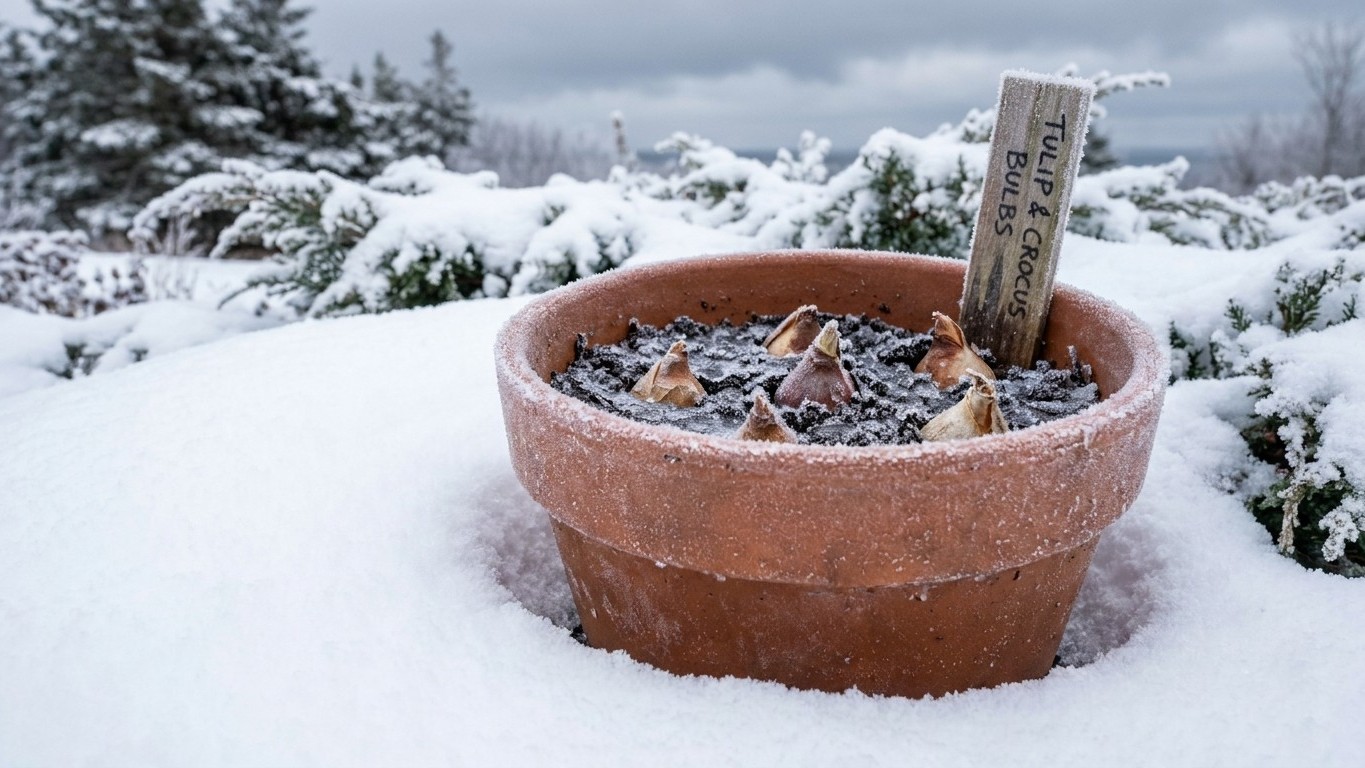

In Newfoundland and Labrador, containers are the real hurdle, not a shortage of winter cold. The coldest month here averages a mean minimum of 16.4°F, so bulbs get more chilling than they need. The catch: a pot freezes solid, roots included, in a way garden soil never does.
Why this matters in Newfoundland and Labrador

Start with the number that settles the question: 16.4°F. That’s the mean daily minimum for the coldest month at the reference station in St. John’s, according to Environment and Climate Change Canada’s 1981-2010 Climate Normals. Spring bulbs need roughly twelve to fourteen weeks of temperatures below 45°F to bloom properly. A winter that bottoms out near 16°F on an average night is delivering far more cold than that threshold, week after week, for months. So the forcing problem, the one where a gardener has to manufacture cold in a refrigerator because the outdoors won’t provide it, doesn’t describe this territory. Newfoundland and Labrador has cold to spare.
That surplus of cold is exactly what makes containers risky here. In a garden bed, the soil mass around a bulb buffers it from the air. Six inches down, the ground rarely matches the air temperature above it, and that lag is what keeps a tulip or a crocus alive through a hard winter even where the hardiness rating looks marginal. A pot has no such buffer. Its sides are exposed to the air on every face, so a container left outdoors tracks the outdoor temperature almost exactly. When the reference zone for this area is 6a under the Canadian hardiness system (Natural Resources Canada, based on 1991-2020 normals for St. John’s), that 6a rating assumes the insulation a bulb gets from being planted in the ground. Pull that same bulb out of the ground and into a pot, and it’s effectively gardening several zones colder.
This is worth being precise about, because the Canadian zone system and the USDA system some readers may know from other regions are not interchangeable. Canada’s zones are built from seven climate variables, not one, and Natural Resources Canada is explicit that there’s no simple conversion between the two scales. A Canadian zone 4a, for instance, can overlap nine different USDA zones. So when this article says 6a, it means the Canadian rating for St. John’s specifically, not a province-wide figure and not something to line up against a USDA map.
How to do it here
The method below covers both reasons a gardener in this territory ends up potting bulbs: forcing them for indoor winter bloom, and simply overwintering a container bulb garden outdoors without losing the bulbs to a hard freeze. Follow it in order.
- Pick the pot and confirm drainage. Use a container with holes in the base, no exceptions. A bulb sitting in trapped water during a twelve-week chill period rots before it ever gets the chance to freeze.
- Decide the purpose before you plant. Bulbs destined for a windowsill in February need a controlled chill. Bulbs meant to live outdoors on a porch or deck all winter need physical protection instead.
- For indoor forcing, find a stable cold spot. An unheated garage that stays above freezing but below 45°F works, as does a refrigerator’s produce drawer, provided it’s kept away from apples, pears, or any ripening fruit. Ripening fruit releases ethylene gas, and ethylene damages the flower bud inside a chilling bulb.
- Check the temperature with an actual thermometer. Don’t guess at a garage’s winter range. If it regularly drops below freezing, the bulbs will freeze along with everything else stored there, and a frozen bulb doesn’t recover.
- Hold the chill for the full twelve to fourteen weeks. Shortening this period is the single most common reason forced bulbs fail to flower.
- For outdoor container gardens, treat the pot as two hardiness zones colder than the ground around it. Since St. John’s sits at Canadian zone 6a, a bulb rated for that zone in open soil needs a container gardener’s workaround: either choose bulbs hardy to a noticeably colder zone, or move the pot.
- Move the pot to an unheated, unheated-but-sheltered space, or bury it. Sinking the whole container into a garden bed up to its rim, or tucking it against a foundation wall and piling mulch over the top, gives back some of the soil insulation a freestanding pot lacks.
- Bring forced bulbs into warmth gradually once the chill period ends. A sudden jump from a cold garage to a heated living room stresses the shoot before it’s ready to elongate.
Which bulbs are worth it
Not every bulb rewards the effort of potting it up, and the difference usually comes down to two things: how much cold it needs before it bothers to bloom, and how tall it gets once it does. A bulb with a short chilling requirement forces faster and forgives a gardener who’s a week or two off schedule. A bulb that throws up a two-foot stem is a liability in a pot with a narrow base, since the whole thing tips over the first time a door swings open nearby.
Some bulbs are worth potting for another reason entirely: they were never going to survive a Newfoundland and Labrador winter outdoors anyway, so there’s no long-term cost to using them up in a single season of forced bloom.
- Hyacinths, sturdy stems, moderate chill requirement, reliable indoors
- Crocus, very short chill requirement, compact and stable in a pot
- Dwarf iris (Iris reticulata), short chill requirement, low growth habit
- Grape hyacinth (muscari), short chill requirement, compact
- Paperwhite narcissus, needs no chilling at all, tender and not winter-hardy here regardless, so a one-season purchase either way
- Tall trumpet daffodils, long stems that flop in a shallow container
- Tall single or double late tulips, top-heavy once the flower opens
- Large ornamental alliums, need a deep root run a typical pot doesn’t offer
- Fritillaria, fussy about drainage and prone to rot in container conditions
What goes wrong, and when you can still fix it
Leaves but no flower
This means the chill fell short of what the bulb needed. The leaves came from stored energy the bulb already had; the flower bud never finished developing because the cold period was cut too short or interrupted by a warm spell in storage. There’s no fix for the bloom already lost. If the bulb is a hardy perennial type, let the foliage die back naturally, then give it a full, uninterrupted chill next season.
A flower buried low in the leaves, hard to even see
This is what happens when a bulb gets pulled out of the cold and into warmth and light too early, before the flower stalk had time to elongate. The stem stays short while the leaves keep growing. This season’s bloom can’t be lengthened after the fact. It’s not a sign anything is permanently wrong with the bulb, just a timing error in how it was warmed.
Soft, rotten bulb in the pot
Rot traces back to drainage, almost always. A pot without holes, or one sitting in a saucer of standing water through the chill period, keeps the bulb wet in cold, oxygen-poor soil, and that’s exactly the condition rot organisms need. A rotten bulb is not salvageable this season or any other. The fix applies to the next planting: drainage holes, a gritty mix, and a pot that’s never left standing in water.
Related guides
- Forcing Spring Bulbs Indoors in New Hampshire
- Growing Spring Bulbs in Containers in New Hampshire
- Beet Soil in Newfoundland and Labrador
- Growing Pumpkins in Newfoundland and Labrador
- Growing Herbs in Newfoundland and Labrador
- the complete guide
- Forcing Spring Bulbs Indoors in Newfoundland and Labrador