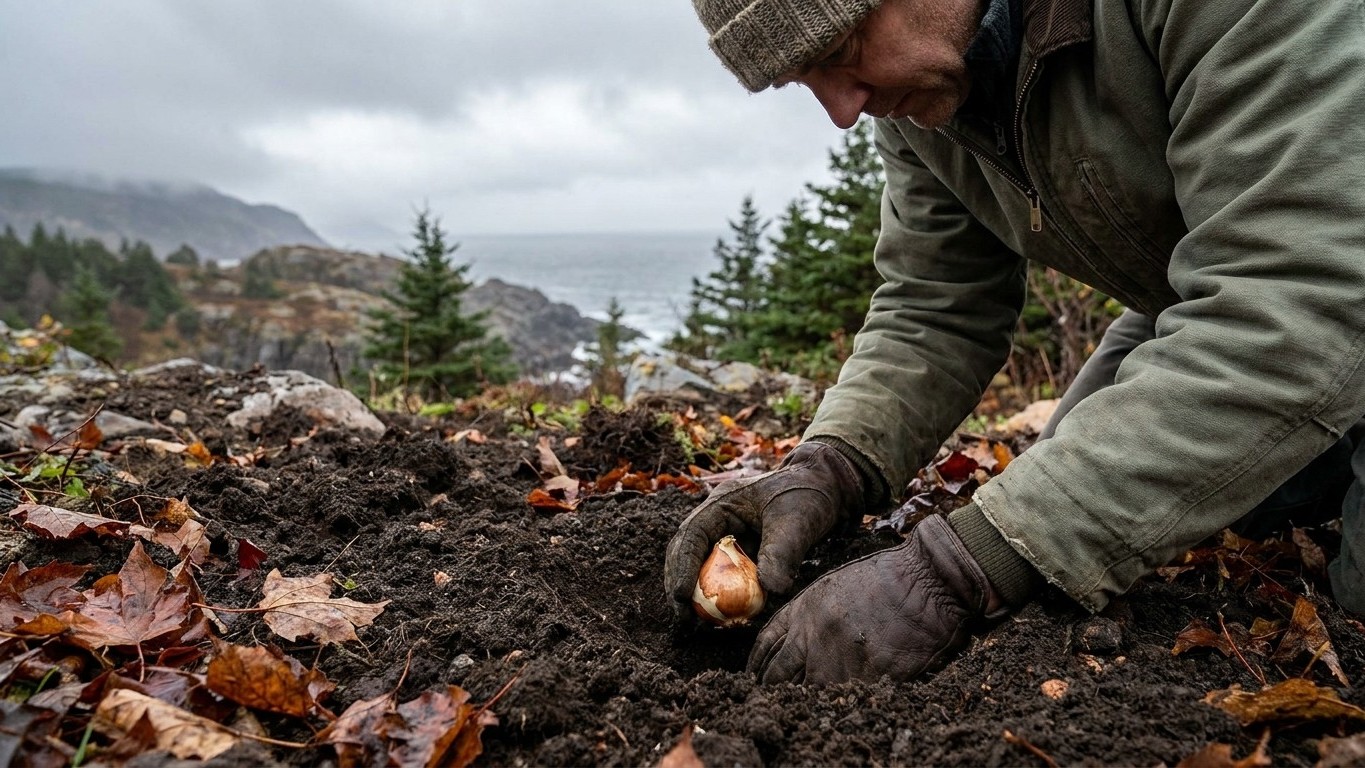

Spring bulbs planted in Newfoundland and Labrador face a paradox: the winters here are cold enough to satisfy almost any bulb’s chilling needs, but not every bulb is built to survive the winter itself. The real question isn’t whether it gets cold enough. It’s which bulbs are hardy enough to take it.
When to plant bulbs in Newfoundland and Labrador

The planting clock here runs backward from the first fall frost, which averages October 17 at the St. John’s A station, according to Environment and Climate Change Canada’s 1981-2010 normals. Spring bulbs want roughly six weeks in cool soil before the ground locks up for winter, and that window is what actually matters, not the calendar date on its own.
Plant too early, while soil is still holding summer warmth, and a tulip or daffodil bulb can push up soft top growth before winter arrives. That growth freezes, and the bulb spends its stored energy recovering instead of building next spring’s flower. Plant too late, after the ground has gone hard, and the bulb goes in without time to grow roots. It may sit dormant through winter with a weak root system, or not root at all, and what comes up in spring is thin, short, or absent entirely.
Working backward from an October 17 average frost, the safer planting stretch in most of eastern Newfoundland runs from roughly mid-September through the middle of October, tapering off as the ground cools toward a hard freeze weeks later. That’s a window, not a deadline, and it needs to be read as one.
The average frost date is not a promise
October 17 is a mean, built from thirty years of data, and a mean date puts roughly half of all years on the late side of it. Some Octobers stay open into November. Others turn hard well before mid-month, especially inland or at higher elevation away from the moderating effect of the coast. A gardener who plants right up against the average and gets an early frost year has effectively skipped the planting window. Getting bulbs in the ground on the early side of that range costs nothing. Waiting for the calculated “perfect” date and losing the bet costs a season.
Whether your winter is cold enough
Every spring bulb needs a stretch of real cold before it will flower. The industry standard is twelve to fourteen weeks with the soil holding below about 45°F. Skip that requirement and the bulb doesn’t die outright, it just doesn’t do the one thing it was planted for: it grows leaves, sometimes a stunted stem, and no visible bloom, or a flower bud so short it never clears the foliage. That figure, the weeks and the 45°F line, is the number every bulb buyer needs, no matter where they garden, because it’s the only thing that tells them whether a variety can even work in their yard. For gardeners who want blooms without waiting on outdoor conditions, Growing Spring Bulbs in Containers in Newfoundland and Labrador offers a way around the wait, and for gardeners who want blooms without waiting on outdoor conditions, Forcing Spring Bulbs Indoors in Newfoundland and Labrador offers a way to meet that chilling requirement artificially and enjoy flowers well ahead of the garden season.
Newfoundland and Labrador is not a place where that requirement is in doubt. The coldest month here averages a daily minimum of 16.4°F, well below the 45°F chilling threshold, and that cold holds for months, not weeks. The reference city sits in Canadian hardiness zone 6a, measured on Canada’s own seven-variable system, which is a different scale entirely from the USDA zones used elsewhere on this site and should never be read as interchangeable with them. What that Canadian rating confirms, alongside the coldest-month figure, is a long, reliably cold winter season, one that clears the vernalization requirement for classic spring bulbs with room to spare.
That margin buys something specific: nobody planting standard Spring Bulbs in this province needs to pre-chill anything. Pre-chilling, for readers unfamiliar with it, means storing bulbs in a refrigerator for about twelve weeks before planting, away from apples, bananas, or any ripening fruit, because the ethylene gas fruit gives off kills the flower bud forming inside the bulb. That’s a workaround for gardeners in mild climates who don’t get enough natural cold. It has no place in a Newfoundland and Labrador planting plan, because the ground here does the job on its own.
| Bulb species | Weeks of cold required (below 45°F) | What this territory delivers | Verdict |
|---|---|---|---|
| Tulip | 12-14 weeks | Cold season runs far longer, coldest month averages 16.4°F | Requirement cleared, no pre-chill needed |
| Daffodil / Narcissus | 12-14 weeks | Same | Requirement cleared, no pre-chill needed |
| Hyacinth | 12-14 weeks | Same | Requirement cleared, no pre-chill needed |
| Crocus | 8-10 weeks | Same | Requirement cleared easily |
| Allium | 8-10 weeks | Same | Requirement cleared easily |
Which bulbs suit Newfoundland and Labrador
Once the chilling question is settled, the second filter is straightforward cold hardiness: not “will it bloom” but “will it survive the winter at all.” Standard spring bulbs with a wide, well-established hardiness range hold up well here, especially in beds with decent drainage, since this province’s maritime winters bring more wet than a dry inland cold snap.
- Daffodil / Narcissus (hardy zones 3-8): reliable, and the safest bet in this climate
- Crocus (hardy zones 3-8): early, tough, and unbothered by a late cold snap
- Tulip (hardy zones 3-7): performs well, but wants sharp drainage to avoid rot in a wet winter
- Muscari / grape hyacinth (hardy zones 4-8): dependable and low-maintenance
- Scilla siberica (hardy zones 2-8): among the hardiest bulbs sold, built for exactly this kind of winter
- Snowdrop / Galanthus (hardy zones 3-9): naturalizes well in cooler, damp ground
- Allium (hardy zones 3-8): trouble-free once established
On the other side of that list sit bulbs sold in the same garden centers that simply aren’t rated for this kind of cold. Anemone blanda (hardy zones 5-8) sits right at the edge and struggles in an open, wind-exposed bed even where it survives in a sheltered one. Ranunculus and freesia, both rated no hardier than zone 8, will not overwinter in the ground here at all. Planted as if they were tulips, they put on a show the first year, on stored energy from the bulb itself, and simply don’t come back. That’s the failure worth knowing about before spending money on them, not after.
Hardiness ratings are never a hard line. A bulb rated for zone 5 that struggles in an exposed, windswept yard often does fine tucked against a south-facing foundation wall a few miles away, where snow cover holds and the soil doesn’t swing through as many freeze-thaw cycles.
What digs them up here
Squirrels and voles are selective, and the pattern isn’t random. Daffodils and every bulb in the onion family, including alliums, contain compounds that make them bitter or mildly toxic to rodents, so they’re left alone almost without exception. Tulips and crocus have no such defense. Both are treated as food by squirrels digging in fall and voles tunneling under snow cover in winter, and a fresh planting of either can be found dug up and scattered within days.
- At risk: tulip, crocus
- Left alone: daffodil / narcissus, allium, snowdrop, muscari, scilla
The one measure that consistently works is physical, not chemical: lay galvanized wire mesh flat over the planting bed, pinned down at the edges, and leave it in place until the ground freezes solid and the digging season ends. Repellent sprays and granules are sold everywhere, but they wash off in the first hard rain, and this is not a dry climate. If tulips or crocus are non-negotiable, plan on the mesh. There’s no shortcut around it.
Where to check for your own county
Every figure above, the frost date, the coldest-month minimum, the 6a hardiness rating, comes from the reference station at St. John’s. Newfoundland and Labrador spans a huge amount of coastline and interior, and a planting calendar built for St. John’s can run two or three weeks off for a garden on the Northern Peninsula, in Labrador, or well inland where the coast’s moderating effect on temperature disappears.
The province’s Department of Fisheries, Forestry and Agriculture is the right place to check local conditions before finalizing a planting date, since regional offices track frost patterns and soil conditions specific to their own district rather than the provincial reference city. A planting date that’s right for St. John’s Harbour isn’t automatically right for Corner Brook or Happy Valley-Goose Bay, and the gap between them is exactly the kind of detail a local office can settle in a five-minute phone call.