
In Newfoundland and Labrador, seed potatoes generally go into the ground about two to three weeks before the last spring frost, not after it. At St. John’s, Environment and Climate Change Canada’s Canadian Climate Normals list the average last spring frost as May 30, so soil typically reaches the 50°F planting threshold somewhere between May 9 and May 16. That’s the window growers count back to, not the frost date itself, because potato sprouts take time to push through the soil and tolerate a light frost better than the tender foliage that follows.
The short answer
The figure that matters is 50°F soil temperature, and it arrives 14 to 21 days before the last frost date, according to Utah State University Extension and the University of Maine Cooperative Extension. For the St. John’s A climate station (climate ID 8403506), Environment and Climate Change Canada’s Canadian Climate Normals 1981-2010 put the average last spring frost at May 30. Counting back 14 to 21 days lands the planting window between roughly May 9 and May 16 for that reference point.
That number needs a caution attached, because it’s a mean, not a promise. In one year out of two, frost at St. John’s falls later than May 30. A gardener who plants strictly on that date and assumes the risk is behind them is working from the middle of a distribution, not the safe edge of it. The soil-temperature rule exists precisely because it sidesteps that guesswork: instead of trusting a calendar average, you take a thermometer reading and let the ground tell you when it’s ready.
St. John’s is also just one point on a large map. Newfoundland and Labrador spans coastal Avalon lowlands, interior barrens, and the much colder Labrador coast and uplands, and none of those share a single frost calendar. A planting date drawn from St. John’s A tells you about St. John’s A. Move inland, gain elevation, or head north along the Labrador coast, and the real last frost slides later, sometimes by weeks. The mean date is a starting reference, not a province-wide instruction.
So the short answer has two parts: the number is May 9 to May 16 at the St. John’s reference station, and the number only holds where your own soil and microclimate resemble that station’s. Everywhere else, the mechanism below is what actually tells you when to plant, not the calendar date itself.
What actually decides it
Soil temperature drives the planting date, not calendar days
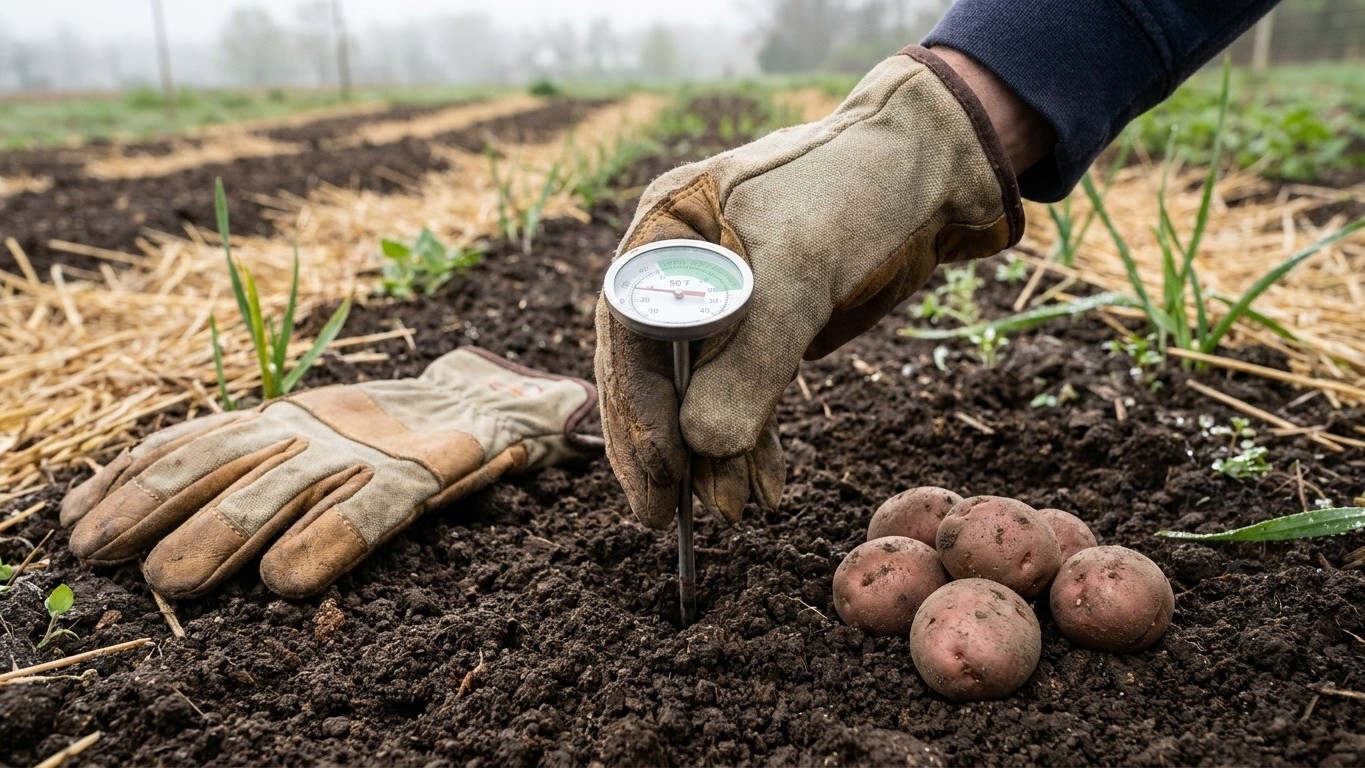
Potatoes are planted as soon as the soil reaches 50°F, according to Utah State University Extension’s Potatoes in the Garden fact sheet and the University of Maine Cooperative Extension’s Bulletin #2077. That threshold is what lets seed pieces sprout and root without rotting in cold, wet ground. Because soil warms more slowly than air, that 50°F point tends to land 14 to 21 days before the average last frost date, which is why the counting-back method works better than fixing on the frost date alone. A gardener with a simple soil thermometer, checked at planting depth on a few mornings in a row, gets a more accurate answer than any calendar can give.
The heat ceiling most NL summers never reach
At the other end of the season sits a second mechanism worth knowing even where it rarely triggers: soils above 90°F stop tuber set and fill, and watering doesn’t reverse it once it happens. In much of the U.S. Midwest and South, that ceiling is the reason growers race to plant early and finish the crop before peak summer heat. Newfoundland and Labrador’s cool maritime and subarctic summers rarely push soil that high, but the mechanism still explains why raised beds, south-facing slopes, or black mulch on a hot stretch of days can quietly stall tuber development even here. Understanding the ceiling means you can recognize the risk in an unusual hot spell instead of blaming poor soil or the wrong variety.
Why elevation and coastline shift the frost date
The same air mass that brings frost to an inland valley floor often spares a nearby slope, and coastal water moderates temperature swings compared to sheltered interior ground. That’s the physical reason a single station’s average, however carefully measured, can’t be extended across a province with this much variation in terrain and exposure. A grower on the coast may see a milder, earlier effective frost date than the provincial mean suggests; a grower in an interior hollow may see a colder, later one. The mechanism to carry forward is simple: cold air pools low and moves slowly, so low-lying, sheltered spots hold frost risk longer than open, elevated, or coastal ground nearby.
How to do it
- Buy certified seed potatoes rather than saving tubers from a previous harvest; uncertified seed carries viruses that reduce yield and spread silently through a garden.
- Choose a season class suited to your growing window, early, mid-season, or late, rather than relying on an unpublished days-to-maturity figure for the variety.
- Starting a few weeks before your expected planting window, check soil temperature at planting depth on several mornings using a simple soil thermometer.
- Plant as soon as the soil consistently reads 50°F, understanding this typically falls 14 to 21 days before your local average last frost.
- Cut larger seed potatoes into pieces with at least one eye each and let cut surfaces dry briefly before planting, so they resist rot in cool soil.
- Keep frost protection such as row cover on hand after planting, since sprouts may emerge before the last frost has actually occurred in a given year.
- Later in the season, watch for unusually hot, sheltered soil conditions, raised beds or south-facing slopes in a hot spell, and mulch to keep soil temperature below the 90°F ceiling that stalls tuber set.
What goes wrong
- Waiting for the calendar date instead of the soil. A gardener who plants only once May 30 has passed may be two or three weeks late in a year when soil actually warmed early. Check soil temperature directly and plant at 50°F, regardless of what the date on the wall says.
- Treating the average frost date as a guarantee. Since frost falls later than May 30 in roughly half of all years at St. John’s, planting on that exact date with no backup plan leaves the crop exposed. Keep row cover ready for the first few weeks after planting.
- Reusing old seed potatoes. Tubers saved from a previous harvest can carry viruses invisibly, and the resulting plants underperform without any obvious cause. Buy certified seed each season instead.
- Applying the St. John’s date to a different part of the province. Labrador, interior uplands, and sheltered inland valleys all run colder and later than the Avalon coast. Use a local reference point where one exists, and lean later rather than earlier when in doubt.
- Letting soil overheat in a warm, sheltered spot. Raised beds or south-facing plots can push soil above 90°F on hot days even in a cool province, quietly stalling tuber set. Mulch the soil surface and avoid dark materials that trap heat during any warm stretch.
Common questions
Can I plant potatoes before the last frost date in Newfoundland and Labrador?
Yes, and that’s the intended timing. Potatoes are planted once soil reaches 50°F, which lands 14 to 21 days before the average last frost, according to Utah State University Extension and the University of Maine Cooperative Extension. Sprouts take time to emerge, so planting ahead of the frost date is standard practice, not a risk to avoid.
What if my soil never reaches 50°F by the average date?
Then you wait, because the soil temperature is the trigger, not the calendar. Cool, wet springs or shaded, low-lying ground can delay that threshold well past a station’s average last frost date, and planting into colder soil raises the risk of seed piece rot rather than saving time.
Does the May 30 frost date apply to all of Newfoundland and Labrador?
No. That figure comes specifically from the St. John’s A climate station’s 1981-2010 normals. Coastal Avalon locations near that station may track close to it, but interior uplands and Labrador run colder and later, sometimes by weeks, so the same counting-back logic needs a local starting point.
Should I choose an early, mid-season, or late variety for this frost window?
Neither source used here publishes a days-to-maturity figure, so the safer approach is choosing by season class and by end use, a variety suited to baking or one suited to boiling, rather than by an exact timeline. Match the season class to how much frost-free growing time your specific site typically offers, factoring in the caution that the average date is a midpoint, not a floor.
The Moon calendar is a separate, older custom: see when to plant potatoes by the moon, written as tradition rather than fact.