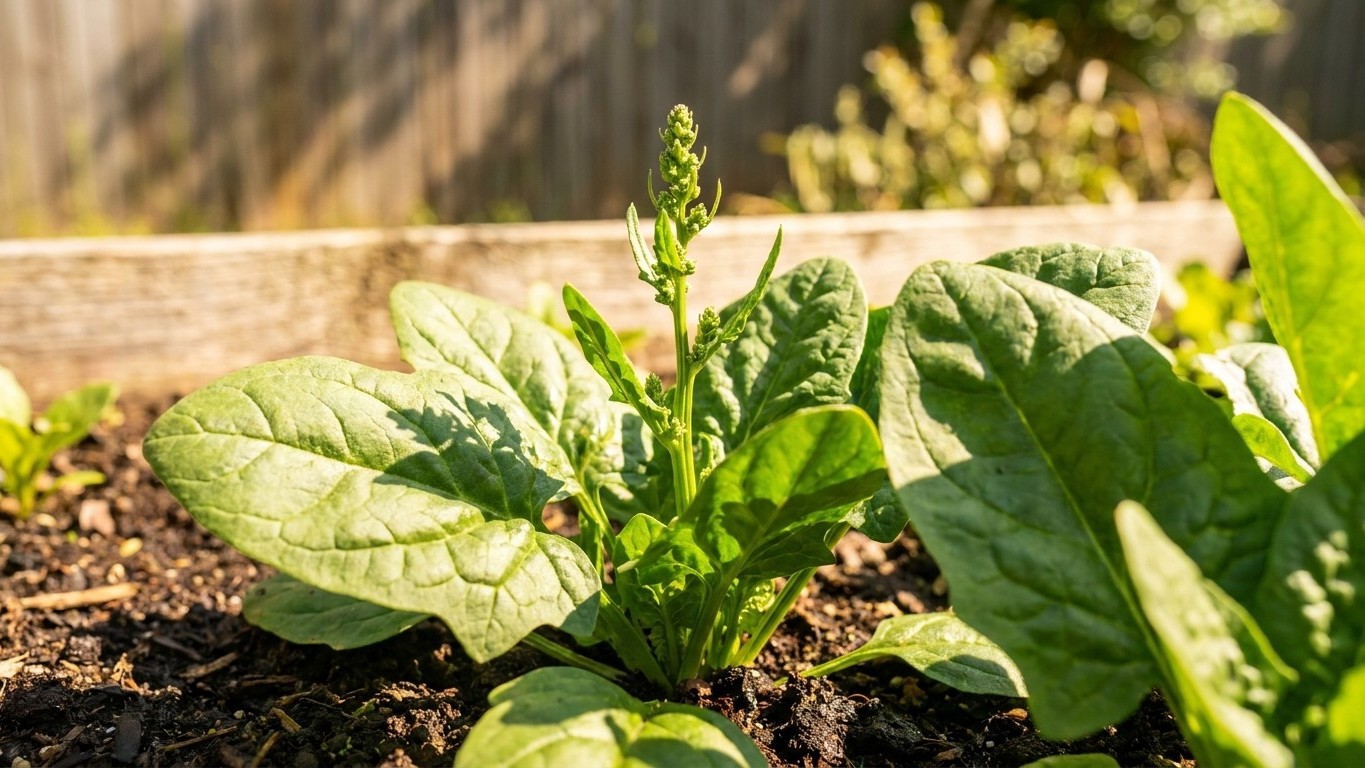

In Newfoundland and Labrador, cut spinach from the cool end of spring until the June days push it to flower, then again in autumn from an August sowing until frost closes the season. Light is the limit here, not heat. Once cut, the leaves are a two-week crop at best, and only when held near freezing. For the wider picture, start with Growing Spinach in Newfoundland and Labrador.
The short answer
On the longest day of the year, St. John’s gets 15 h 47 of daylight. That figure is calculated from the latitude of the St. John’s A climate station using the geometric horizon, so the roughly seven extra minutes that atmospheric refraction adds are not counted. It is a long day by any standard, and for spinach it is the number that matters most.
Spinach flowers in response to long days as well as warm temperatures, and Utah State University Extension says it grows best where temperatures stay at or below 75 F (about 24 °C). Flowering turns the leaves bitter and ends the harvest. The surprise is that long days alone are enough to trigger it. A cool, foggy summer does not buy extra weeks, because the plant is reading the sky, not the thermometer. So the limit here is day length first. Heat is the softer, second limit.
Heat is soft because the extreme end barely exists at the reference station. St. John’s A recorded 0.0 days a year reaching 32 °C across the thirty years of normals, and only 0.16 days a year above 30 °C. That is one airport, not the whole province, and it says nothing about the 75 F line, which a sunny afternoon can cross. But a scorching spell is not what ends spinach in this part of the world. The long June days do that, whatever the weather is doing. If you have ever wondered why a cool summer still produced flower stalks, this is the reason. The mechanics are covered in Will Spinach Bolt Early in Newfoundland and Labrador?
In practice, cut early and cut often. Take outer leaves while they are tender and leave the center growing. When the center starts to rise into a stalk, cut the whole plant, because the leaves will not improve from there.
Storage is where expectations go wrong. UC Davis Postharvest says the optimum is 0°C (32°F) at 95 to 98 percent relative humidity, and that spinach “is highly perishable and will not maintain good quality for more than 2 weeks.” Wilting, yellowing and decay increase beyond 10 to 14 days, and faster at 5 to 10°C (41 to 50°F), which is about what a home fridge door actually holds. Treat two weeks as a ceiling, not a plan. The coldest spot in most refrigerators is the back of the bottom shelf, so put a closed container of leaves there, not in the door.
How long the spring window really is
The standard advice is to sow two to three weeks before the last spring frost. The reference figure here is the St. John’s A normal: the last spring frost falls on average on May 30. That is a midpoint, not a safe date. In one year out of two the last frost comes later, and northern or upland districts, Labrador included, run weeks behind the airport. Working from that midpoint:
- Find the anchor. The mean last frost is May 30 at St. John’s A. Treat it as the middle of a window, and shift later if your garden sits inland, high or far north.
- Count back two to three weeks. That puts the sowing window between about May 9 and May 16. Spinach is sown into cold ground on purpose, so these dates are not reckless.
- Check the heat ceiling. Growth stops being good above 75 F (about 24 °C), and that same number is where bitterness begins. With almost no days at 30 °C at the airport, heat rarely cuts this window short, though a warm afternoon will slow the plants.
- Count forward to the longest day. From May 9 to the June solstice is about six weeks. From May 16 it is about five. The solstice is not a deadline, but it is the peak of the pressure, and a crop sown inside that window has to be eaten within it.
- Cut at leaf stage. Harvest young leaves as soon as they are usable. Waiting for big plants in a short window is how a crop ends up bolted instead of eaten.
So the usable spring is roughly five to six weeks, counted from sowing to the longest day, and the plants will not be at full size for all of it. I cannot tighten that further. The source publishes no days to maturity for spinach, and I would not borrow a number from another crop. A late frost shifts every date above, which is a reason to sow in two or three small batches across the window rather than all at once.
Utah State names four varieties: Bloomsdale, Melody, Teton and Olympia. It gives no data about any of them, so there is nothing here to rank. Choose by what your seed packet states, not by a claim this page cannot back up. Pests also arrive with the warmth, and What Eats Spinach in Newfoundland and Labrador, and When covers what to watch for.
The autumn crop, and when the soil lets you sow
Autumn is the better second chance, because the days are shortening and the pressure that ended spring is falling away. Two obstacles shape it, and only one of them is the frost.
Warm soil blocks germination, not cold
Seed germination drops once soil passes 80 F (about 27 °C). That is why the autumn sowing is held back in hot regions: the window opens when the soil cools, not when frost approaches. In Newfoundland and Labrador, air heat of that order is rare at the reference station, so warm soil is unlikely to be what holds you back. I will not give a soil-temperature figure, because none is published for this territory in the sources behind this page. A simple precaution is to sow in the cooler part of the day and keep the seedbed watered and shaded until the seedlings are up.
The frost that ends the season
Utah State’s rule for a fall crop is to plant 50 to 75 days before the date you want to harvest. The first fall frost at St. John’s A falls on average on October 17. Count back 50 days and you land on August 28. Count back 75 and you land on August 3. That gives a sowing window from about August 3 to August 28.
Like the spring date, October 17 is a midpoint. In one year out of two the first frost arrives earlier, and inland or northern gardens see it sooner than the airport does. So the early end of the window is the safer end. A crop sown near August 3 has more room to reach picking size before a hard stop, and one sown on August 28 is betting on a late frost. The same caution applies to the figure itself: it comes from thirty-year normals for one station, and a province is not one climate.
The leaves from this crop keep to the same rule as spring leaves, which is cold, humid and short. Harvest only what you will use in the next week or so, and leave the rest standing in the row, which is a better store than any fridge.
Common questions
Can I rely on a cool Newfoundland summer to delay bolting?
No. Long days alone can trigger flowering, and St. John’s reaches 15 h 47 of daylight on the longest day. Cool weather slows the process but does not cancel it. Sow so the crop is cut before the longest days, or wait for the August sowing.
How long does cut spinach keep in the fridge?
UC Davis Postharvest says it will not hold good quality beyond two weeks, even at 32°F and 95 to 98 percent humidity. At 41 to 50°F, which a fridge door often delivers, it yellows in days. Use it within a week and keep it on the back of the bottom shelf.
When should I sow spinach in spring?
About two to three weeks before the last frost. With a mean last frost of May 30 at St. John’s A, that is roughly May 9 to May 16. Because half of years see frost later than the mean, and colder districts run weeks behind, sow in small batches and adjust for your own garden.
Does the source say which variety to grow?
It names Bloomsdale, Melody, Teton and Olympia and publishes no data on any of them, including bolting behavior or days to maturity. Check the seed packet, and plan around day length first, since no variety changes the length of a June day.