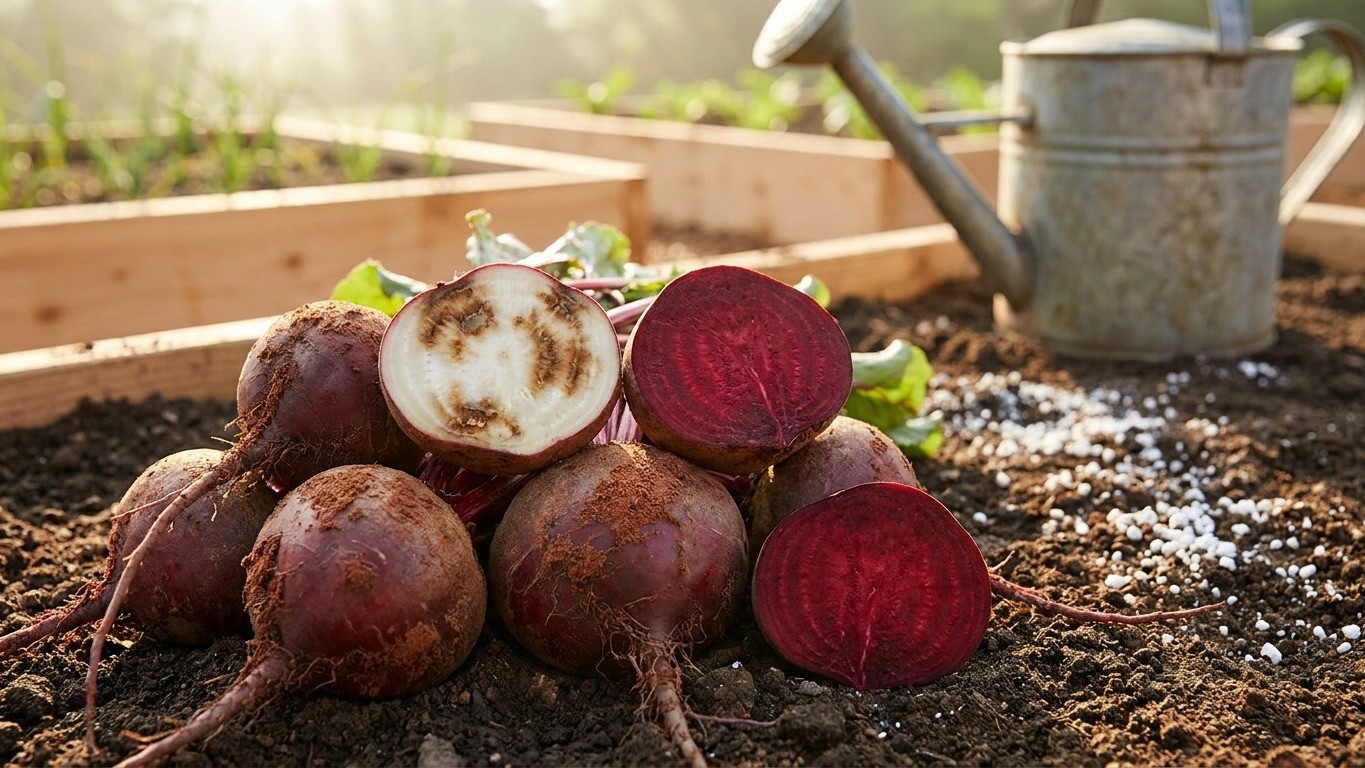

In Newfoundland and Labrador, beets are mostly eaten away by thirst, heat and acid, wet-footed ground, in that order of timing. Dry spells in the first six weeks push plants to bolt. Hot, dry weather later turns roots woody. Strongly acid, imperfectly drained soil sets the stage for both. This page does not carry a list of insect pests. It covers the failures the sources can actually back up.
The short answer
Start with the ground. The most common soil in the mapped agricultural parts of the province is a Podzol, the acid, leached soil that forms under conifers, where rain has washed the bases out of the surface. It covers 59 percent of the mapped surface, with Organic soils next. The median surface horizon (n=459, from the Canadian Soil Information Service at Agriculture and Agri-Food Canada) comes in at 56 percent sand, 9 percent clay and 35 percent silt, with about 3.3 percent organic matter, a pH around 4.3 (strongly acid) and imperfect drainage. Canada has no official provincial soil the way each American state does, so treat this as the dominant profile of the province, not an emblem.
For a beet, that profile is a split verdict. Utah State University Extension, the authority behind this page, says beets want deep, sandy, well-drained soil rich in organic matter. The sand share and the modest clay fit that description. The imperfect drainage does not, because water lingers after heavy rain where a beet wants it to move on. The same source caps amendments at no more than 1 inch of composted organic matter per 100 sq ft, so piling on compost to fix a wet bed is the wrong lever. Raising the bed or loosening it deeper is the better direction. The acidity is a separate question, and the full picture is in Beet Soil in Newfoundland and Labrador: What the Root Will Meet.
Heat is the second half of the answer, and here the page has to be plain about a gap. Utah State puts the danger line at 85 F combined with water stress, which makes the root woody. A count of how many days a year St. John’s passes 90 F is not published here, so no number appears. Woodiness needs heat and dry roots at the same time. A hot day on well-watered ground is a different story from a hot week on a bed that dried out.
One caution before going further. A province spans hundreds of soil series, and this median is a starting point, not a diagnosis. River bottoms, muskeg and any lot a builder has scraped or filled will behave nothing like it. The survey also covers the agricultural regions only, so the far north of Labrador is not represented. The pH of 4.3 is the middle of a pile of measurements, not the number in your own bed. A soil test gives you that.
The six weeks that decide it here
The average last spring frost at the St. John’s A station falls on May 30, according to Environment and Climate Change Canada’s climate normals. That is a mean date, not a safe one. In one year out of two, frost arrives later than May 30. Treat it as the middle of a window, and remember that northern and upland districts run weeks behind the St. John’s airport.
Beets are sown in place, so the clock starts at seeding. Sowing 2 to 3 weeks before the last frost, measured against that mean, points to roughly May 9 to May 16 in the St. John’s area. The first six weeks then run to about June 20 to June 27. Maturity takes 60 to 80 days from seeding, never from a transplant, which puts the first pulling in July or early August for those sowings. The calendar logic for other districts is in When to Sow Beets in Newfoundland and Labrador.
Those six weeks matter because Utah State ties water stress in that stretch to premature flowering. A beet that bolts early has already spent its energy on a flower stalk, and the root never fills out properly. What the spring usually does in that window is not something the sources here measure, so no rainfall figure appears. The island’s coastal springs have a reputation for being cool, damp and slow, and a province is not one climate, so inland and Labrador gardens will differ. Reading the pattern conservatively, the bolting risk does not sit in the average damp spring. It sits in the dry run that interrupts it, a week or two of wind and sun in June on a bed whose seedlings have shallow roots.
Soil type shapes how that dry run plays out. A bed with 35 percent silt and a few percent organic matter holds moisture reasonably, which buys some time. A sandier raised bed, the kind many gardeners build to escape poor drainage, loses water faster and can swing from soggy to parched within days. If you build one, plan to check moisture often during those six weeks. Woodiness comes later, once roots are sizing up and summer heat arrives. It is a different failure on a different schedule, and watering habits that prevent one do not automatically cover the other.
What goes wrong here
- Bolting from early thirst. Water stress in the first six weeks after seeding triggers premature flowering. Remedy: keep the seedbed evenly moist through the window described above, and check raised or sandy beds more often because they dry quickly. A dry week in June counts even if May was soggy.
- Woody roots from later heat. Heat above 85 F with water stress makes the root tough and fibrous. This is a separate failure from bolting. Remedy: water deeply during hot spells once roots are sizing up, and pull roots at a modest size instead of leaving them to stand through a heat run.
- Strongly acid ground. The median surface pH of about 4.3 is a regional tendency, not your reading. Remedy: take a soil test before sowing and follow its recommendation for any correction instead of guessing. Your own bed may sit well away from the median.
- Waterlogged, imperfectly drained beds. Water that lingers works against the deep, well-drained ground beets want. Remedy: build the bed up, loosen it deep, and avoid sites where puddles stand after rain. Muskeg and low pockets are the worst candidates.
- Too much compost. More organic matter feels like a cure for everything, but the guidance is no more than 1 inch of composted organic matter per 100 sq ft. Remedy: measure it out once and stop, especially where the native soil already carries about 3.3 percent organic matter.
- Trusting May 30. One year in two, frost comes after the mean date. Remedy: treat the date as a midpoint, watch your own district’s weather, and keep row cover on hand in case a late frost hits young seedlings.
- Storage rot from over-chilling. This one runs against every other root crop. USDA Agricultural Handbook 66 says more black spot and rot occur at 32 to 34 F than a little warmer, so the target for topped roots is 33 to 36 F at 98% humidity. Remedy: top the beets first, because bunched beets with leaves last only about 10 to 14 days. In a pit or cellar, keep the temperature between 31 F and 41 F. Keep the big roots for storage, since they lose water and shrivel more slowly, and eat the small ones first.
Common questions
Does this page cover insects and animals that eat beets?
No. The sources behind this page cover soil, water, heat and storage, and they hold no pest data for the province. Rather than invent a list, this page leaves that gap open. For the broader growing picture, see Growing Beets in Newfoundland and Labrador.
Is May 30 a safe date to sow or plant out?
No. It is the average last spring frost at the St. John’s A station, so in one year out of two the last frost comes later. Northern and upland districts run weeks behind that station. Beets are sown directly, so the date is a reference point for timing seed, not a guarantee of frost-free nights.
How much compost should I add to a bed?
No more than 1 inch of composted organic matter per 100 sq ft, according to Utah State University Extension. Adding more will not fix poor drainage. The regional median already sits near 3.3 percent organic matter, though your own bed may differ, which is another reason to test before amending.
What is the best way to store beets?
Cut the tops off first, because bunched beets with leaves keep only about 10 to 14 days. Store topped roots at 33 to 36 F and 98% humidity, not at the colder end, where black spot and rot increase. Save the large roots for storage and eat the small ones first, since small roots shrivel faster. If you use a pit or cellar, the source says to keep it from dropping below 31 F or rising above 41 F.