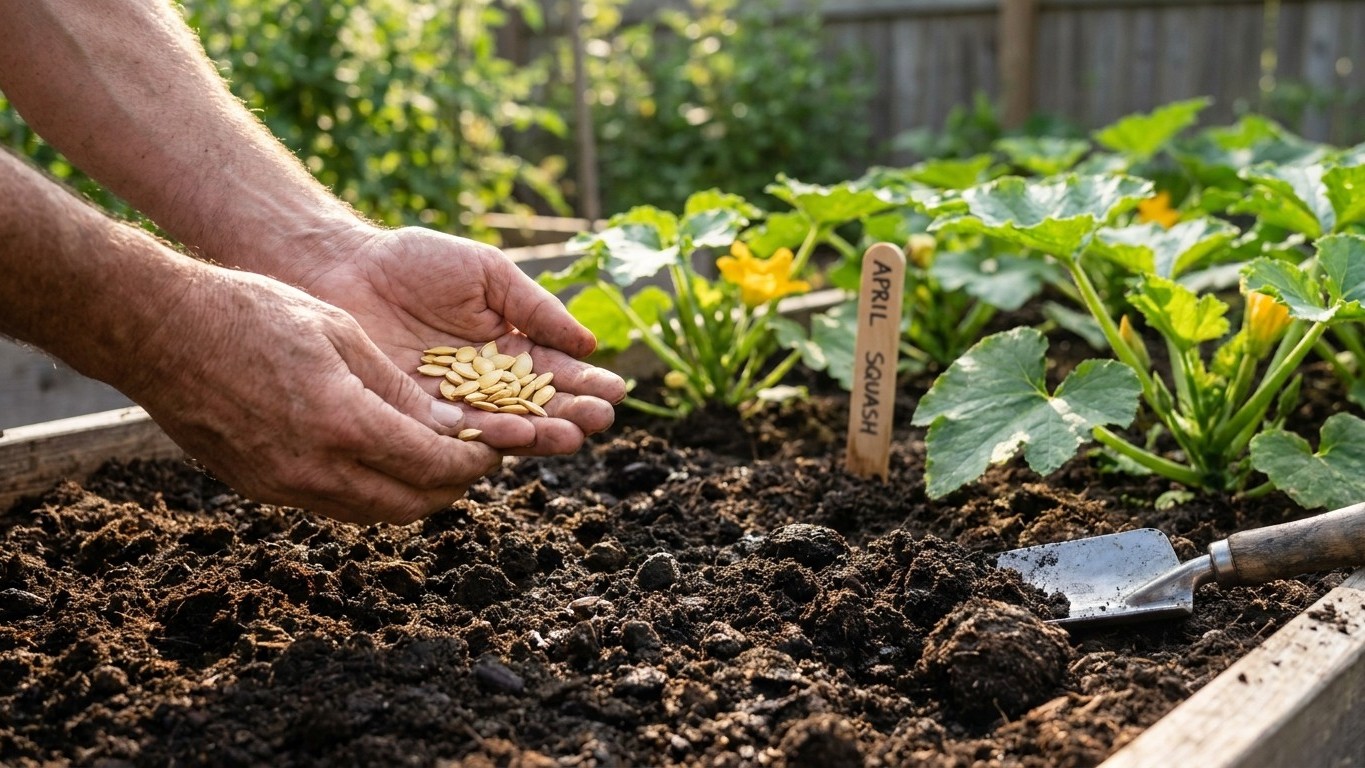

Summer Squash in Newfoundland and Labrador goes into the ground after the average last spring frost of May 30, and it needs to finish well before the average first fall frost of October 17. That’s the outdoor window on paper. In practice, growers here lean hard on transplants and season-extension tricks because the raw frost dates only tell half the story.
The short answer for Newfoundland and Labrador
The sowing window for Summer Squash in this province runs from late May to mid-October, bracketed by two averages from Environment and Climate Change Canada’s St. John’s A station: last spring frost on May 30, first fall frost on October 17. That gap looks like roughly 140 days on a calendar. It is not 140 usable growing days for a warm-season crop like squash, and treating it as such is the single most common mistake made here.
Both dates are means, not guarantees. In one year out of two, frost arrives later than May 30 in spring, or earlier than October 17 in fall, according to the same Climate Normals dataset. That is the nature of a 30-year average: it is the midpoint of a spread, not a safe line you can plant right up against. A gardener who sows squash outdoors on May 31 and calls it done is gambling on the favorable half of that split.
Reading the window correctly
The safer approach used across the island is to start squash indoors three to four weeks before the frost-free date, then move transplants out only once the soil has had time to warm past the frost line, not the instant the calendar flips to June. Direct seeding is possible but riskier here than in warmer provinces, because cold, damp soil slows or rots squash seed before it germinates.
| Marker | Date (St. John’s A, 1981-2010 mean) |
|---|---|
| Last spring frost | May 30 |
| First fall frost | October 17 |
| Calendar span | About 140 days |
Remember too that this station sits in St. John’s. A province is not one climate, and gardens further north or further inland run behind these dates, sometimes by weeks.
What will not work here
Two separate failure modes show up in this province, and they come from different numbers in the same climate record.
The first is heat, or the total absence of it. The mean count of days reaching 90F or higher at the reference station is 0.0. Zero. Summer squash is a warm-season plant that wants heat to push flowering and fruit set along quickly, and a season that never reaches that threshold means growth stays slower than a gardener transplanting from a warmer region would expect. Varieties or techniques built around a hot, fast finish, direct-seeded outdoors with no cover, no black plastic, no cloche, tend to sit sluggish through June and still be catching up when the October frost date closes in. The fix used locally is warming the soil artificially, with plastic mulch or row cover, rather than waiting on sun that this station’s own normals say will not deliver much heat load.
The second failure mode is moisture, and it runs the opposite direction from what gardeners in hotter, drier provinces deal with. Summer rainfall here averages about 11.4 inches across June, July and August, with July, the driest of the three, still bringing 3.61 inches. That is a wet summer by most standards, and it arrives alongside cool, damp coastal air. A watering schedule built for a dry-summer garden, where the worry is thirst, simply does not apply. What fails instead is anything planted too close together: tight spacing that would be fine in a hot, dry climate traps humid air around squash leaves here, and that is exactly the condition powdery mildew and downy mildew need. Wide spacing and good airflow matter more in this province than in a hotter, drier one, precisely because the rain and the cool air are already doing the fungal disease’s work for it.
Put together, a squash planting scheme copied from a hotter province, tight rows, no row cover, watered on a dry-climate schedule, runs into trouble on both ends here: too little heat to finish on time, too much humidity to stay disease-free while it tries.
What changes across Newfoundland and Labrador
The hardiness zone figure available for this province, 6a, comes from Natural Resources Canada’s Plant Hardiness Site and applies specifically to the reference city named in that dataset, not to the province as a whole. That distinction matters more here than almost anywhere else in the country, because Newfoundland and Labrador is not a single climate. The island’s south and east coasts, moderated by the ocean, sit in a different world from the province’s northern reaches and the Labrador interior, where winters run colder and growing seasons run shorter.
The Canadian hardiness system itself is not a simple one-to-one scale. It’s built from seven climate variables rather than the single minimum-temperature figure the USDA system uses, and Natural Resources Canada is explicit that there is no clean conversion between the two systems: a single Canadian zone can overlap several USDA zones at once. That is a separate point from the zone spread within this province, but both add up to the same caution: one zone number, cited for one city, cannot stand in for the whole territory.
A gardener working near St. John’s is working close to the reference conditions behind that 6a figure and the frost dates given above. A gardener further along the coast, at higher elevation, or well north into the Labrador portion of the province, should expect a shorter frost-free window than the St. John’s dates, sometimes meaningfully shorter.
The right move for confirming where a given garden actually falls is Natural Resources Canada’s own hardiness map at planthardiness.gc.ca, which lets a reader check the zone for their own municipality rather than relying on a single reference city.
Where to check this for your own county
Newfoundland and Labrador’s provincial government runs the agricultural extension resource that matters for this kind of question, through the Department of Fisheries, Forestry and Agriculture. That is the address to check next for a planting calendar built for a specific region of the province, and a list of squash varieties actually trialled under local conditions.
What to look for there specifically is any regional variation on the frost-date window described above, since the department works with growers across coastal, interior and northern parts of the province, not just the St. John’s reference station. A regional recommendation, built from local trial plots and local frost records, will always outrank a provincial average drawn from one weather station. The provincial picture is a starting point; the extension service adjusts it down to a specific bay, valley or growing district.
It’s also worth checking whether the extension service publishes any current guidance on season-extension methods for warm-season vegetables, since the zero-days-above-90F figure discussed earlier means techniques like black plastic mulch, cold frames or row covers show up more often in local extension advice here than they would in a hotter province’s equivalent material. That kind of practical, locally-tested detail is exactly what a state or provincial extension service exists to provide, and exactly what a general climate-normals page cannot substitute for.
If you follow the almanac, here is when to plant zucchini by the moon. It is a tradition, not a proven method.
Checking this against your own garden
Every date given here is an average pulled from one weather station. A gardener’s own plot will confirm or contradict it faster than any calendar can, and three signs are worth tracking through the season.
- Soil warmth by feel. Squash seed sits and sulks, or rots, in soil that still feels cold and damp to the touch, whatever the calendar says. Soil that feels warm and dry a couple of inches down is the real green light, and in a province averaging zero days above 90F, that warmth often lags well behind the May 30 average frost date.
- The first flush of male flowers. Squash plants typically produce male flowers before the female flowers that actually set fruit. An early, strong flush of male blooms signals the plant has settled into steady growth; a delayed or sparse one suggests the local microclimate is running cooler or slower than the provincial average.
- The first true leaves. The timing between germination and the first set of true leaves, as opposed to the initial seed leaves, is a rough read on how much heat and light the plant is actually getting on that specific site, which can differ noticeably from a nearby garden a few hundred feet away, let alone from the St. John’s reference station.
None of these require any equipment beyond a hand and an eye, and together they tell a gardener more about their own particular patch of ground than any provincial average ever will.