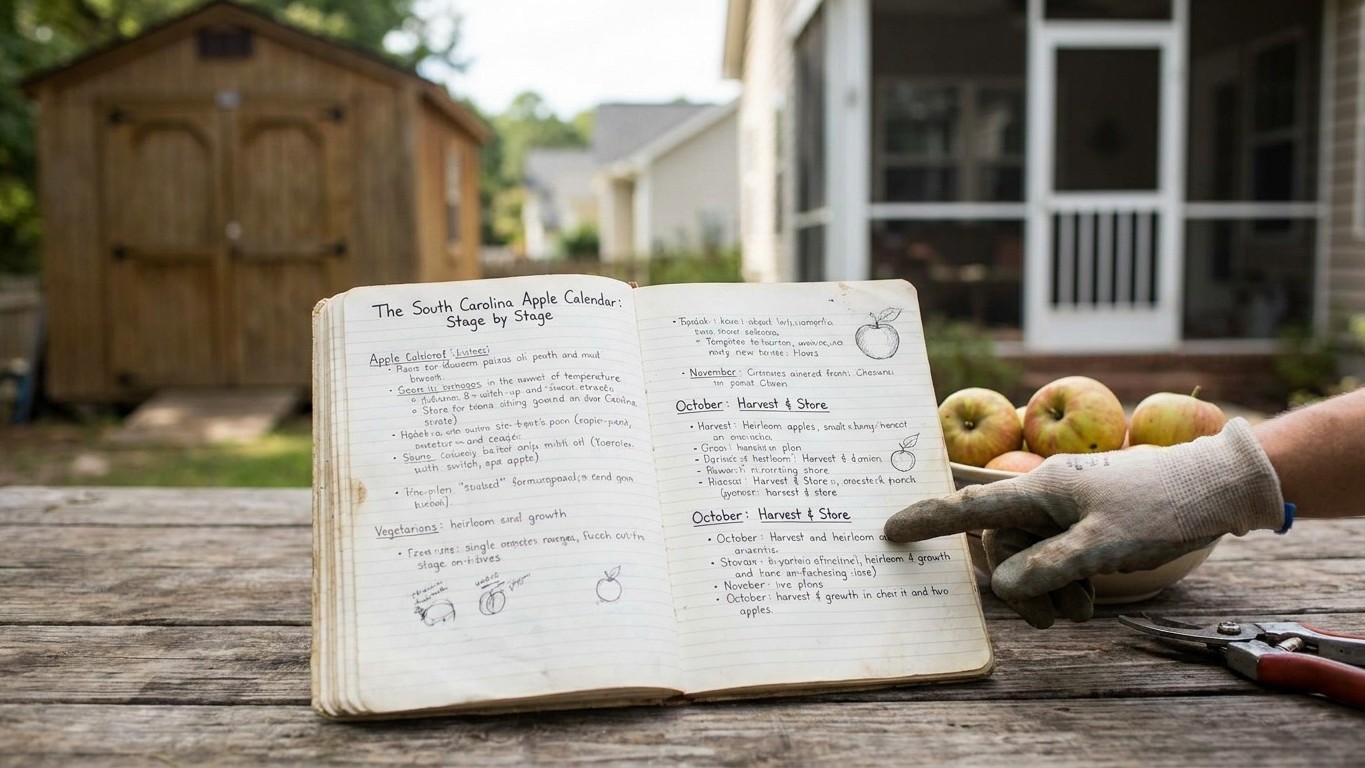

South Carolina’s apple calendar runs on frost, not the date on a wall calendar. NOAA’s NCEI 1991-2020 climate normals put the Charleston-area last spring freeze at February 28 to March 17 and the first fall freeze at November 20 to December 5, with the Upstate running several weeks tighter at both ends. Charleston’s winters are mild enough that most classic apple cultivars never bank the cold hours they need to flower well. Check your tree’s actual stage against your own county’s frost window before you plan a spray or a harvest date off this one.
The short answer for South Carolina
Hardiness versus chill
Apple trees in South Carolina don’t run on a wall calendar — they run on frost, chill hours, and whatever stage the buds are in right this minute. Near Charleston, winters rarely stay cold long enough to satisfy a mid- or high-chill variety, so bloom can come late, thin, or uneven, and that same mild spring still carries a real freeze risk clear into mid-March. Go look at your buds today — dormant, green-tip, or already swelling pink — because that single check, weighed against your county’s last freeze date, is what tells you whether to prune, spray, or cover the tree tonight.
What the answer depends on
Near Charleston, a winter that barely dips below the high 30s on an average night does not deliver the several hundred hours of chill a mid-chill or high-chill apple cultivar expects. A tree that never fully satisfies its chill requirement blooms late, unevenly, or thin, and some buds may not open at all that season. That is why the practical answer starts with the cultivar list before it starts with a date. Growers near the coast do better working from The Best Apple Varieties for South Carolina and picking backward to a bloom date, rather than choosing a favorite cultivar first and hoping the winter delivers enough cold for it.
Once the cultivar is settled, the calendar itself follows the same frost windows NOAA publishes for the Charleston-area station: a last spring freeze clearing sometime February 28 to March 17, and a first fall freeze arriving November 20 to December 5. Everything downstream, from when to prune to when to worry about a late blossom freeze, reads off where the tree sits in its own developmental stage relative to that window, not off a fixed date on the wall. If you have not yet chosen a site or a rootstock, Growing Apples in South Carolina covers the groundwork this calendar assumes is already done.
Working through it

An apple tree does not read a calendar. It moves through the same seven stages every year, and the pace of that sequence is set by accumulated heat and by how much chill it banked over winter, not by a date on the kitchen wall. The stage the tree is actually in, checked against the Charleston-area frost windows NOAA publishes, decides whether you spray, protect, or just wait.
Dormancy

The tree sits bare and leafless from late fall through midwinter. This is when you prune, since cuts made on a dormant tree heal without inviting disease, and it is also when the tree is quietly banking the chill hours it needs to flower well later. Nothing here is time-sensitive to the day, only to the season.
Green tip

The first sliver of green leaf tissue shows at the tip of the bud. This can arrive well before the Charleston-area last freeze window closes, so it is not a signal to relax on cold protection. It is a signal to finish any remaining pruning and get a dormant oil spray on before growth advances, since the tree is easiest to treat while there is still almost no foliage in the way.
Pink

The buds swell and show pink, unopened blossom clusters. This is usually the last easy window to thin overcrowded spurs by hand and to get ahead of early insect pressure, because once the blossoms open, the tree is drawing pollinators and every spray choice has to account for bees.
Bloom

White to pale pink flowers open fully. This is the stage that matters most against the frost window: if bloom lands before the last freeze clears, an open blossom can be killed outright by a freeze that would do a dormant bud no harm at all. NOAA’s normals put that Charleston-area clearing at February 28 to March 17, with the Upstate closing out several weeks later still. A cultivar that blooms early for its type is gambling against that window every single spring.
Petal fall

Petals brown and drop, and the small green ovary at the base of each flower starts to swell. This is the point to judge how well pollination actually went. A poor petal fall, with few ovaries swelling, usually traces back to either a late freeze during bloom or a chill shortfall that left flowering thin to begin with.
Fruit set

Marble-sized green fruit cluster on the spur. A second, natural fruit drop often happens right around this stage as the tree sheds what it cannot support, and it is a reasonable point to thin what remains by hand for size, since everything left on the spur after this is fruit the tree has committed to carrying to harvest.
Harvest
Fruit reaches full size and full color for its cultivar. Timing here is set by the cultivar’s own maturity window more than by the calendar, but it needs a comfortable margin before the first fall freeze, since NOAA’s normals put that arriving November 20 to December 5 in the Charleston area, and noticeably sooner inland and upstate.
What changes across South Carolina
The coastal plain
The frost figures above come from the Charleston-area NOAA station, and they describe the coastal plain, not the whole state. Peninsular Charleston itself runs even milder than that airport station, buffered by the harbor and the ocean, so a backyard tree right downtown can push bloom earlier than the regional normals suggest, and it can also come up short on chill more often.
The Upstate and Midlands
Move inland toward the Midlands and up into the Upstate foothills near the Blue Ridge, and the numbers stop being the mild coastal figures and start closing in from both ends. NOAA’s own caution on this dataset is that Upstate South Carolina runs several weeks tighter at both ends of the frost window, meaning winter arrives sooner in fall and lingers later in spring the farther you get from the coast and the higher the elevation climbs. That tighter window cuts both ways for apples. It is worse news for an early-blooming cultivar, because the last freeze clears later there. It is better news for chill accumulation, because a colder Upstate winter delivers the several hundred hours a mid-chill or high-chill cultivar actually needs.
This is why a single statewide planting date has never made sense for apples in South Carolina. A grower on the coastal plain is playing a chill-shortage game and should lean on the lowest-chill cultivars on the market. A grower in the Upstate foothills is playing a frost-timing game instead, with a colder winter that satisfies chill easily but pushes the safe bloom date later into a spring freeze window that closes weeks after Charleston’s does. Neither region’s problem is solved by the other region’s cultivar list.
The mistakes this climate punishes
Three mistakes account for most of the disappointing apple crops reported in this state, and all three trace back to matching the wrong stage to the wrong window.
- Planting a high-chill cultivar on the coastal plain. A cultivar bred for a genuinely cold winter may never satisfy its chill requirement where NOAA’s normals put the coldest month’s average low at 37.5°F. The result shows up every spring as thin, uneven bloom and a light, patchy fruit set, not as a dead tree, which is what makes the mistake easy to miss until the third or fourth disappointing harvest.
- Planting an early-blooming cultivar where the last freeze runs late. Near the Charleston-area station, NOAA’s normals put the last spring freeze anywhere from February 28 to March 17, and the Upstate closes out several weeks later still. A cultivar that blooms at the early edge of its type is exposed to a freeze that a later-blooming cultivar on the same site would have avoided entirely. This shows up as a strong bloom followed by almost no fruit, because the blossom froze after it opened.
- Feeding or pruning late enough to push soft new growth into fall. Nitrogen applied in late summer, or a heavy prune that forces new shoots, produces tender growth that has not hardened off by the time the first fall freeze arrives. In the Charleston area that freeze lands November 20 to December 5 under NOAA’s normals, and inland counties see it sooner. Soft wood caught by that freeze dies back, and the damage often is not obvious until the following spring’s growth flush shows dead tips where live wood should be.
All three mistakes share the same fix: read the tree’s stage against its own site’s frost window, named by county where you can get it, rather than against a date that worked for someone else’s orchard two counties over.
Checking this against your county
The frost windows and temperature figures in this article are anchored to the Charleston-area NOAA station, and every county inland or upstate of it will read differently, sometimes by several weeks in either direction. Clemson Extension is the land-grant service covering South Carolina and keeps county-level guidance on planting windows, spray timing, and fruit tree performance. Before you lock in a bloom date or a spray schedule to a specific week, check it against your own county’s figures through Clemson Extension rather than assuming the coastal numbers above apply directly to your yard.
Common questions
Can I grow apples in Charleston, or is it too warm for them?
You can, but only with a cultivar bred for a low chill requirement, since Charleston’s average winter is mild enough that most classic cultivars never accumulate enough cold to flower properly. Catalogue-listed low-chill apples such as ‘Anna’, ‘Dorsett Golden’ and ‘Ein Shemer’ carry published chill requirements roughly in the 100 to 300 hour range, well under what a cultivar like ‘Fuji’ or ‘Granny Smith’ expects, and that gap is what lets an apple tree flower reliably on the coastal plain.
How many chill hours does my county actually get?
No figure in this article covers chill hours by county. NOAA’s normals dataset used here reports freeze dates and temperature averages, not chill-hour accumulation. Clemson Extension is the office to ask for that number for your specific county, and it is worth checking before you buy a cultivar based only on a chill requirement printed on a nursery tag.
My apple tree bloomed and then we had a freeze. Is the crop gone?
Not necessarily. A freeze during full bloom is far more damaging than one hitting tight pink buds or a tree already past petal fall, since the open flower is the most cold-sensitive stage in the whole sequence. Check a few days later for browned, dead centers in the flowers versus flowers that still show a green, living ovary at the base. A partial kill still leaves you a partial crop.
Do I need to plant two different apple trees for pollination?
Most apple cultivars need pollen from a different cultivar to set fruit well, since very few are reliably self-fruitful. A second cultivar that overlaps in bloom timing, or a crabapple growing within normal bee range, usually solves it. This is worth settling at planting time rather than after a tree has bloomed alone for several years with nothing to show for it.