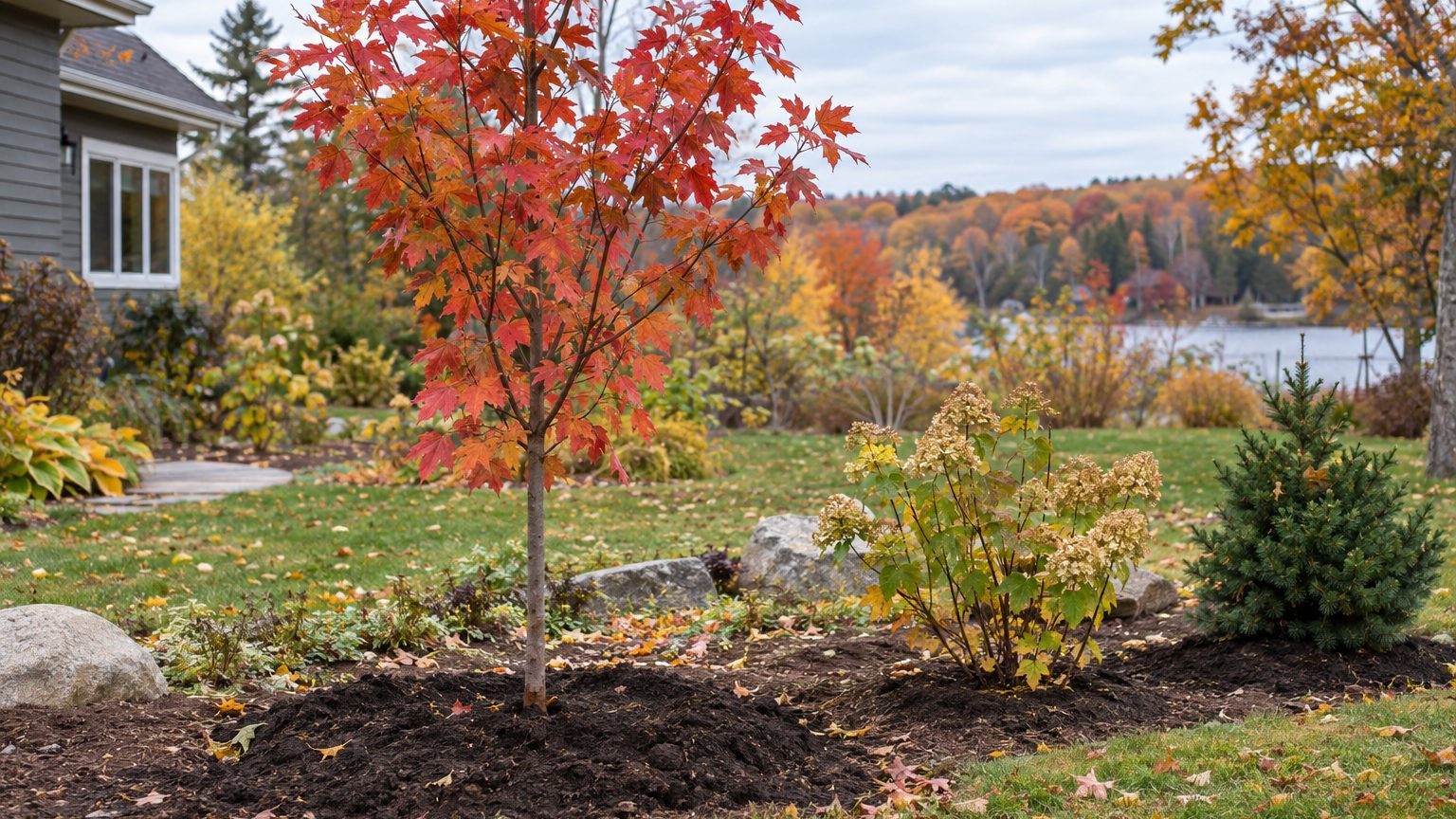

The safe target for fall planting in North Dakota is August 14 to August 24, which is six weeks before the first fall frost of September 25 to October 5 at the Fargo airport station. Later planting is not forbidden. Hardy container and balled trees and shrubs often settle in after that window, as long as the soil is still workable. But each week past the target trades root time for risk, and evergreens and borderline plants pay the highest price.
The deadline in North Dakota
Roots do not follow the air thermometer. They keep growing as long as the soil is workable and above freezing, which stays true well after the first frost has blackened the tomato vines. Cornell Cooperative Extension frames the rule around the soil, not the sky: “Fall is an excellent time for transplanting, provided you get them to their new home at least 6 weeks before the ground freezes, allowing them time to establish roots before winter dormancy.”
Nobody knows in August which day the ground will lock up, but the frost record is public. NOAA’s NCEI U.S. Climate Normals for 1991-2020, using the 30-70% probability band for 32°F freezes, put the first fall frost at the Fargo airport station between September 25 and October 5 (NOAA NCEI data). Count six weeks back from that range and you get a conservative planting deadline: August 14 to August 24. Write that range on the calendar, and treat it as the safe target rather than the last possible day.
Why the true limit falls later
Soil holds summer heat far longer than air does. A couple of 28°F nights will end the flower garden, yet the ground a few inches down is still taking in moisture and letting roots push outward. The real cutoff is the day the ground freezes, and that falls after the first frost. Planting between the safe date and freeze-up is a gamble with decent odds for hardy plants and poor odds for fussy ones.
North Dakota is not a place where this rule can be waved off. NOAA NCEI’s 1991-2020 Climate Normals give a mean daily minimum of 0.2°F for the coldest month at Fargo, so the ground freezes hard every winter and the deadline applies in full. The clock is a real one here, and it runs shorter than most gardeners expect.
Your garden is not the airport
Those frost dates describe one weather station. Suburban and rural gardens typically see the first fall frost one to two weeks earlier than the airport, and higher ground sees it earlier still. The colder north of the state reaches frost and freeze-up sooner than the Red River Valley, so fall tasks, planting deadlines included, move earlier as you go north. Check your own county’s numbers in First and Last Frost Dates in North Dakota before you commit to a date.
Hardiness zones add a second layer. The USDA Plant Hardiness Zone Map 2023, built on 1991-2020 normals, places North Dakota in zones 3a-4b. That is a statewide range, which is why the dated advice here is anchored to Fargo and why a garden elsewhere in the state may sit at a different point on it. Calendars also do not travel well across state lines: How Late Can You Plant Trees and Shrubs in Fall in Washington? runs on an entirely different clock.
What to plant late, and what to wait on
Cold tolerance comes before timing. A plant that cannot take a North Dakota January will not be saved by a perfect planting date. The figure that decides survival is the mean daily minimum of the coldest month, 0.2°F at Fargo according to NOAA NCEI’s 1991-2020 normals. That is an average night, not the record low, so the worst nights run colder. The USDA zone system uses a different variable, the average annual extreme minimum, but both point the same direction: choose plants rated for your zone, and in the colder north favor the tougher end of the list.
Safe bets for late planting
Container-grown and balled-and-burlapped trees and shrubs that are fully hardy here are the best candidates for planting near or past the deadline. Their roots arrive with soil attached, so the transplant shock is smaller. Deciduous plants have an extra advantage once the leaves drop, because they stop spending water through foliage and can put their energy into roots while the soil is still cool but workable.
Plants that should wait for spring
Evergreens are the trouble. Spruce, pine, juniper and broadleaf evergreens keep their needles or leaves all winter and keep losing water through them, while frozen soil blocks any resupply. A late-planted evergreen has thin new roots and a full canopy to keep hydrated, and that mismatch is how brown, dead-looking trees show up in March. Plants rated only marginally hardy for your area face a similar problem: they may survive winters once established, but a first winter on a small root system is the hardest test they will ever get. If a plant is borderline for your zone, hold it until spring.
| Plant type | Late fall planting | What decides it |
|---|---|---|
| Hardy deciduous trees and shrubs, container or balled | Good bet, best by the safe window, workable after | Roots keep growing in cool, unfrozen soil |
| Evergreens, including conifers | Earlier is better; late planting is risky | Foliage loses water all winter |
| Plants at the edge of your zone | Wait for spring | One hard winter on a thin root system |
| Bare-root stock | Spring | Exposed roots dry out quickly |
Technique matters as much as timing. A hole that is too deep or a root ball left circling in its container will undercut a perfect date. Planting and Caring for Trees, Shrubs and Perennials covers the digging, depth and aftercare that carry a plant through its first season.
Watering and mulch until the ground freezes
Water deeply until freeze-up
A newly planted tree lives in a small pocket of loosened soil, and that pocket dries faster than the ground around it. Fall in the northern Plains is often dry and windy, so rain alone rarely keeps up. Soak slowly enough that water sinks past the root ball instead of running off, then let the top layer dry a little before the next round. Keep watering until the ground freezes, not until the leaves fall. Evergreens in particular should go into freeze-up with moist soil, because they will not get another drink until spring thaw.
The first winter is about roots, not growth. A tree dug at the nursery left much of its root system behind, and its main job for the next season is rebuilding that network. Top growth is secondary. That is why heavy pruning, fertilizer and fussing over a few brown leaf tips do little good, while steady moisture and a stable root zone do plenty. The plant that makes strong roots in its first fall and spring is the one that grows well in year two.
Mulch in a ring, not a volcano
Mulch evens out soil temperature and slows moisture loss, which is exactly what a young root system needs as the ground cycles toward freezing. NC State Extension’s Gardener Handbook gives two sentences on depth that land in the same range. On weeds: “A 2-inch to 3-inch layer of mulch suppresses most annual weed seeds and makes it easy to hand-pull any that do germinate.” On trees: “Provide a 3-inch layer of mulch to reduce water loss and maintain uniform soil moisture and temperature around roots.” That source is from North Carolina, but mulch physics do not change at the state line.
Stay inside that range. More is not better, and deep mulch piled against a trunk is how a ring turns into a volcano that holds moisture against the bark, invites rot and gives rodents a place to hide. Spread the mulch wide, keep it thin enough to stay within those depths, and pull it back so the base of the trunk stays visible and dry. More detail on avoiding the common errors is in Mulching Without Killing the Plant.
What goes wrong
Planting too late, and winter burn
The first failure is simply timing. A tree planted when the soil is nearly frozen has no days left to grow anchor roots, so it enters winter held in place by the hole rather than by its own roots. In a climate with a coldest-month mean daily minimum of 0.2°F (NOAA NCEI, Fargo), that is a poor setup. Frozen ground also cannot absorb water, which compounds the next problem.
Winter burn shows up on evergreens as brown, scorched needles in late winter or early spring. Sun and wind pull water out of the foliage while the roots, locked in frozen soil, cannot replace it. Open North Dakota landscapes, with long stretches of unbroken wind, make this worse. A burlap screen on the windward side and a deep watering before freeze-up reduce the damage, but neither fully rescues an evergreen planted too late.
Heaving and drying out
Shallow root balls are vulnerable to frost heave. Repeated freezing and thawing of the soil pushes a small root ball upward a little at a time, until roots are exposed to dry air. Planting at the right depth and keeping a steady mulch ring both help, and so does a quick check in late winter and spring: if a young tree has lifted, press the soil back firmly around it. A dry fall brings the opposite problem, soil so parched that new roots stop growing and the plant enters winter dehydrated.
One decision prevents a lot of grief. If the ground is already frozen when the plant arrives, hold the planting until spring. A hole chiseled out of frozen soil leaves air pockets and poor contact around the roots. For local timing that matches your part of the state, the North Dakota guides are the next stop.
Common questions
Can I still plant a tree in October in North Dakota?
Sometimes. The first fall frost normally arrives September 25 to October 5 at the Fargo airport station, and the soil usually stays workable for a while after that. A fully hardy container or balled deciduous tree has a fair chance if the ground is not frozen, and it will need steady watering and a mulch ring. Evergreens and borderline plants are better left until spring.
Does the ground freeze right after the first frost?
No. The first frost is an air temperature of 32°F, and soil lags behind because it holds heat. The ground freezes later, which is why Cornell’s rule counts back from freezing ground rather than from frost. In North Dakota it does freeze, since the coldest-month mean daily minimum is 0.2°F at Fargo (NOAA NCEI, 1991-2020).
Is the six-week rule too cautious for North Dakota?
It is deliberately conservative here. The Cornell Cooperative Extension rule from Orleans County, New York, counts six weeks before the ground freezes. The deadline of August 14 to August 24 counts six weeks before the first fall frost, which comes earlier than freeze-up. Planting after the safe date is not an automatic failure, but you are using up your margin.
When is spring planting the better call?
Spring is better for evergreens that missed the safe window, for plants rated only borderline for your zone, and for bare-root stock. The colder north of the state thaws later, so its spring planting also shifts later. Rural and suburban sites that see frost one to two weeks sooner than the airport figure should move the fall target earlier by the same amount.