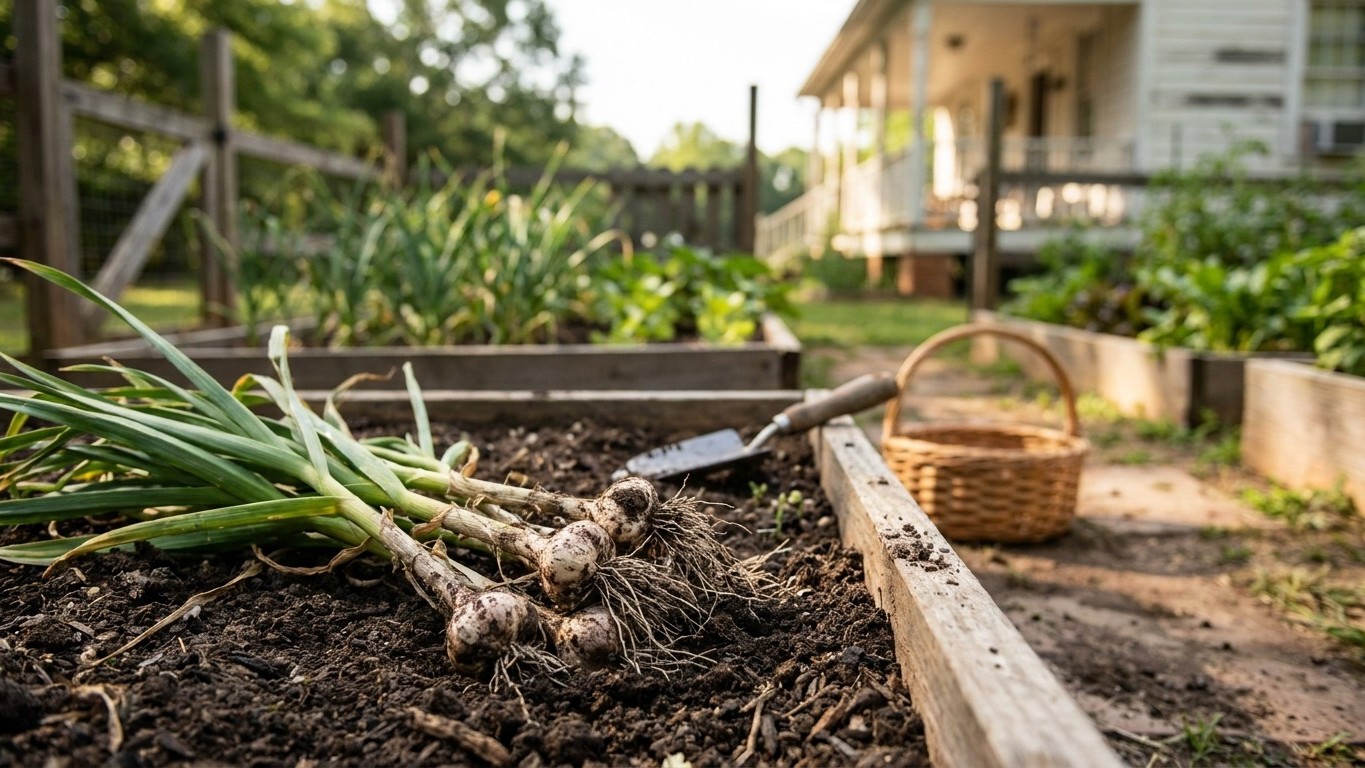

In North Dakota, garlic goes into the ground in autumn, sits under snow all winter, and comes up the following summer, usually in July, once the lower third to half of its leaves have turned brown while the top stays green. Pull a test bulb before committing to the whole row. Cure it for two to three weeks in a shaded, airy spot, then store it cool and dry through winter, ideally between 32°F and 50°F.
When garlic is ready to lift in North Dakota
Garlic planted here follows a fall-to-summer cycle that trips up a lot of first-time growers who expect a spring-planted, same-season crop. Cloves go into the soil in autumn, well ahead of the ground freezing solid, and then they overwinter as dormant roots before pushing up green shoots once the soil warms again in spring. The bulb itself doesn’t form and mature until the following summer, which means the harvest you’re planning for right now was actually planted nearly a year earlier.
That fall planting window matters because it’s tied to frost timing. At the reference weather station tracked by NOAA, the first fall freeze typically lands somewhere between September 25 and October 5. That’s a midpoint, not a guarantee. In roughly half of all years, the freeze arrives later than that window, sometimes by a week or two, and gardens away from the airport station, especially in low-lying or rural spots, tend to see frost even earlier than the reference date suggests. Check your own county’s history rather than treating this as a fixed calendar mark.
Reading the plant instead of the calendar
Once summer rolls around, the real signal isn’t a date on a calendar, it’s the foliage. Garlic tells you it’s close to ready when the lower leaves start yellowing and drying out while the upper leaves are still green and upright. Each leaf roughly corresponds to a wrapper layer around the bulb, so a plant that’s lost too many leaves too early has thinner protective skins, and one you leave too long can start splitting its wrapper or resprouting inside the bulb.
The safest approach is a test dig. Pick one plant when about 40 to 50 percent of the leaves have browned, lift it carefully with a garden fork rather than pulling by the stalk, and check the bulb. You’re looking for well-defined, plump cloves with intact skins. If the cloves look small or the skins are thin and papery-loose, give the rest of the row another few days before pulling everything.
Curing it, and where to hang it here
Curing is the step between harvest and storage, and skipping it or rushing it is probably the single most common reason home-grown garlic goes soft or moldy by midwinter. Freshly pulled bulbs still carry moisture in their necks and outer layers. Curing dries that moisture down slowly, which toughens the wrapper skins and seals the neck, both of which are what let a bulb sit in storage for months without rotting.
Plan on two to three weeks of curing time, longer if the bulbs came out of the ground with thick, wet stalks or if the weather turned humid right after harvest. The goal during that stretch is steady airflow, shade, and moderate warmth, generally somewhere in the 60°F to 80°F range. Direct sun will scorch the outer skins and can actually cook the cloves near the surface, so a covered space always beats a spot in open sun.
Practical curing spots for North Dakota homes
A detached garage with the door cracked, a covered porch, or a shed with a window fan are all workable. Lay bulbs in a single layer on screens or hang them in loose bundles of six to ten, stems intact, roots still attached. Don’t wash the bulbs first. Soil brushed off gently once they’re dry is fine, but wet bulbs cure poorly and are far more prone to mold.
One local wrinkle worth planning around: as curing stretches into late September, boxelder bugs start looking for shelter ahead of the cold. NDSU Extension documents boxelder bug as an established pest in North Dakota, and outbuildings, garages, and sheds are exactly the kind of structures they swarm into once temperatures drop. If your curing space is the same garage that suddenly has boxelder bugs collecting on a sunny wall, that’s a known regional pattern, not a coincidence, and it’s a reason to keep bulbs elevated on screens rather than piled directly against walls or window frames where the bugs tend to cluster.
Storing it through a North Dakota winter
Once the necks are fully dry and papery, trim the stalks to about an inch above the bulb, brush off loose soil, and move garlic into its winter storage spot. The target conditions are cool, dark, and dry, generally 32°F to 50°F with moderate humidity, and steady airflow around the bulbs rather than a sealed plastic bag, which traps moisture and invites mold.
North Dakota winters make some storage spots better than others, and the swing between an insulated basement and an attached but unheated garage can be dramatic once outdoor temperatures fall well below zero for stretches of the season.
| Storage location | Typical winter conditions | Suitability for garlic |
|---|---|---|
| Unheated attached garage | Can swing below 32°F for weeks in deep winter | Risky; freezing can turn cloves mushy on thaw |
| Insulated basement or root cellar | Steady 40°F to 50°F, moderate humidity | Strong choice for long-term storage |
| Interior pantry or closet | 60°F to 70°F, low humidity | Workable short-term but bulbs sprout faster |
| Mesh bag hung in a cool hallway | Varies with home heating patterns | Fine if temperature stays under 60°F |
Mesh bags, breathable baskets, or cardboard boxes with a few holes punched in the sides all work better than airtight containers. Check bulbs every few weeks through winter and pull any that feel soft or show mold before it spreads to neighbors in the same bag. Softneck types generally hold longer in storage than hardneck types, though exact storage life depends heavily on the variety and how well the curing went, and no single number applies across the board.
What goes wrong here
Most garlic failures in North Dakota trace back to one of two things: timing the harvest wrong, or storing it somewhere that swings too cold or too damp. Pulling bulbs too early leaves cloves underdeveloped and prone to shriveling in storage. Waiting too long past full leaf die-back lets the outer wrapper split, which exposes cloves to rot and moisture the moment they hit a storage container.
On the pest side, garlic itself isn’t a heavily targeted crop for the pests documented in this region. North Dakota State University Extension tracks apple maggot, boxelder bug, Colorado potato beetle, corn earworm, emerald ash borer, and yellowheaded spruce sawfly as established pests across the state, but none of these are garlic pests specifically. The practical overlap is limited to boxelder bug’s fall habit of swarming into the same garages and sheds many gardeners use for curing, which is more of a nuisance during the curing window than a threat to the bulbs themselves.
The bigger risk is environmental. A curing space with poor airflow, especially one closed up tight during a stretch of humid late-summer weather, is where mold gets a foothold. On the storage end, an unheated garage that dips well below freezing for days at a stretch during a North Dakota cold snap can turn stored bulbs to mush once they thaw, even if they looked fine going into winter. Checking stored bulbs periodically and moving them if a cold snap is forecast for an exposed storage spot beats finding a bag of ruined garlic in February.
Common questions
When should garlic be planted in North Dakota so it’s ready to harvest the following summer?
Garlic is planted in autumn, generally with enough time for roots to establish before the ground freezes solid. Since the first fall freeze at the reference weather station typically falls between September 25 and October 5, and that date can land later in about half of all years, many growers aim to have cloves in the ground several weeks ahead of that window rather than cutting it close.
How do I know garlic is ready to harvest instead of waiting too long?
Watch the leaves rather than the calendar. When the lower third to half of the leaves have browned while the top leaves are still green, do a test dig on one plant to check bulb size and skin condition before harvesting the full row.
How long does cured garlic last in North Dakota storage?
It depends heavily on variety and how thoroughly the bulbs were cured, and no single figure applies universally. What’s clear is that steady cool temperatures between 32°F and 50°F with moderate humidity extend storage life far more than a warm pantry or a container that traps moisture.
Can I store garlic in an unheated North Dakota garage?
It’s risky during the coldest stretches of winter. Unheated garages here can swing well below freezing for extended periods, and garlic cloves that freeze and thaw repeatedly tend to turn soft and unusable. A basement, root cellar, or interior closet that stays consistently cool is a more reliable choice.