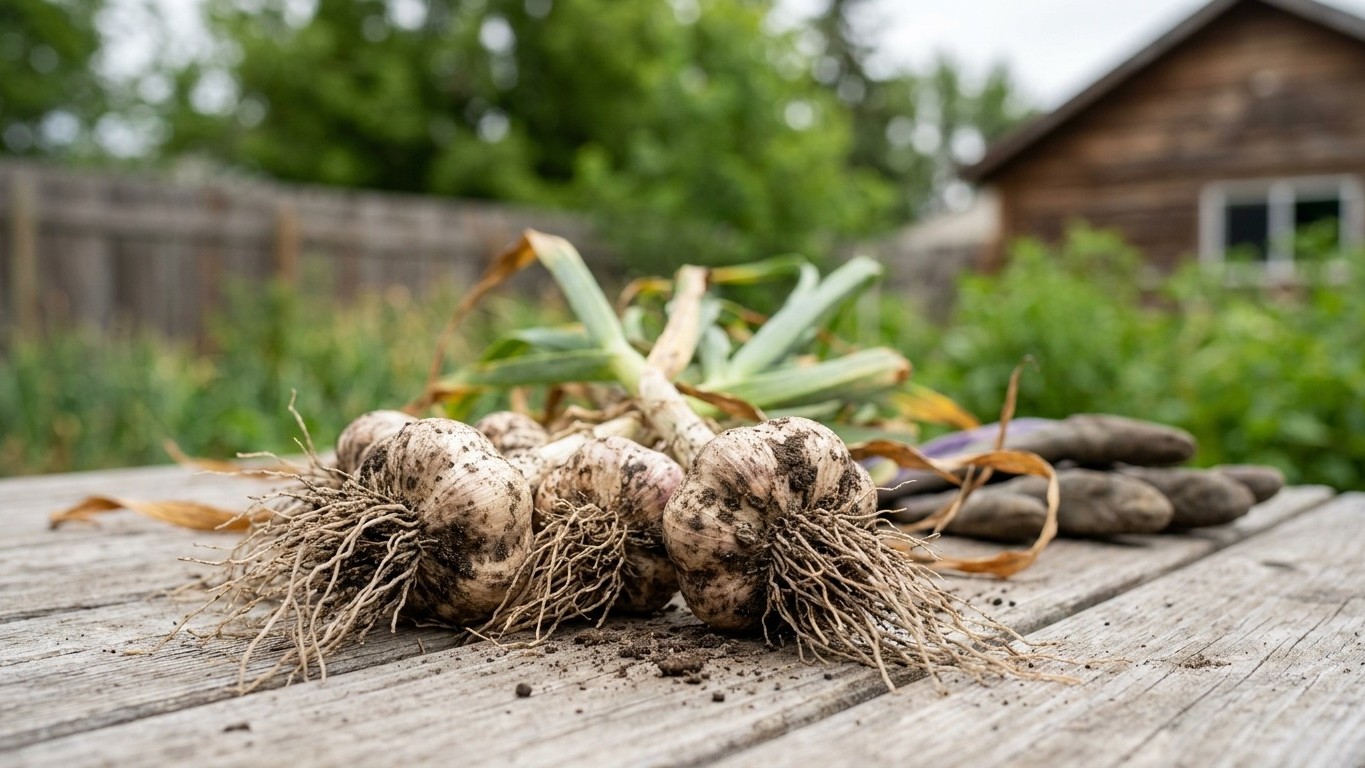

North Dakota’s growing season shuts down hard and early. NOAA’s 1991-2020 climate normals put the first fall freeze at the Fargo airport station between September 25 and October 5, and that cold arrives right on schedule for garlic’s vernalization needs. Set cloves in the ground in early September to mid-September, four to six weeks ahead of that freeze window, so roots take hold before the soil locks up. Check your own county’s frost pattern with the North Dakota State University Extension service before you settle on a date, since Fargo’s numbers do not describe the whole state.
Will garlic get the cold it needs in North Dakota

Garlic clove division depends on a real stretch of cold after planting. Without it, the bulb never splits into cloves. What comes up at harvest is a single round, onion-like bulb instead of a head. University of Georgia Extension publication C854 puts the requirement at six to eight weeks of soil temperatures below 40°F before the plant will bulb properly.
North Dakota clears that bar without much argument. This is a state where winter settles in and stays, and the cold season here runs weeks longer than the minimum that garlic actually needs. That is very different from the situation in Northwest Territories, where the challenge runs the opposite direction, or in a place like coastal California, where growers sometimes have to work to find enough chill at all.
The practical risk in North Dakota is not too little cold, it is too much exposure of a shallow-planted clove before the ground fully closes up. A bulb planted too late, or mulched too thin, can suffer freeze injury or heaving rather than simply getting the vernalization it needs. If for some reason your site runs unusually mild, such as a sheltered urban courtyard bed with heavy mulch and reflected heat from a wall, you have two real fallbacks: refrigerate seed cloves at a consistent 35°F to 40°F for six to eight weeks before planting to force the vernalization artificially, or plant a softneck type, which tolerates a shorter chill period and still forms a usable, if smaller-cloved, bulb. Neither situation describes most North Dakota gardens, but it is worth knowing the workaround exists rather than assuming a failed crop means garlic simply will not grow here. For a closer look at which cultivars perform best under these conditions, see this guide to Garlic Varieties That Suit North Dakota Winters.
When to put the cloves in
Anchor your planting date on the first fall freeze, not on a spot on the calendar. NOAA’s 1991-2020 normals for the Fargo station put that freeze between September 25 and October 5. That is a midpoint range drawn from one weather station, not a guarantee for every yard in the state. For a full breakdown by region, check this guide on When to Plant Garlic in North Dakota. Counting back four to six weeks from that window lands on the last week of August through the first week of September, which is why catalogue guidance for this territory clusters in early September to mid-September for every variety listed below.
The goal of that window is narrow: enough time for roots to establish in the soil before it freezes solid, but not so much time that green top growth pushes up before winter. A clove that roots without much leaf shows the balance you want. One that sends up several inches of green before the ground freezes was planted too early for this climate.
What shifts the date at your own site
- Elevation: higher ground east of the Missouri Coteau or in the Turtle Mountains tends to cool faster in autumn than the Red River Valley floor.
- Proximity to a large lake or reservoir, which moderates the first hard freeze slightly compared with open cropland nearby.
- Soil type: heavy clay holds warmth longer into fall than a sandy or gravelly bed, delaying the point where root growth stalls.
None of these local factors are numbers you can look up statewide. Fargo’s frost window is a reference point, and your own county’s pattern, along with any local frost log kept by nearby growers, is worth more than a single station’s average once you are picking an actual planting week.
Which types suit North Dakota
Hardneck or softneck is not a matter of taste in this climate, it is a matter of which garlic survives the winter you are going to give it. Hardneck garlic wants a genuine cold season to perform well, and North Dakota supplies that in abundance. Softneck garlic tolerates mild winters better and stores far longer in the pantry, but it is the less natural fit for a climate this cold, and it needs heavier winter protection here than it would in a place like California, where the mild winters that suit softneck are the norm rather than an exception.
Hardneck varieties worth planting from the catalogue list, all set out in the same early September to mid-September window calculated above, include Bavarian Purple, Blue Music, Chesnok Red, Duganski, Fall Festival, Georgian Crystal, Georgian Fire, German Red, German White, and Ivan. All of these produce a hard central scape that most growers cut in early summer, and all size up reliably with the vernalization North Dakota’s winter provides.
Softneck types from the same list, including Inchelium Red, Lorz Italian, Early Red Italian, and Italian Late, will grow here, but they need more deliberate winter mulching than hardneck garlic and give up some of their storage advantage if a hard freeze reaches an under-protected clove.
| Variety | Neck type | Scapes | General storage life |
|---|---|---|---|
| Bavarian Purple | Hardneck | Yes, cut in early summer | Shorter than softneck |
| Duganski | Hardneck | Yes | Shorter than softneck |
| German White | Hardneck | Yes | Shorter than softneck |
| Inchelium Red | Softneck | No | Longer, often many months |
| Lorz Italian | Softneck | No | Longer, often many months |
| Italian Late | Softneck | No | Longer, often many months |
Soil and bed preparation
Garlic sits in the same bed for the entire winter, through freeze-thaw cycles and any wet spell that comes with an early snowmelt. Drainage matters more than fertility in the weeks before planting. Standing water rots a clove long before any soil-borne disease gets the chance. If your bed holds water after a heavy rain, build it up into a raised row four to six inches above grade before you plant, rather than trying to fix drainage after the cloves are already in the ground.
Work the bed over a few weeks ahead of the September planting window rather than the day of. Loosen the top eight to ten inches so roots can push down before the ground firms up for winter, and mix in a couple inches of finished compost or well-rotted manure to loosen heavy clay and give the roots something to establish into. A soil test through your local extension office will tell you where your pH and phosphorus actually stand. Garlic does best in a soil that is not extremely acidic, and a test is far more useful than guessing.
Break up any compacted subsoil while you are at it. A clove that roots into a hardpan a few inches down will heave more readily when the soil freezes and thaws through the winter, since the roots have nowhere firm to anchor into. Clear the bed of the previous crop’s debris too. Alliums left to rot in place can carry disease pressure into next year’s planting, and a clean bed going into winter is one less variable to manage once the snow is down.
What the climate here favours, and what it does not
Disease pressure on garlic tracks temperature, and the picture in North Dakota is mixed rather than uniformly good or bad. UC IPM’s Pest Management Guidelines for Onion and Garlic (UC ANR Publication 3453) give published temperature ranges for the major garlic diseases, and running this territory’s growing-season air temperatures against those ranges shows where the risk actually sits.
Two diseases with real overlap
White rot, caused by Sclerotium cepivorum, has a published range of 50°F to 75°F, and this territory’s growing-season mean air temperature falls inside that range in four separate months: September, May, June, and July. Fusarium basal rot, caused by Fusarium oxysporum f. sp. cepae, has a published range of 59°F to 90°F, and the mean falls inside that window in three months: September, June, and July. Both are counted among the more serious garlic diseases going, and the overlap here is not trivial.
Two things temper that count, and you should hold onto both. First, those published thresholds are soil temperatures, and the figures above are air temperatures. Soil lags well behind air, warming and cooling more slowly and swinging less day to day, so a month with a favorable air mean does not mean the soil sat at that temperature the whole time. Second, a monthly mean is an average, not a description of every day in that month. A June averaging in the low 60s still has days well outside that range in both directions.
Two diseases that rarely find their window here
Southern blight, caused by Sclerotium rolfsii, has a published optimum of 86°F to 95°F, and no month of this territory’s growing season reaches a mean air temperature inside that band. Pink root, caused by Setophoma terrestris, has a published optimum of 75°F to 85°F, and the same is true there: no growing-season month lands inside it. Outside its optimum, a disease is less active, not absent, and neither of these should be treated as impossible here. Infected seed stock carries a pathogen into any climate regardless of temperature. But North Dakota’s climate does not favor either one the way it favors white rot or Fusarium basal rot, and that is worth knowing before you assume every garlic disease is an equal threat in this state.
Getting it through the winter
Mulch is what separates a bed that survives a North Dakota winter from one that does not. Lay it down after the ground has begun to cool but before a hard freeze locks the surface, in a loose layer several inches deep of straw, chopped leaves, or clean marsh hay. The point of the mulch is not to keep the clove warm exactly, it is to buffer the freeze-thaw swings at the soil surface that heave a shallow-planted clove up out of the ground over the course of a winter.
A clove planted at real depth, firmed in well, and mulched properly rarely heaves. One planted shallow, or mulched thin, can end up sitting half-exposed by late winter even without any single catastrophic freeze, just from the accumulation of small thaw cycles working it upward. Check the bed after any early winter thaw and press any exposed clove back down and re-cover it. That five-minute check in January is cheaper than replanting the whole row in spring.
Leave the mulch in place through the coldest months. Pull it back gradually as shoots begin pushing up in spring, watching the plants rather than the calendar, since North Dakota’s spring warm-up varies from one year and one part of the state to the next. Pulling mulch too early exposes new green growth to a late cold snap it does not need to face. Leaving it too long can smother shoots or hold excess moisture against the base of the plant, so the middle path, thinned gradually rather than stripped all at once, works best.
Harvest and curing here
Read the plant, not the calendar, to decide when to lift. Garlic is ready when the lower third to half of the leaves have browned and dried while the upper leaves are still mostly green. Pull a test bulb or two and check that the cloves have filled out and the skins have started to set. Waiting for every leaf to die back risks the bulb splitting its wrapper underground, which shortens its storage life considerably.
Curing is where a lot of an otherwise good crop gets lost, and North Dakota’s summer conditions matter here. Move the whole plant, tops and roots intact, to a spot with good airflow and out of direct sun. A shaded porch, an open garage with a fan running, or a shed with the doors cracked all work. Humid stretches slow curing and raise the risk of mold setting in at the neck, so increase airflow rather than heat if a wet spell rolls through during your curing period.
Give the bulbs a full three to four weeks before trimming tops and roots and moving garlic into long-term storage. Cutting corners on curing time is the single most common reason a home-grown garlic crop that survived the winter fine still fails to keep past a couple months in the pantry.
Local help
County-level frost dates, soil test results, and current disease pressure all vary across a state this size, and Fargo’s numbers only describe one corner of it. The North Dakota State University Extension service can provide planting guidance, soil testing, and pest identification specific to your county, and is worth contacting before you finalize a planting date or a variety list for your particular site.
Common questions
Can I Plant Garlic in spring in North Dakota instead of fall?
You can, but expect smaller bulbs. Garlic planted in spring skips most or all of the cold period that triggers clove division, so the harvest tends to come in as smaller, sometimes single-clove bulbs rather than a full head. Fall planting timed to this territory’s frost window gives a much better result.
My garlic sent up tall green shoots before winter. Did I plant too early?
Likely yes. A clove that pushes several inches of leaf before hard freeze was probably planted more than six weeks ahead of the first fall freeze. The top growth itself usually survives a mild winter under mulch, but it is a sign to plant a week or two later next season.
Is it too late to plant if I missed the early September window?
Garlic can still be planted into the window described here as long as the ground remains workable and there is enough time left before the first fall freeze for roots to establish. Past that point, the risk of a clove going into winter without any root system rises, and results get less predictable the later you push it.
Do I need to cut the scapes on hardneck varieties?
Cutting the scape, the curling flower stalk that hardneck garlic sends up in early summer, redirects the plant’s energy into bulb size rather than the scape itself. It is not strictly required, but most growers cut it, and the scapes are edible and worth using rather than discarding.
Can I use garlic from the grocery store as seed stock?
You can, but it is a gamble. Grocery garlic is often treated to slow sprouting, may carry disease, and is rarely labeled by variety, so you cannot match it to the varieties and their known cold requirements discussed above. Seed garlic from a supplier that names the cultivar gives a far more predictable result in this climate.