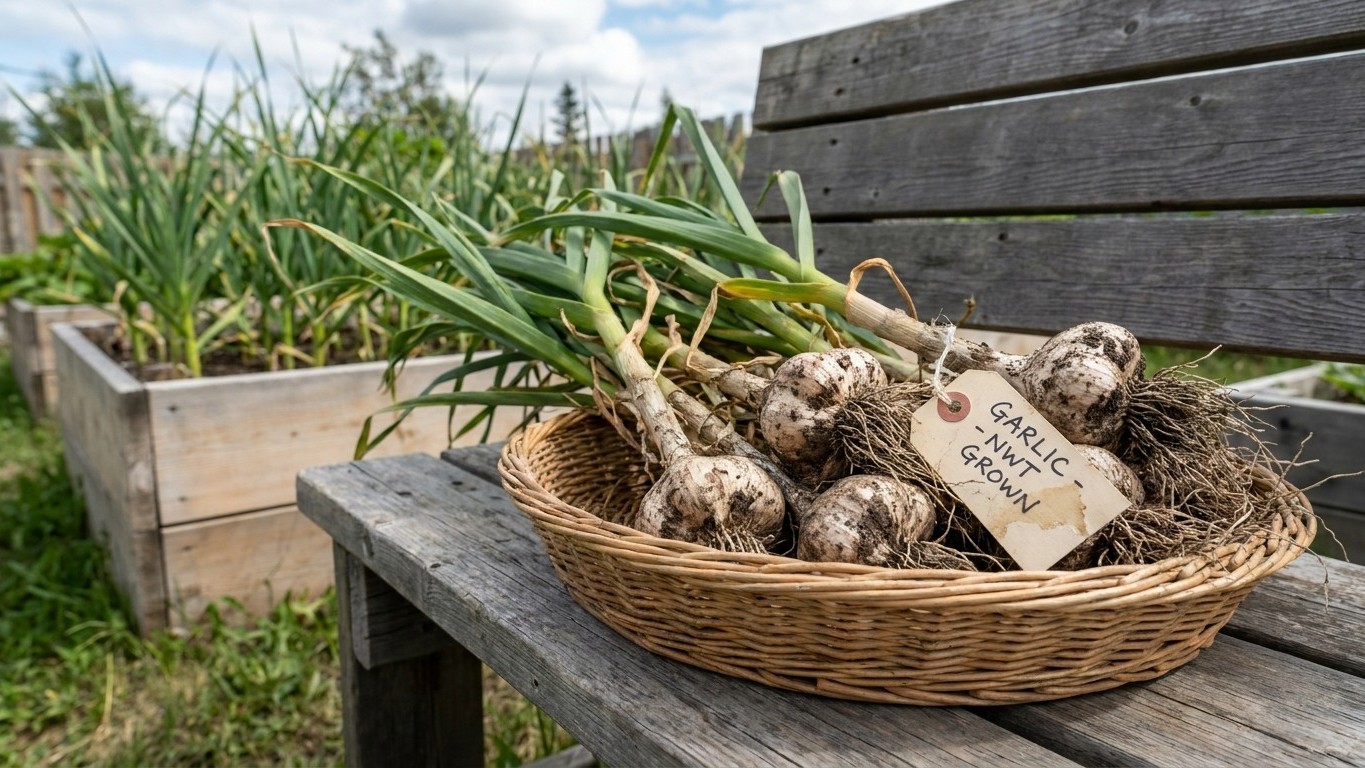

Plant garlic in the Northwest Territories in early September and you’ve likely already lost the crop before the snow even flies. The clove needs time to push roots down before the ground locks up solid, and by then it’s too late to fix. Cold isn’t the problem here — this territory has that in abundance. It’s the narrow stretch of open soil beforehand that decides whether German Red or Inchelium Red comes up strong next July, or barely at all.
The short answer for Northwest Territories

Set garlic out in late August across the Northwest Territories. That window covers every cultivar in this territory’s catalogue, from hardnecks like German Red to softnecks like Inchelium Red. The date is anchored on the territory’s average first fall frost, which Environment and Climate Change Canada’s 1981-2010 climate normals put at September 18 for the Yellowknife A station. That’s a mean date, not a countdown: frost falls later than September 18 in about half of all years there, and earlier in the other half. Treat late August as the safe side of that average, not a deadline tied to the exact day.
Winter cold is not what limits garlic here. University of Georgia Extension bulletin C854 says garlic needs six to eight weeks of temperatures below 40°F after planting for the clove to split and vernalize properly. The Northwest Territories runs about 39.1 weeks a year below that mark, which clears that requirement with room to spare. The real risk in this climate is not too little cold, it’s too little root growth before the ground freezes solid, which is why the planting date matters more here than the winter that follows it.
Softneck varieties such as Lorz Italian, Early Red Italian and Italian Late can be grown this far north, but they evolved in milder climates and rely on mulch to protect the clove from frost heave and desiccation. Hardneck cultivars, including Duganski, Blue Music and Fall Festival, tolerate exposed, unmulched winters far better, which is why growers this far north lean toward them by default.
Working it out for your own garden
The late-August planting date on every cultivar’s catalogue listing isn’t arbitrary. It’s built from two numbers you can check yourself: the average first fall frost and the six-to-eight week root-establishment window University of Georgia Extension bulletin C854 attaches to garlic. Counting forward from a late-August planting to Environment and Climate Change Canada’s September 18 average frost at Yellowknife A gives roughly three weeks before that first light frost, and the ground itself doesn’t freeze solid the moment that frost hits. Air temperatures keep dropping through the following weeks before the soil locks up, which is what stretches a three-week head start into the six-to-eight weeks the clove actually needs to split and root.
Redoing the math for a different district
That arithmetic only holds for a garden near the Yellowknife A station. A different community’s own climate normals, when you can get them, are what to plug into the same equation. Elevation, a large lake nearby, or a coastal position can shift a local frost date by roughly two weeks in either direction from a reference station’s average, which is enough to matter for a crop that needs every week of fall to root. A garden sitting higher than the surrounding land tends to run colder and earlier into frost. A garden close to a large body of water tends to run milder and later, because the water releases stored summer heat slowly through the fall.
If your own frost date runs earlier than Yellowknife’s, move your planting into the first half of August rather than the last, so the clove still gets its six to eight weeks. If it runs later, late August still works, and there’s little to gain from waiting, since a longer wait only trims the root-establishment window without adding anything useful. For the fuller breakdown of counting backward from frost to a planting date, see When to Plant Garlic in Northwest Territories: Counting Back From the First Frost.
What changes across Northwest Territories
Yellowknife sits on the shore of Great Slave Lake, and that body of water moderates the air around it, softening both the spring warm-up and the fall cool-down compared with places further from the shore. Hay River and Fort Resolution, also on Great Slave Lake, likely see some of that same moderation. Fort Simpson, well inland along the Mackenzie River valley away from the lake’s influence, tends to see sharper swings between day and night temperatures once fall sets in. Inuvik, north of the Arctic Circle, faces a shorter frost-free season overall than communities further south in the territory, simply because the sun angle and day length work against it earlier in the year.
Permafrost, common across much of the territory, is a separate factor from air temperature but still shapes how garlic performs. A bed sitting over shallow permafrost warms slowly in spring and can hold excess moisture the clove doesn’t want, which argues for a raised bed or heavily amended soil wherever the water table sits close to the surface. None of this changes the late-August planting window itself. It changes how much buffer to build in and how much you mulch, since a slower-draining, slower-warming bed benefits from the extra protection a thick mulch layer provides even for a hardneck cultivar.
A gardener in any of these communities is better served by their own station’s climate record than by Yellowknife’s, where one is available. Where it isn’t, treating Yellowknife’s September 18 average as a rough guide, and erring a week or two earlier for anywhere further north or higher in elevation, is the more cautious read.
The mistakes this climate punishes
Three mistakes cost a garlic crop in this climate more than anywhere milder, and none of them are about picking a bad variety.
- Planting a softneck like Italian Late or Early Red Italian without a heavy mulch, expecting it to shrug off an exposed winter the way a hardneck does.
- Setting cloves too shallow, so a hard freeze-thaw cycle heaves them partway out of the soil before they’ve rooted deep enough to hold.
- Waiting past late August on the bet that frost will run late, when Environment and Climate Change Canada’s own average says it arrives around September 18 and can land earlier in any given year.
- Buying seed garlic without checking it over for soft spots or rot, since some diseases travel in the planting stock itself rather than waiting in the soil for the right weather.
Why cold winters don’t rule out disease
It’s tempting to assume a climate this cold keeps garlic diseases out entirely. The UC IPM Pest Management Guidelines for Onion and Garlic (UC ANR Publication 3453) list published temperature ranges for the major garlic diseases, and measured against mean air temperatures across the growing season, a few of those windows do open up even here.
| Disease | Pathogen | Published range | Months mean air temp falls inside it |
|---|---|---|---|
| White rot | Sclerotium cepivorum | 50-75°F | 2 (June, July) |
| Fusarium basal rot | Fusarium oxysporum f. sp. cepae | 59-90°F | 1 (July) |
| Southern blight | Sclerotium rolfsii | 86-95°F (optimum) | 0 |
| Pink root | Setophoma terrestris | 75-85°F (optimum) | 0 |
Those published thresholds are soil temperatures, not the air readings behind this table, and soil lags air by weeks and swings far less. A monthly average also isn’t a month spent inside the range: a June averaging in the 50s still carries days well outside it in both directions. A count of zero months for southern blight or pink root means the disease is less active here, not that it’s impossible, and white rot in particular survives for years in soil once introduced, regardless of how cold the following winters run. Checking seed garlic before you plant it matters here as much as it does anywhere warmer.
Checking this against your county
Everything above is built around the Yellowknife A weather station, and the Northwest Territories is not one climate. For a figure specific to your own community, the Government of the Northwest Territories’ Department of Industry, Tourism and Investment runs an agriculture extension service that can point you to local growing information. That’s also the right first call before you commit a whole bed to a planting date, since a local office can flag anything about your specific district that a territory-wide average like this one can’t capture. For the broader steps that come before this stage, see Growing Garlic in Northwest Territories.
Common questions
Can I still plant garlic in September if I missed late August?
You can, but you’re cutting into the six-to-eight week root-establishment window University of Georgia Extension says garlic needs before winter, and Environment and Climate Change Canada’s own average puts the first frost around September 18 at Yellowknife A. A clove planted in early September may still root enough to survive, but a hardneck cultivar and a thick mulch layer both improve its odds more than they would for an on-time planting.
Do I need to mulch hardneck garlic here, or just softneck?
Hardneck varieties tolerate an unmulched winter better than softnecks do, but that’s a difference in margin, not a guarantee. A bed with thin snow cover or one that sits in a wind-exposed spot benefits from mulch regardless of which type you planted, since mulch is what buffers the soil against the freeze-thaw cycles that heave cloves loose.
Will the cold up here actually kill off garlic diseases in my soil?
Not reliably. White rot, for one, can persist in soil for years once its resting bodies form, and a cold winter doesn’t reset that clock. The safer approach is keeping infected material out of the bed in the first place by starting with clean, inspected seed garlic rather than counting on the climate to clean up a mistake after the fact.
Is there a difference between the varieties on the list, or are they interchangeable?
They differ mainly in flavor, clove size and storage life rather than in cold tolerance within their own type. All the hardnecks on this list share the late-August set-out window and the same basic winter tolerance, and the same is true across the softnecks, so the choice between, say, Chesnok Red and Georgian Crystal comes down to taste and how long you want the bulbs to keep in storage.