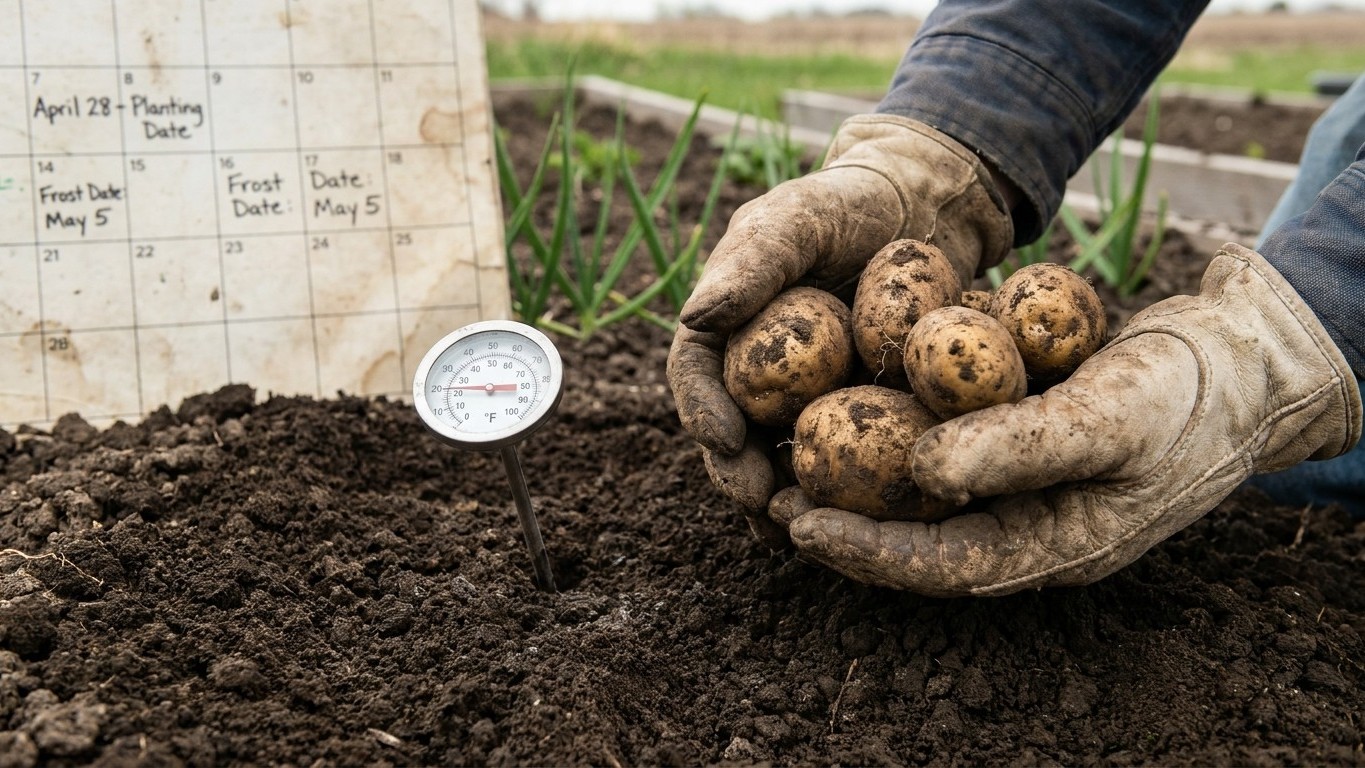

Plant Potatoes in North Dakota 14 to 21 days before your last spring frost, once soil temperature hits 50°F, not on a fixed calendar date. At Fargo’s reference weather station, NOAA’s 1991-2020 climate normals put the last spring frost between May 4 and May 15, which pushes most seed-potato planting into mid-to-late April for that location. Your own county can run later.
The short answer
The number that matters is 50°F soil, not a date on a seed packet. Utah State University Extension and the University of Maine Cooperative Extension both frame potato planting around soil temperature and a window of 14 to 21 days ahead of the last frost, because seed pieces planted in cold, wet ground rot before they sprout, while seed pieces planted too late lose growing days before summer heat starts working against the crop.
For the Fargo area, NOAA NCEI’s 1991-2020 U.S. Climate Normals (32°F freeze probability data, 30-70% band) place the last spring frost somewhere between May 4 and May 15. Counting back 14 to 21 days from that range lands most plantings in the second half of April, sometimes edging into the first days of May depending on how cold the spring has run and how quickly the soil has warmed. That’s a station reading from one airport, not a promise for every yard in the state.
North Dakota is a big place, and the gap between a river-bottom garden in the Red River Valley and a wind-scoured plot on the western plains is real. Elevation, soil drainage, and how much shelter a garden has from tree lines or buildings all shift the local frost date later or earlier than what an airport thermometer records. The NOAA caution built into these normals is blunt: suburban and rural gardens typically see their last frost later, and their first fall frost earlier, than an airport station shows, sometimes by one to two weeks, more at elevation. A garden sitting in a low spot that collects cold air overnight can trail the Fargo numbers by a wide margin.
So the short answer has two parts. First, work backward from your local last-frost expectation, not the state average. Second, confirm with a soil thermometer before you drop seed pieces in the ground, because a warm afternoon doesn’t mean the six inches of dirt underneath has caught up. Air temperature lies. Soil temperature doesn’t.
What actually decides it
Two separate mechanisms are at work here, and conflating them is where most planting mistakes start. One governs when you can safely plant. The other governs when the crop stops making tubers no matter what you do.
The 50°F soil threshold
Seed potatoes sprout and root reliably once soil reaches 50°F, according to Utah State University Extension. Below that, cut seed pieces sit in cold, damp soil far longer before sprouting, and the exposed cut surfaces become an open door for rot organisms that are common in any garden soil. This is why the 14-to-21-day-before-frost window exists: it’s not an arbitrary planting-calendar rule, it’s the lag between soil warming to 50°F and the air finally clearing its last frost risk. In a cool, wet spring, soil can lag well behind that window; in a dry, sunny spring, soil can hit 50°F earlier than the calendar window suggests. A thermometer pushed six inches into the row beats any date on a seed packet.
The 90°F heat ceiling
The mechanism that decides the whole season, and the one gardeners most often miss, is what happens at the other end of the temperature scale. Both Utah State University Extension and the University of Maine Cooperative Extension (Bulletin #2077) describe tuber set and tuber fill as inhibited once soil temperatures climb above 90°F. This isn’t a moisture problem you can water your way out of. Once soil crosses that ceiling, the plant’s underground energy allocation shifts away from bulking tubers, and no amount of irrigation reverses that response while the heat holds.
This is the fact that should shape a North Dakota gardener’s whole strategy, not just the planting date. In a region where summer soil temperatures can climb well past that ceiling during a hot stretch, the answer isn’t to baby a crop through July heat. It’s to plant as early as the 50°F soil threshold allows, so the plant has already set and sized its tubers before the hottest weeks arrive. Think of it as racing the thermometer from both directions: warm enough to plant, but harvested or well along before it gets too warm to size up. A gardener reasoning through a site this page never covered (a low-lying garden near a slough, a raised bed with dark mulch that overheats fast) should ask the same two questions every time: has the soil reached 50°F yet, and how many weeks of buffer exist before soil temperatures are likely to push past 90°F there.
How to do it
- Find your local last spring frost expectation from a garden site closer to your address than an airport reading, since NOAA’s station data (used here for Fargo) can run one to two weeks earlier than what a low-lying or rural yard actually experiences.
- Buy certified seed potatoes rather than saving tubers from a grocery bag or a neighbor’s bin. Certified seed is inspected for disease; uncertified seed can carry viruses that stunt the crop and spread to future plantings, and there’s no way to see that risk by looking at the tuber.
- Check soil temperature directly with a soil thermometer pushed about six inches deep in the planting row, ideally in the morning over several consecutive days, rather than trusting air temperature or the calendar.
- Once soil reads at or above 50°F, and you’re roughly 14 to 21 days ahead of your expected last frost, cut larger seed potatoes into pieces with at least one or two eyes each, and let the cut surfaces dry and callus for a day or two before planting to reduce rot risk.
- Plant the seed pieces at a depth and spacing suited to your garden’s soil drainage, choosing a well-drained bed since cold, saturated soil is exactly where cut seed pieces rot before sprouting.
- Match variety to purpose rather than to a maturity-date claim. Choose from early, mid-season, or late season classes based on how much of the growing season you have before summer heat risks pushing soil past that 90°F ceiling, and pick varieties suited to baking or to boiling depending on how you plan to use the harvest.
- Track soil temperature again as summer approaches, and plan harvest timing around getting tubers sized before extended stretches of soil above 90°F, rather than leaving an early or mid-season crop in the ground through the hottest weeks hoping for more growth.
What goes wrong
- Planting by the calendar instead of the soil. A gardener plants on a fixed date because that’s when they planted before, but a cold spring has left the soil below 50°F. The seed pieces sit and rot instead of sprouting. The fix is simple: check soil temperature every spring instead of trusting last year’s date.
- Using saved or grocery-store tubers as seed. These often carry viruses invisible to the eye, and a virus-infected planting can quietly reduce yield all season, then reinfect next year’s bed. Buying certified seed potatoes each season is the direct fix.
- Watering harder when tuber growth stalls in midsummer. If soil has crossed above 90°F, tuber set and fill are inhibited by heat itself, not drought, and more irrigation doesn’t restart the process. The remedy is upstream: plant early enough that tubers size before that heat ceiling is reached, especially with early or mid-season varieties.
- Trusting one regional frost date for a whole garden. A gardener several miles from Fargo’s reference station, or sitting in a frost-prone low spot, plants on the airport’s May dates and gets caught by a later local frost. NOAA’s own data flags that suburban and rural sites often run one to two weeks behind or ahead of an airport reading, so treat that range as a starting point to verify locally, not a guarantee.
- Skipping the cut-and-cure step on seed pieces. Planting freshly cut seed straight into cold, damp soil raises rot risk right when the plant is most vulnerable. Letting cut surfaces callus for a day or two before planting cuts that risk substantially.
Common questions
Can I plant potatoes before the last frost date in North Dakota?
Yes, and that’s actually the point of the 14-to-21-day window described by Utah State University Extension and the University of Maine Cooperative Extension. Potato foliage that emerges before the last frost can be nipped back by a light freeze, but the seed piece and developing roots underground are generally undamaged, and the plant regrows. Waiting until after the last frost date to plant often means missing the cooler window the crop needs before summer heat sets in.
Do I need a soil thermometer, or can I guess based on air temperature?
A soil thermometer is worth the small cost. Air temperature and soil temperature don’t move together, especially in early spring when the sun can warm the air quickly while soil six inches down is still cold from winter. Both extension sources tie planting readiness to soil temperature specifically, not air temperature, which makes a direct soil reading the more reliable check.
What happens if my soil never gets above 90°F during summer?
Then the heat-ceiling mechanism simply doesn’t come into play that season, and mid-season or late-season varieties have more room to keep sizing tubers through summer. The concern is specific to soils that do cross that threshold, which is common in warmer, drier stretches of the growing season across parts of the state.
Is certified seed really necessary, or is it just an upsell?
It’s a real distinction, not a marketing label. Certified seed potatoes are inspected for disease before sale, while uncertified tubers, including anything saved from a previous harvest or bought as food, can carry viruses that reduce vigor and yield without showing obvious symptoms. Since there’s no reliable way to visually check a tuber for virus, buying certified seed each season is the only practical safeguard.