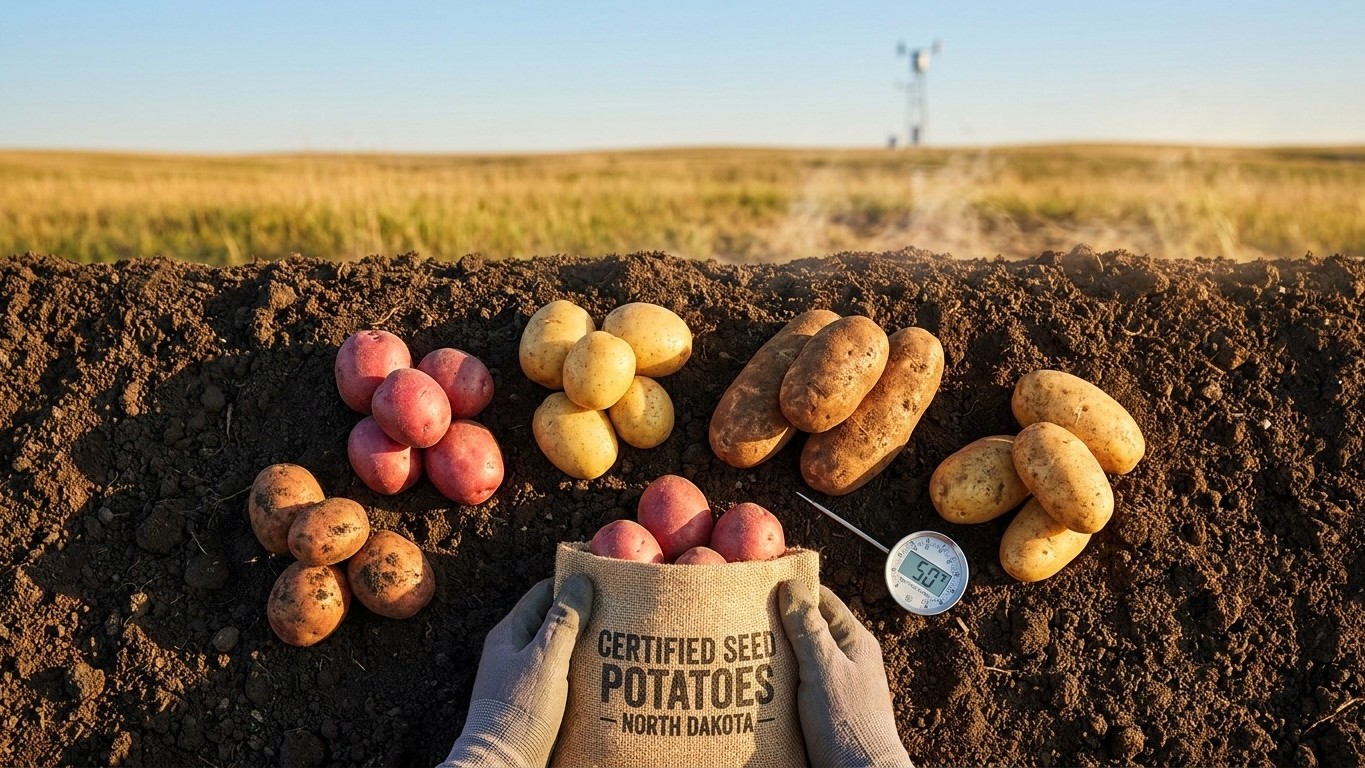

North Dakota’s growing season is short and its summer soils run hot, so the varieties that do best are early- and mid-season potatoes that bulk up fast before the ground heats past 90°F. Certified seed, planted the moment soil hits 50°F, matters as much as the variety name itself. Late-season types can still work, but only with careful timing.
The short answer
Start with the window you’re actually working inside. At the Fargo Hector International Airport weather station, NOAA’s 1991-2020 Climate Normals put the last spring frost somewhere between May 4 and May 15, depending on the year. That’s a reference point, not a promise for every yard in the state, since suburban and rural gardens often see frost linger a week or two past what an airport station records. Still, it tells you the shape of the season: planting doesn’t really start until early-to-mid May in much of North Dakota, and the clock on tuber development starts ticking from there.
What ends the window matters just as much as what opens it. Utah State University Extension and the University of Maine Cooperative Extension both describe the same mechanism: once soil temperatures climb above 90°F, tuber set and fill shut down. Watering more doesn’t reverse it. The plant simply stops putting size on the tubers it already has. North Dakota summers push soil past that mark often enough that a potato crop with a long season class can run out of usable growing time before the vines even finish bulking.
That’s the whole case for leaning on early and mid-season varieties here. They’re built to size up quickly, before the heat ceiling closes the window, and before the first fall frost cuts the season short from the other end. Late-season varieties aren’t off the table entirely, but they need a grower who’s timing planting tightly and watching the soil thermometer, not just circling a date on the calendar.
None of this is decided by variety name alone. It’s decided by when you get seed in the ground relative to two thresholds: the 50°F soil temperature that triggers planting, and the 90°F ceiling that shuts tuber fill down. Everything else, including which variety fits your kitchen use, from baking to boiling, is secondary to getting that timing right.
What actually decides it
The frost window sets your planting date, not your harvest date
Growers tend to treat the last frost date as the finish line for planning, but Utah State University Extension frames it differently: potatoes go in the ground 14 to 21 days before that date, as soon as soil reaches 50°F. In the Fargo area, with a last-frost range of May 4 to May 15, that pushes planting into late April for many years. A gardener two counties over with heavier clay soil, or land at slightly higher elevation, will see that 50°F mark later, and needs to test the soil rather than copy someone else’s date.
The heat ceiling is the real deadline
Frost damage is visible and dramatic, so gardeners plan around it. The 90°F soil threshold is quieter but does more damage to yield, because tuber set and fill simply stop without any obvious symptom above ground. A vine can look green and healthy while the tubers underneath have stopped sizing entirely. This is why season class matters more than variety folklore: an early or mid-season plant reaches most of its bulking before the hottest weeks arrive, while a late-season plant is often still trying to size tubers right when the soil is least able to support it.
Season class is the only maturity figure that holds up
Neither Utah State nor the University of Maine publishes an exact days-to-maturity count for named varieties, and for good reason: soil temperature, moisture, and daylight all shift the real number from one season to the next. What both sources do publish is season class: early, mid-season, or late. That’s the figure worth planning around, because it tells you how much of the growing window a variety needs relative to the two thresholds above, without pretending to a precision the biology doesn’t support.
| Season class | How it fits North Dakota’s window | Typical kitchen use |
|---|---|---|
| Early | Bulks up before soil regularly exceeds 90°F; best fit for most of the state | Boiling, salads |
| Mid-season | Workable if planted at the 50°F soil mark without delay | Baking, boiling, general use |
| Late | Needs the earliest possible planting and close heat monitoring | Baking, storage |
Seed health decides whether any of this matters
A well-timed planting of virus-carrying seed still produces a poor crop. Certified seed potatoes are grown and inspected specifically to keep viral disease out of the tubers you plant, and skipping that step undercuts every other decision on this page. It’s the one variable that isn’t about climate at all, and it’s worth treating as non-negotiable.
How to do it
- Pick a season class before you pick a variety name: early or mid-season for most North Dakota locations, late only if you’re prepared to plant at the earliest safe date and track soil temperature through summer.
- Source certified seed potatoes rather than grocery-store tubers or last year’s leftover stock, since uncertified seed can carry virus that no amount of good timing will fix.
- Take an actual soil temperature reading in your own bed starting in mid-to-late April; don’t rely on a neighboring county’s date.
- Plant as soon as the soil holds at 50°F, which lands 14 to 21 days before your local last-frost date, using the Fargo-area range of May 4 to May 15 only as a rough regional reference, not a fixed calendar entry.
- Track soil temperature again through the hottest stretch of summer; once it’s regularly crossing 90°F, know that tuber sizing has effectively stopped regardless of watering.
- Harvest early-season varieties as soon as vines die back naturally, rather than leaving them in ground that’s already too hot to add size.
What goes wrong
- Planting a late-season variety on a mid-season timeline. The vines look fine into midsummer, but tuber fill stalls once soil crosses 90°F before the plant has finished sizing. The remedy is choosing early or mid-season varieties unless you can plant at the very earliest safe date and still beat the heat.
- Planting by calendar date instead of soil temperature. A gardener who waits for a fixed date, ignoring an actual 50°F soil reading, either plants into cold soil that stunts early growth or misses the 14-to-21-day window before frost. Check soil temperature directly instead of trusting a single date for the whole region.
- Using uncertified seed to save money. Uncertified tubers can carry virus that reduces yield regardless of how well the season is timed. Buying certified seed potatoes each season removes that risk at the source.
- Assuming the Fargo frost dates apply statewide. A garden in a different county, especially at higher elevation or in a low-lying frost pocket, can see last frost well past May 15. Treat the NOAA figure as a reference point and verify local conditions before planting.
- Watering harder once heat sets in and expecting tubers to keep sizing. Above 90°F soil, tuber fill is inhibited regardless of moisture. The fix isn’t more water, it’s earlier planting and an early-season variety that’s mostly finished bulking by the time that heat arrives.
Common questions
Can late-season potato varieties still work in North Dakota?
They can, but only with the earliest possible planting date and close attention to soil temperature through summer. Because soil above 90°F halts tuber set and fill, a late-season variety has less margin for a delayed planting or a hot stretch than an early or mid-season one does.
How do I know when my soil has hit 50°F for planting?
Use a soil thermometer at planting depth in your own bed rather than relying on a regional date. Utah State University Extension recommends planting once soil reaches that mark, which typically lands 14 to 21 days before the local last frost date.
Does watering help potatoes during a hot spell?
No. Once soil temperature climbs above 90°F, tuber set and fill are inhibited by the heat itself, not by lack of moisture. Extra watering doesn’t restart tuber sizing during that stretch.
Why does certified seed matter more than the variety I choose?
Uncertified seed potatoes can carry virus that reduces yield no matter how well the planting is timed to frost dates or soil temperature. Certified seed removes that risk before the season even starts, which makes it a more consistent investment than chasing a particular variety name.