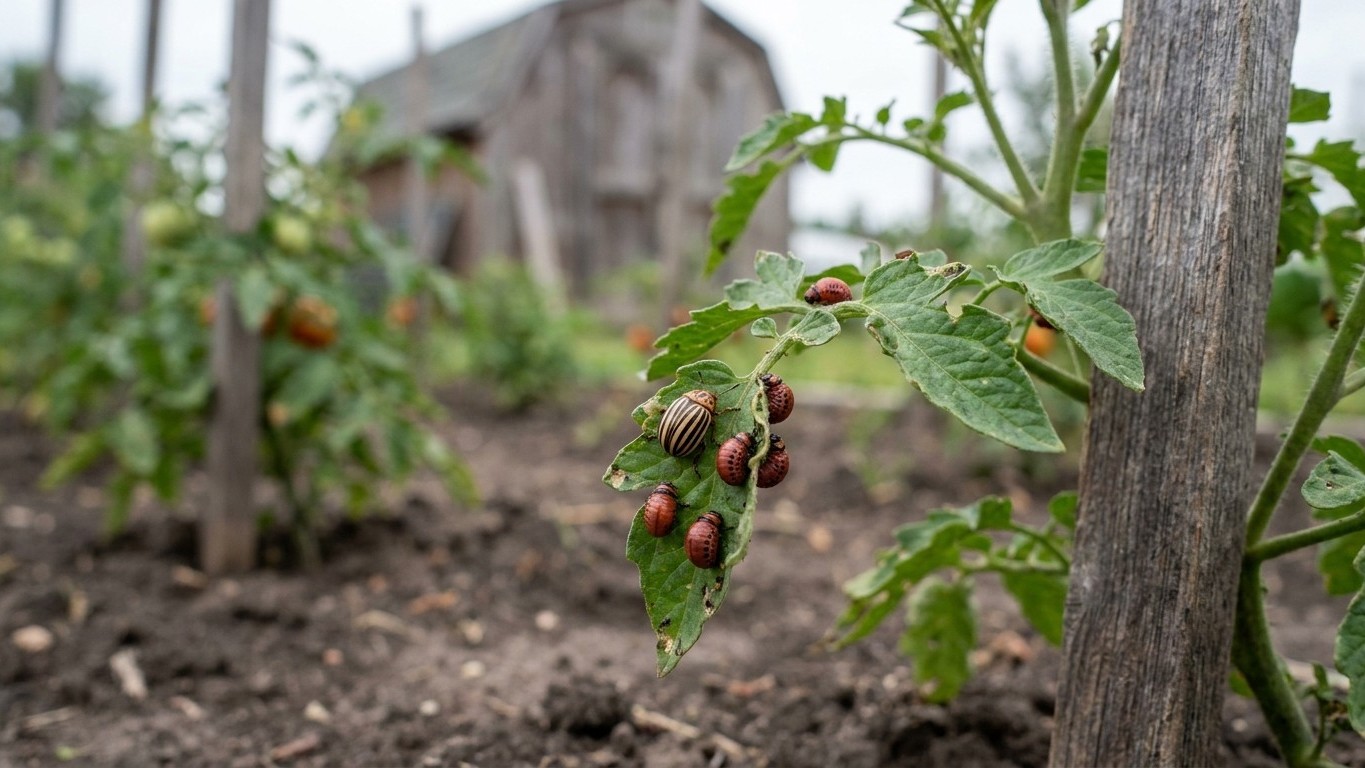

Tomato Pests in North Dakota are fewer in number than in warmer states, but the ones that do show up here are cutworms, flea beetles, Colorado potato beetles, aphids, tomato hornworms, and spider mites, and each one arrives on a fairly predictable stretch of the growing season that runs between Fargo’s last spring freeze and its first fall freeze, both measured by NOAA’s 1991-2020 climate normals. Walk your rows in the two weeks right after you set transplants out, since that is when cutworms and flea beetles do the most damage and the easiest to prevent.
What this comes down to in North Dakota

Tomato hornworms get most of the worry before the season even starts, but they rarely open the account here. What hits North Dakota tomatoes first is a collar of cut stems at soil level, weeks before any horned caterpillar would show its face. Cutworms move in right at transplant, flea beetles follow within days, and by midsummer the Colorado potato beetle has usually joined in. The damage sequence runs in that order, not the one most people brace for.
Cutworms

Cutworms show up first, right around transplant time. The larva is the stage that does the damage: it feeds at night and severs young stems right at the soil line, so you find a healthy-looking seedling toppled over with no top growth eaten. A cardboard or foil collar pushed an inch into the soil around each stem stops most damage, and it costs almost nothing.
Flea Beetles

Flea beetles follow close behind, feeding on the same tender transplants. The adult beetle is the damaging stage and leaves a telltale pattern of small round shot-holes across the leaf surface. A floating row cover kept on until plants are established blocks them, but pull it before daytime heat builds under the fabric.
Colorado Potato Beetle

North Dakota grows a lot of potatoes, and the beetle that lives on them will move onto tomato plants without much hesitation. Both the adult and the humpbacked larva feed on foliage, and a heavy infestation can strip a plant of leaves in a matter of days. Handpicking works on small plantings. Check the underside of leaves for clusters of bright orange eggs and crush them before they hatch.
Aphids

Aphids can turn up anytime from early summer on, clustering on the undersides of leaves and on new growth, where their feeding curls and yellows the foliage and leaves a sticky residue behind. A hard spray of water knocked directly onto the colony most mornings will keep numbers down without reaching for a spray bottle at all.
Tomato Hornworm

By mid to late summer, watch for the tomato hornworm, a caterpillar big enough to strip a branch of leaves overnight. It is easiest to find by looking for its dark, pellet-shaped droppings on the leaves below the feeding damage, then tracing upward. Leave any hornworm covered in small white cocoons alone: those are parasitic wasp larvae already working in your favor.
Spider Mites

Spider mites are a late-season, hot-and-dry pest, showing up when North Dakota’s summer turns dry for a stretch. The damage looks like fine pale stippling across the leaf, and a heavy infestation leaves visible webbing between leaves and stems. Consistent watering to reduce plant stress, plus a strong water spray to the leaf undersides, handles most home-garden cases.
Working it out for your own garden
Figuring out which pest you actually have starts with two questions: what does the damage look like, and where does it fall on the calendar. A stem chewed through at ground level in the weeks right after you moved plants out past Fargo’s May 4 to May 15 frost window points to cutworms, not aphids. Small round holes chewed through young leaves at the same point in the season point to flea beetles. Skeletonized leaves and visible caterpillars in July or August point to hornworm, and a curled, sticky, yellowing leaf cluster at almost any point in summer points to aphids.
A quick diagnostic table
| Pest | Where you’ll find it | Life stage doing the damage |
|---|---|---|
| Cutworms | Soil surface at stem base | Larva |
| Flea beetles | Leaf surface, shot-hole pattern | Adult |
| Colorado potato beetle | Leaf surface and underside | Adult and larva |
| Aphids | Leaf underside, new growth | Adult and nymph |
| Tomato hornworm | Stems and leaves, mid-plant | Larva (caterpillar) |
| Spider mites | Leaf underside | Adult and nymph |
Once you have narrowed it down by damage type and timing, confirm with a close look. Cutworms hide in the top inch of soil during the day, so a quick dig around a fallen seedling usually turns one up. Colorado potato beetle larvae and adults sit right out on the leaf in daylight, unlike cutworms, which is one of the easiest ways to tell the two apart. Choosing a shorter-season cultivar, covered on Tomato Varieties That Ripen in Time in North Dakota, does not prevent any of these pests, but it does mean fewer weeks of exposure to the late-season ones like spider mites, since the plant is finished and picked before the driest, hottest stretch sets in.
What changes across the state
The frost figures above come from Fargo, in the Red River Valley, and USDA’s Plant Hardiness Zone Map places the state as a whole between zones 3a and 4b, with the coldest ground in the north and at elevation in the west, and the mildest conditions in the southeast near Fargo. That spread matters for pests because warmth is what drives the calendar, not the pest itself. A garden that warms up later than Fargo’s will see cutworm and flea beetle activity start later too, and the whole sequence described above shifts back by roughly the same stretch.
Western North Dakota’s higher, drier ground tends to favor spider mites even more than the Fargo area does, since mites thrive on plant stress from heat and low humidity. The Missouri River corridor and other lower, more sheltered pockets can run a bit warmer and hold moisture differently than the open plains around them, which shifts aphid and mite pressure slightly without changing which pests you’re dealing with. None of this changes the list of pests. It changes when each one shows up and how bad it gets, and your own county’s timing is the one that matters, not Fargo’s.
The mistakes this state punishes

The costliest mistake with this pest list is treating the season as forgiving when it isn’t. Growers who skip a cutworm collar because “it’s just one seedling” often lose several before they notice a pattern, since the larvae move down the row. Skipping row cover on young transplants because flea beetle damage looks cosmetic at first is the second version of the same mistake: a plant stressed early by flea beetles has less capacity to shrug off aphids or mites later.
The other pattern this climate punishes is planting a long-season cultivar and then losing the back half of the harvest window to a pest problem that shows up right when the fruit needs those final weeks to ripen. A plant still carrying green fruit into a spider mite outbreak in a hot, dry late summer has far less margin than one that finished ripening earlier. Rotating tomatoes and potatoes to different beds each year also matters more here than in states that grow less potato, since the Colorado potato beetle overwinters in the soil and moves onto whichever nightshade crop is closest come spring.
Do the opposite on both counts: use stem collars and row cover as routine steps at transplant, not as a response to damage already seen, and rotate tomato beds away from last year’s potato patch whenever your garden layout allows it.
Checking this against your county
Everything above is built on Fargo’s numbers and a general list of pests documented across the Northern Great Plains. Your county’s warm-up date, soil type, and local pest pressure can all run differently, sometimes by a week or two, sometimes more. Before you plan your season around any of this, check with your county extension office and with NDSU Extension, which keeps current, location-specific guidance on tomato pests and controls for growers across the state.
Common questions
Do I need to spray for these pests every year?
No. Most home gardens in North Dakota see uneven pest pressure from one year to the next, and a dry summer brings more spider mites while a wet spring brings more cutworm activity. Check plants regularly instead of spraying on a schedule, and treat only the pest you actually find.
Are ladybugs enough to control aphids on tomatoes?
They help, but they rarely arrive in large enough numbers early enough to stop a fast-growing colony on their own. A daily water spray to the underside of affected leaves knocks numbers down faster and buys the ladybugs time to catch up.
Why do my tomato leaves have holes but I never see a bug?
Flea beetles and cutworms both feed mostly at dusk or overnight and hide during the day, which is why the damage shows up without an obvious culprit. Check the soil at the base of the stem for cutworms and look closely at the leaf edges at dawn or dusk for flea beetles.
Is it too late to save a plant a hornworm has already stripped?
Often, yes, if the caterpillar has been feeding for several days and most of the leaf tissue is gone, since the plant needs its leaves to keep producing. Remove the hornworm as soon as you find it and give the plant time; some recovery is possible if enough foliage remains, but a badly stripped plant late in the season may not have enough growing time left to matter.