
Winter Squash in North Dakota needs a plan built around a short frost-free window, not around a calendar date borrowed from a warmer state. Plant after soil has truly warmed, choose an earlier-maturing type, and expect one sowing rather than two. The details below explain why, and what changes the answer for your own yard.
When the soil is warm enough in North Dakota

At the reference station used for these normals, the last spring frost falls somewhere between May 4 and May 15 (NOAA NCEI U.S. Climate Normals 1991-2020, 32F freeze probabilities). That’s a 30 to 70 percent probability band, not a fixed switch that flips on a single morning. Half the years in the record still carry frost risk after that window closes, which is why the date matters less than what it signals.
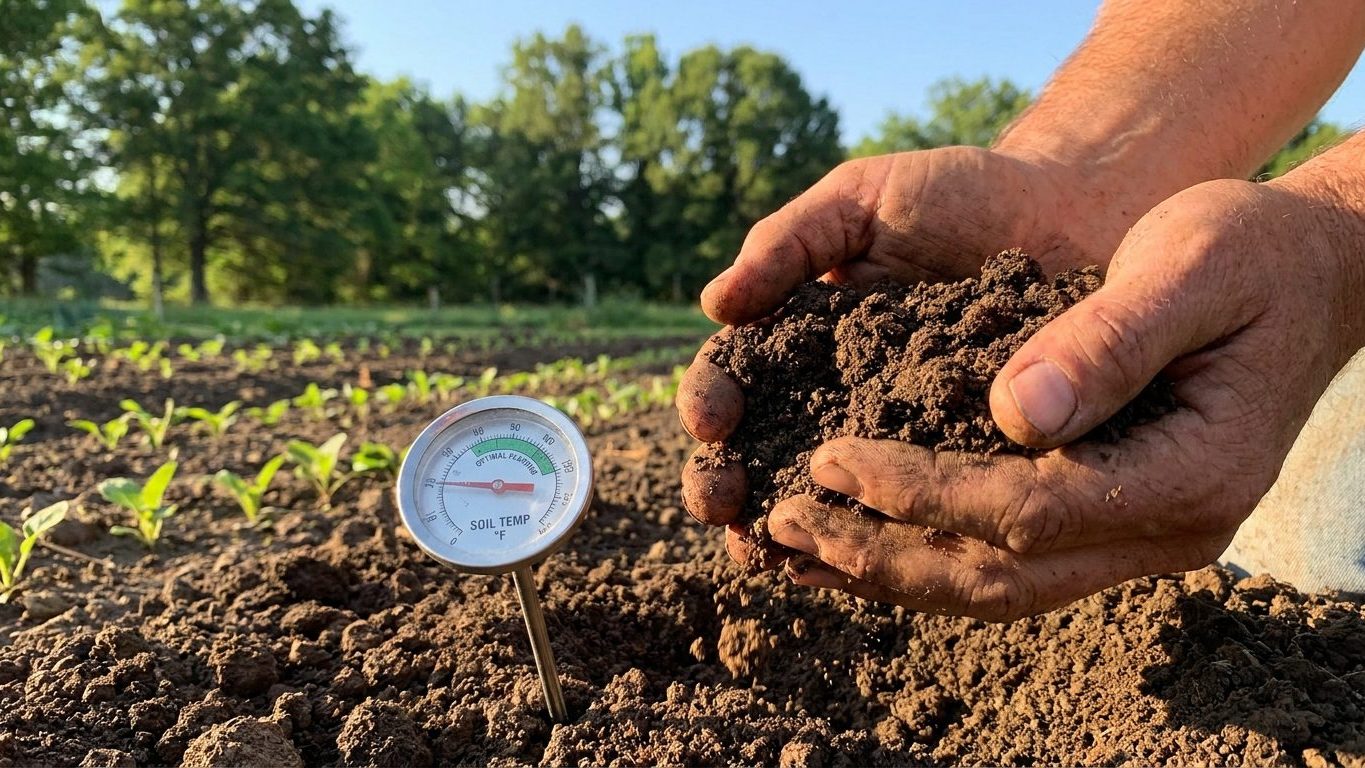
Frost date is a proxy. What winter squash actually needs is warm soil, and soil lags behind the air by days, sometimes close to two weeks after the last freeze risk has passed. A garden bed that feels safe from frost can still be cold four inches down, and squash seed sitting in cold, damp soil rots before it germinates rather than waiting patiently for warmth. Direct-sown too early, the seed simply loses the race.
The safer read: let the frost date pass, then give the soil another week or so of settled, warm weather before you commit seed to the ground. Gardeners who transplant rather than direct-sow get a shortcut here, since a seedling started indoors under lights doesn’t have to survive that cold-soil gap at all. It only has to be hardened off and set out once the soil has caught up.
Rural and suburban plots rarely match the airport station exactly. This region’s frost data comes from a single reference site, and gardens away from that station, especially those in low-lying spots or at any elevation above the surrounding land, commonly see frost linger a week or two longer in spring and arrive that much earlier in fall. Treat the May 4 to May 15 window as the region’s baseline, then check your own county’s extension office or a personal frost log before you trust it for your specific plot.
None of this changes with variety selection, and no single cultivar name changes the physics of cold soil. What does matter is picking a squash type suited to a short window in the first place, a question this page answers later. For now, the practical move is patience: wait for warmth in the ground, not just the absence of frost in the forecast.
How long the season lasts here
Put the two frost windows from these normals side by side and the frost-free season runs, at its shortest read, from roughly May 15 to September 25, about 133 days. At its longest read, using the earlier end of the spring window and the later end of the fall window, it stretches from May 4 to October 5, closer to 154 days. The honest answer sits somewhere in that range, depending on the year, because both dates are probability bands rather than fixed points.
Either figure puts North Dakota firmly in short-season territory for a crop that needs its fruit to mature fully on the vine before any hard freeze. A squash pulled green off the vine doesn’t ripen further in storage the way a tomato might, and it won’t cure properly for keeping. So the season length isn’t a background detail here, it’s the constraint that decides almost every other choice a grower makes.
What a short window changes
A window of 130 to roughly 155 days generally makes a second sowing impractical for winter squash, unlike quicker crops such as bush beans or salad greens that can go in twice. The first sowing, whether direct-seeded or transplanted, is effectively the only shot at a full-sized harvest here. That raises the stakes on timing it well and on choosing a type that reliably finishes within the window rather than pushing the calendar.
It also tips the balance toward transplanting for many growers. Starting seed indoors three to four weeks before the soil is ready to receive it buys back some of the days lost to a slow spring warm-up, though squash roots resent disturbance more than many vegetables, so a shift into biodegradable or root-safe containers matters more here than in a longer-season state where a late transplant still has time to recover. For a broader look at how to sequence plantings when the season allows more than one round, the site’s succession sowing guide covers the timing logic in more depth.
Heat and water in North Dakota

The Fargo reference station averages 11.7 days a year at or above 90F (NOAA NCEI Climate Normals 1991-2020). That’s a modest heat load compared with the Southern Plains or the Southwest, and it means summer heat stress isn’t the primary threat to a squash crop here the way it is farther south. The bigger risk in this climate is running out of season before the fruit finishes sizing and hardening its rind, not the vine wilting under sustained 95-degree afternoons.
Rainfall during the growing months runs about 10.0 inches across June, July and August, with June the wettest at 4.29 inches, July at 3.07, and August the driest at 2.6 inches (NOAA NCEI Monthly Climate Normals 1991-2020, station USW00014914). That August dip lands right when many squash plantings are filling out fruit and hardening rind, the stage where a steady water supply does the most good and a dry stretch shows up fastest as stalled growth or blossom drop.
Ten inches over three months sounds workable on paper, but it rarely arrives evenly. Summer rain in this region tends to come as thunderstorm bursts rather than gentle, soaking rain, and a heavy downpour on compacted soil sheds more water than it absorbs. Squash roots want moisture held a few inches down, consistently, not a single flood followed by two dry weeks. A rain gauge on the actual plot, not the regional average, is what tells a grower whether supplemental watering is needed in any given week, since soil texture changes how far ten inches actually goes: sandy soil lets it drain through in a day, clay holds it far longer.
Because the heat load here is moderate rather than extreme, the more common problems in a wet or humid stretch aren’t scorch or wilt but slow ripening and fungal pressure, powdery mildew showing up on lower leaves late in the season being the one most growers eventually encounter. Airflow between plants and morning watering that lets foliage dry by afternoon do more for that risk than any product applied after the fact.
Which winter squash suit North Dakota
Given a roughly 130 to 155-day window and a hardiness zone across the state running 3a-4b (USDA Plant Hardiness Zone Map, 1991-2020 normals), the type of winter squash matters more here than in almost any warmer territory in this series. A grower in a long-season state can absorb a slow-finishing type and still get a full harvest. A North Dakota grower generally can’t, since a fruit still sizing when frost arrives won’t cure into something worth storing.
That points toward earlier-maturing squash types as the starting shortlist: acorn and delicata types tend to finish sooner than the larger-fruited hubbard or many buttercup types, and smaller-fruited selections within the butternut group often close out the season faster than the largest-fruited ones. Vine habit matters too in a state with a moderate but real mildew risk in wet years, since compact or bush-type plants generally offer better airflow around the foliage than a sprawling vine left to mat against damp soil.
This page stops short of naming a specific variety, and that’s a deliberate choice rather than an oversight. A cultivar bred and trialed for a coastal or mid-Atlantic climate can carry a listed maturity date that simply doesn’t hold up under North Dakota’s shorter, cooler season, and a name picked here without local trial data would be a guess dressed up as a recommendation. North Dakota State University Extension maintains the actual list of squash varieties trialed for the state’s growing conditions, updated as new selections are tested regionally, and that list is the one worth following. A type is a starting filter; the specific variety is a local answer, and this page isn’t positioned to give it.