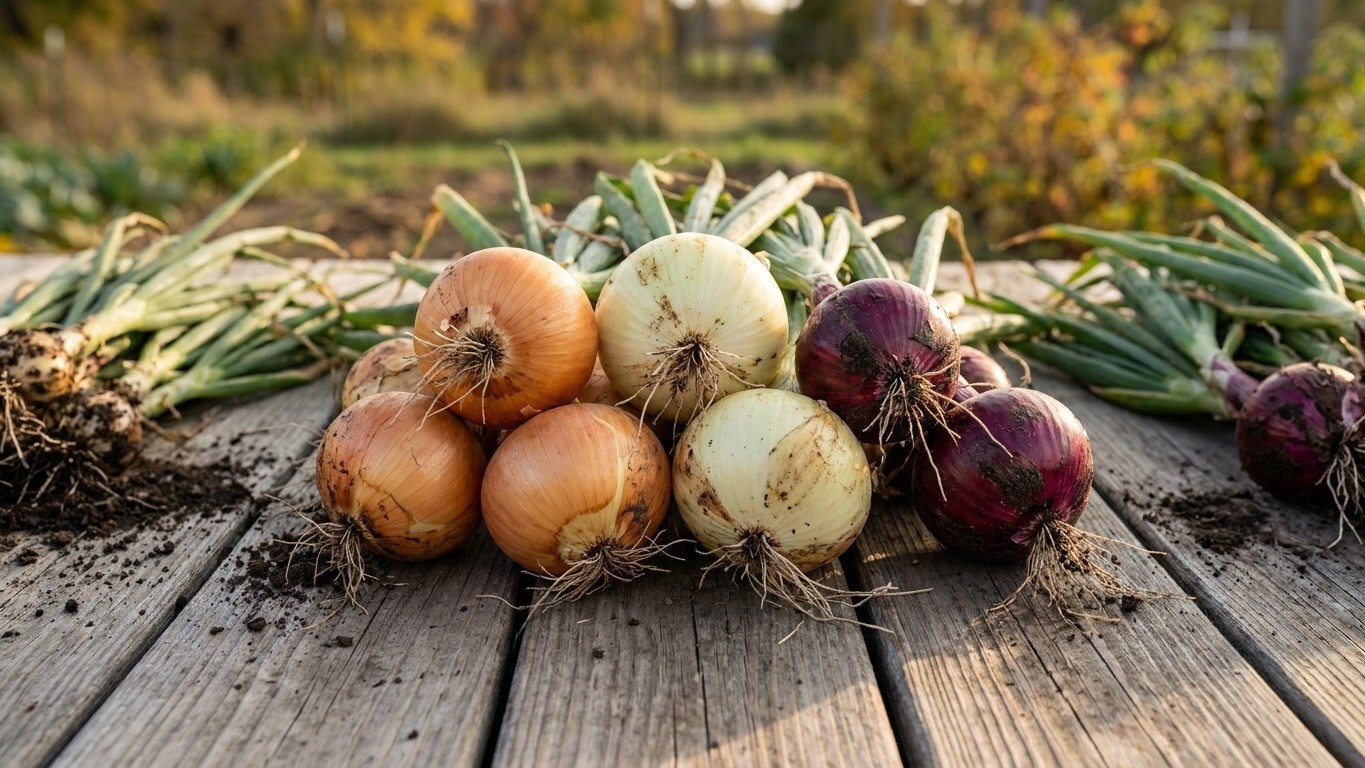

Lift onions once most of the tops have flopped over and yellowed, usually in late summer. Then cure them in a warm, dry, airy spot until the necks are tight and the skins rustle. After that, store them cool and dry. Rush the cure or store them damp, and a good crop turns to mush by midwinter. Below you’ll find the temperature and humidity to aim for, where in a northern house that is realistic, and how to tell when a bulb is ready to go in.
Keeping them, and for how long
Storage is about keeping a bulb asleep. A cured onion is dormant, and cool air, dry air and darkness hold it there. Warmth and moisture wake it up, and it sprouts or rots. Freezing ruptures the cells, and a thawed bulb turns glassy and soft.
What temperature and humidity do stored onions need?
Clemson Cooperative Extension’s Home & Garden Information Center gives the target in its onion, leek, shallot and garlic fact sheet: “Ideal conditions are between 45 °F and 55 °F, and 50 to 60 percent humidity.” That is cool but well above freezing, and drier than most food storage.
The humidity figure is the one people get wrong. Carrots, beets and other roots want damp air, and onions want the opposite. Damp air invites neck rot and mold, and it coaxes roots from the base of the bulb. One cellar cannot hold both crops well. If your root cellar is set up for carrots, the onions belong somewhere else.
None of this works on a bulb fresh from the ground. Curing comes first. Onions go into storage only when the necks are tight and the skins papery, because a thick, moist neck is an open door for rot. The curing steps are covered further down.
How long do onions last in storage?
Any storage time you read for onions is a maximum, reached under those ideal conditions with sound, fully cured bulbs. A kitchen shelf or a garage will fall short of it. Sweet, mild types soften first. Pungent storage types hold longest, so the variety you planted in spring matters more than anything you do after harvest. The Best Onion Varieties for Northwest Territories sorts out which ones are worth growing for the pantry.
Check the bin every couple of weeks. Pull any bulb that feels soft, has started to sprout, or gives off a sour smell. One bad onion passes rot to its neighbors faster than you’d expect. A bulb with a nick or a maggot scar goes to the front of the line for dinner and never into the long-term pile.
Where in the house that actually is
A range of 45 °F to 55 °F is easy to write down and awkward to find in a real house. Most homes run warm where people live and cold where they don’t, and the middle ground is narrow.
| Spot | How it compares with 45 °F to 55 °F | Verdict |
|---|---|---|
| Kitchen or living area | Warmer, so bulbs wake up and sprout | Fine for a week’s supply |
| Refrigerator | Colder, and damp when the drawer is crowded | Whole onions go soft |
| Attached garage or shed | Follows the weather and freezes in deep cold | Unreliable |
| Interior closet or cool spare room | Often close, with the door shut and the vent closed | Closest fit |
| Basement corner | Often cool, sometimes damp | Good if humidity reads in range |
Which room comes closest in a northern house?
An interior closet or a spare room with the heat turned down comes closest. Choose a spot away from exterior walls, the furnace, the water heater and any plumbing. A basement corner works when it stays dry. The garage is the worst choice up north, because one hard cold snap goes straight through the door and the walls. Onions that freeze and thaw cannot be saved.
What should you check with a thermometer?
Do not guess. Leave a min-max thermometer on the shelf for a week before you move the onions in, and read it at the height where the bulbs will sit. Skipping this step is how a “cool” room turns out to dip below freezing on the coldest night or climb into the sixties near a vent. A cheap hygrometer beside it shows whether the air sits in the 50 to 60 percent band. If it reads higher, add airflow and a dehumidifier, or choose a drier spot.
Once the spot passes, store bulbs in mesh bags, slatted crates or shallow boxes so air moves around them. Avoid sealed plastic bags and deep piles.
How do you know when onions are ready to lift?
The plant tells you. When most of the tops have fallen over and begun to yellow, the bulb has stopped growing and the neck is softening. That is the moment to lift, usually late in the season, and it varies by year and by variety. Ease off watering as the tops start to go. Choose a dry day, loosen the soil with a fork, and handle each bulb gently, since a bruise becomes a rot spot in storage. The overview, Onions in Northwest Territories, covers planting and care. For pests that mar bulbs before harvest, see What Eats Onion in Northwest Territories, and When.
Latitude explains why onions behave differently up here. Yellowknife A, the Environment and Climate Change Canada climate station used as the reference, sits at 62.46 degrees north. The longest day there has 19 h 30 of daylight, calculated from the latitude at the June solstice (the figure leaves out the few extra minutes of daylight that atmospheric refraction adds). Clemson Cooperative Extension reports that short-day onions begin to bulb at about 12 hours of daylight, while long-day onions wait for 14 to 16 hours. Yellowknife clears both thresholds. Short-day varieties bulb early and stay small, and long-day varieties have room to size up. Gardeners near the southern border or out toward the Arctic coast should check their own latitude, because day length shifts with every degree.
If a hard freeze is forecast before the tops have fallen, lift anyway. Mature bulbs finish curing indoors far better than they sit in frozen ground.
How do you cure onions in a short northern summer?
Curing dries the outer skins and seals the neck so rot cannot enter. Spread the bulbs in a single layer on screens, racks or slatted crates, with the tops still attached. Pick a place that is warm, dry, shaded and breezy. A covered porch works on a good day. Northern fall weather brings rain and cold nights, so a spare room or garage with a fan running often beats leaving them outside. Keep the bulbs off the ground and out of direct sun, which can scald them.
How do you know curing is finished?
Go by the bulb, because the weather sets the calendar. Curing is done when you can check off every one of these:
- The neck is tight and dry, with no moisture when you squeeze it.
- The outer skins are papery and rustle in your hand.
- The roots are dry and wiry.
- The tops have shriveled, and you can trim them to a short stub.
Brush off loose soil, but do not wash the bulbs. Move them to the cool, dry storage spot only after the checklist is complete.
Common questions
Can onions finish drying in the ground?
A little, in a dry spell. A wet northern fall can spoil them in the ground, though. Once most tops are down, lift them on a dry day and finish the job on racks.
Is the refrigerator a good place for whole onions?
No. It runs colder than the 45 °F to 55 °F range and is often damp, which softens whole bulbs. Use the fridge only for cut onions, wrapped well.
Can onions share a cellar with carrots?
Rarely. Carrots want damp air, and onions want 50 to 60 percent humidity. A single space can’t give both what they need, so keep the onions in a drier spot, such as a closet or the dry side of the basement.
What should I do with thick-necked or damaged bulbs?
Use them first. Thick necks stay moist and let rot in, and damaged bulbs spoil quickly. Keep them in a separate bin from the sound ones you plan to store.