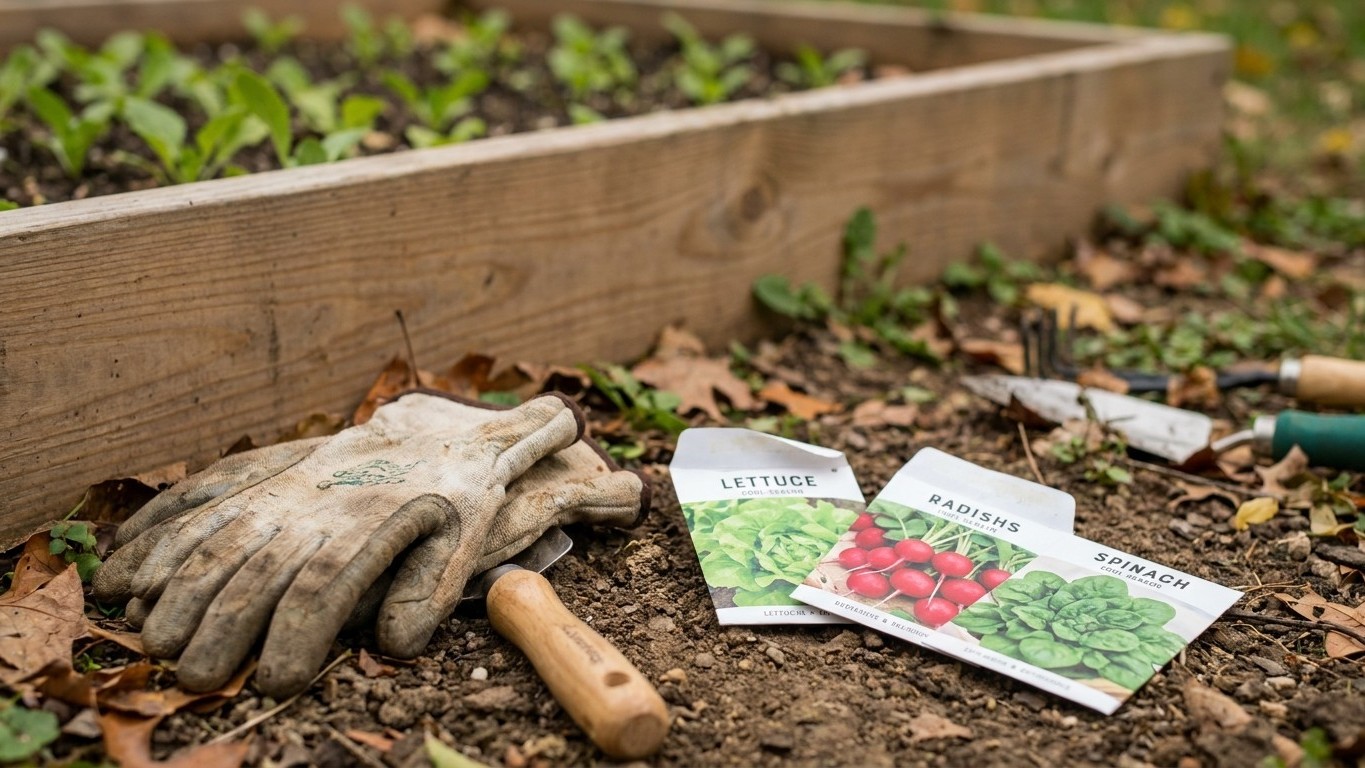

Direct sowing outdoors is basically finished in the Northwest Territories once you hit September. The average first fall frost lands around September 18 at Yellowknife, so most of the month sits right at or past that line. What still makes sense: fall garlic, a few fast greens tucked under cover, and a full slate of harvest and cleanup work before the ground locks up.
What goes in the ground in September

The calendar isn’t what decides this. Soil Temperature and the frost window do. In the Northwest Territories, Environment and Climate Change Canada’s normals for the Yellowknife A station put the average first fall frost at September 18 and the average last spring frost at May 25, which frames a growing season of roughly four months. That’s a mean date, not a guarantee: in one year out of two, frost arrives later than September 18, and in the other half it can show up earlier. Treat it as the middle of a window, never as a line you can plant right up to.
With that window already closing, almost nothing sown directly into open soil this month has time to mature. The one clear exception is garlic, and shallots where growers have them. Both go into the ground now specifically because they need a cold, dormant stretch over winter to break bulb dormancy before next season’s growth. Plant cloves root-down, four to six weeks before the ground freezes solid, mulch heavily once the soil chills, and leave them alone until spring.
What still counts as “planting” here
Beyond garlic, September planting in this territory means protected planting, not open-ground planting. Cold frames and low tunnels let a gardener push a few more weeks out of hardy greens. Bare-root fruit stock and dormant perennials, where nurseries still have them, can go in as long as the soil is workable and there’s time to firm them in before freeze-up. Forcing rhubarb or chicory indoors, in a dark box or cellar, is a real September project too, and it has nothing to do with outdoor frost risk at all.
| Reference point (Yellowknife A station) | Value |
|---|---|
| Average last spring frost | May 25 |
| Average first fall frost | September 18 |
| Canadian plant hardiness zone | 1b |
That hardiness rating, zone 1b, comes from Natural Resources Canada’s Plant Hardiness Site and uses the Canadian system, which is built from seven climate variables rather than the single minimum-temperature figure the USDA system uses. It isn’t a stand-in for a USDA zone and shouldn’t be read against one. It also describes conditions at the reference station, not every community across a territory this size.
What to start under cover
Anything sown now needs to be counted backward from that September 18 average frost date, not forward from the day you happen to plant it. A radish or a loose-leaf mesclun mix that matures in 25 to 30 days, sown in the first days of the month under a cold frame or low tunnel, has a real shot at a harvest before hard freeze shuts the frame down for good. Spinach behaves the same way and tolerates a light frost on top of that, which buys a few extra days of margin the radish doesn’t get.
Counting backward from September 18
Take the days-to-maturity printed on the seed packet, subtract that number of days from the average frost date, and that’s the latest safe sowing day, with a week or so of slack built in for a cold snap arriving early. A 40-day crop sown after the first week of September is already racing a clock it’s likely to lose.
The two ways to get it wrong
One mistake is sowing too early into a cold frame that’s still baking in late-summer sun: seedlings stretch, go leggy, and struggle once the frame cools for real. The other is sowing too late and running out of the little season that’s left, since once the frost window opens in the Northwest Territories it tends to close for the year, not tease with a warm week afterward. Neither mistake is fatal to the garden as a whole, but both waste seed and a frame slot that could have grown something that actually finished.
What is ready to pick
Root crops carry September in this territory. Potatoes, carrots, beets, and turnips are all bulking up through the month, and none of them mind a light touch of frost on the foliage, since it’s the leaves that take the hit, not the roots underground. Cabbage and kale actually improve with a cool snap; the cold converts some of the plant’s starches to sugars, which softens the bitterness that heat brings out earlier in the season.
Reading the signs instead of the date
Potatoes are ready when the vines have yellowed and started to die back, not on a fixed day. Carrots and beets pull cleanly and show full color at the shoulder when they’re done sizing up; if the shoulder is still pale, they’ll keep gaining for another week or two. Garlic planted the previous fall is long since harvested and curing by now, so September’s job with it is storage, not picking.
Anyone with crops already in storage from earlier in the season should be checking bins of squash, potatoes, and onions on a rotation, pulling out anything soft, sprouting, or showing a soft spot before it takes the neighbors with it. A single rotting potato in a bin of fifty can spread faster than most people expect, especially in a root cellar that’s still warmer than it will be once the real cold sets in.
The jobs that matter this month
Harvest timing outranks everything else in September here. Once the season’s average frost date passes, tender crops left in the open, squash vines, tomatoes if anyone’s managed to grow them under cover, unhardened greens, are on borrowed time, and a single hard night can take the whole planting at once. Pulling and curing onions and garlic properly, in a dry, airy spot out of direct sun for one to two weeks, is what determines whether they store through winter or rot by December.
Harvest and curing come first
Digging potatoes before the ground itself starts to freeze matters more than digging them at any particular calendar point; a frozen potato left in cold soil turns to mush the moment it thaws. Cutting back spent perennial foliage and clearing fallen fruit reduces the places pests and disease overwinter, which pays off directly in fewer problems the following spring.
Prep work for the long dark
September is also when the off-season work starts in earnest: dormant pruning on fruit trees and berry canes once they’ve dropped their leaves, ordering seed early while northern-adapted, short-season varieties are still in stock, and testing soil pH and nutrient levels while beds are empty and easy to work. Turning compost, sharpening and oiling tools before they sit unused for months, and mending fencing or raised-bed frames damaged over summer all belong on this list too. None of it is filler; a fence that goes unrepaired now is a fence a moose or a hare finds in spring.
What not to do in September
The most common misstep is trusting a mild afternoon over the calendar’s frost window. A warm stretch in early September doesn’t mean the season has been extended, it means the average first frost, September 18, hasn’t shown up yet on schedule. Planting anything tender on the strength of a warm week is a bet against a mean date that already tells you frost arrives later than that in half the years on record, which cuts both ways: it can also arrive earlier.
Uncovering a cold frame or removing row cover after a stretch of pleasant weather is another version of the same error. The point of the cover isn’t to react to the current temperature, it’s to buffer against the night nobody predicted. Pulling it off early exposes tender growth right when it has the least time left to recover.
Feeding nitrogen this late is a mistake too, and an easy one to make out of habit. Nitrogen pushes soft, leafy growth, and soft new growth is exactly what a light frost damages first. Anything still in the ground benefits more from being left to harden off naturally than from a boost that encourages it to keep growing right up until the freeze arrives.
Checking this against your own county
Every figure here comes from one station, Yellowknife A, and a territory this size holds far more variation than one station can capture. Elevation, distance from the treeline, and how far north or south a community sits can shift a frost window by weeks in either direction; Inuvik and Norman Wells don’t run on the same schedule as Yellowknife, and neither does a garden tucked into a warmer microclimate along a riverbank. Use the dates as a starting point, then check them against the Government of the Northwest Territories’ agriculture services page for guidance specific to your community.
Common questions
Is it too late to plant garlic in September in the Northwest Territories?
No, September is generally the right window. Garlic needs four to six weeks in cool ground before hard freeze to establish roots without pushing top growth, and planting it now, ahead of the average September 18 first frost, fits that timing.
Can I still start a fall garden this late?
Only under cover, and only with very fast crops. A cold frame or low tunnel sown with radish, spinach, or a quick mesclun mix in the first week of September has a narrow chance of maturing before the season’s average frost date; anything slower than about 30 days to maturity is unlikely to finish.
Do potatoes and carrots need to come out before frost?
The foliage takes frost damage, but the roots underground don’t, and carrots and beets actually sweeten with a cool snap. The real deadline is the ground itself starting to freeze, not the first light frost on the leaves.
What does Canadian hardiness zone 1b actually mean for a garden here?
It places the reference location among the coldest rated zones in the Canadian system, which is built from seven climate variables rather than the single minimum-temperature reading the USDA scale uses. It doesn’t translate into a USDA zone number, and it describes the reference station, not every community across the territory.
Gardeners who plant by the Moon can check the September 2027 moon planting calendar, a tradition rather than a proven method.