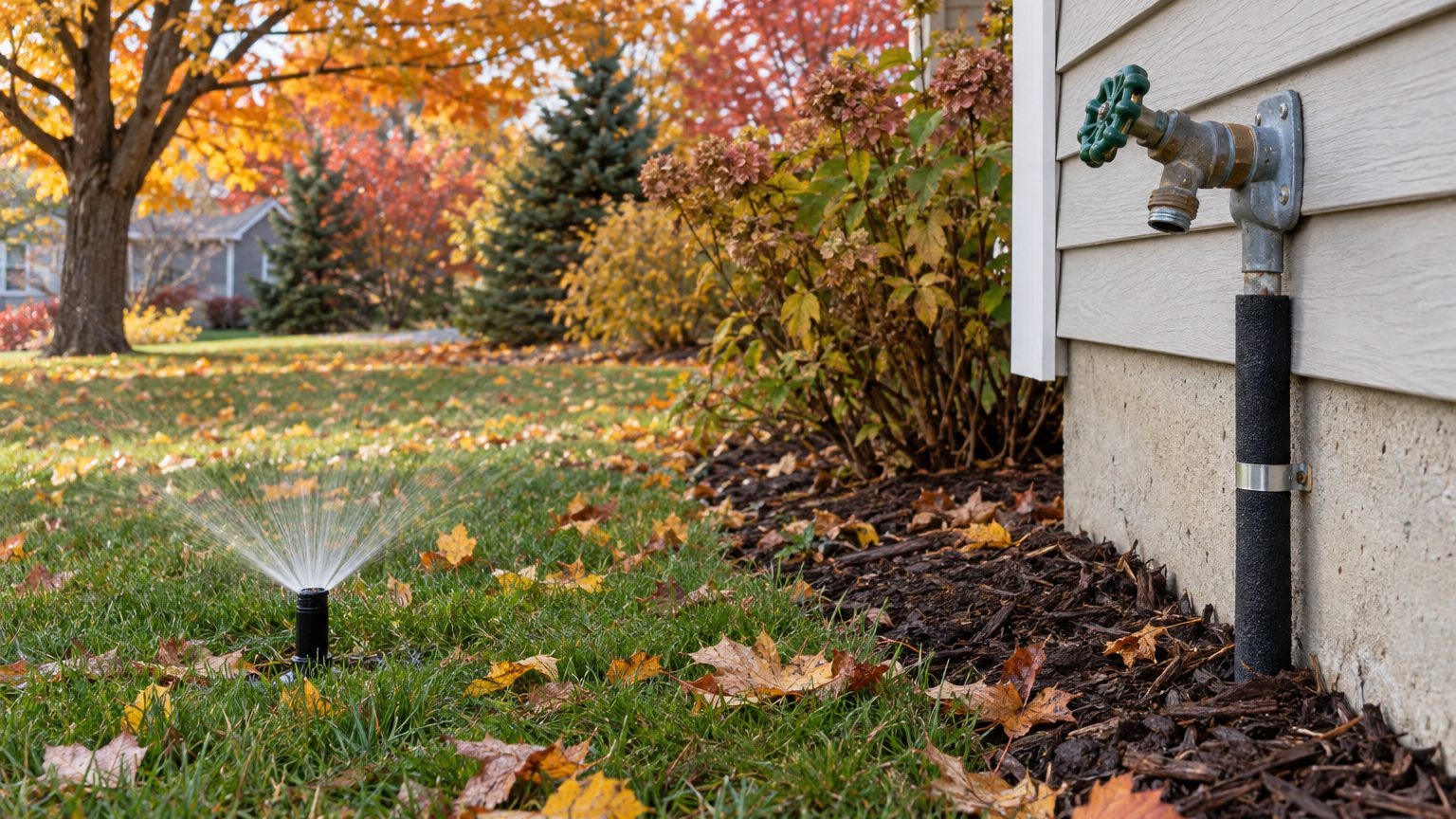

In Northwest Territories, drain sprinkler lines and outdoor faucets between late August and about September 18, the average first fall frost at Yellowknife per Environment and Climate Change Canada. Go earlier in the window if you live farther north or on higher ground. The deadline is the first hard freeze, and a pipe that still holds water can split on the first night cold enough to freeze it. The job takes an afternoon. Repairing a burst line in spring takes far longer.
When to do it in Northwest Territories
Plan to winterize between late August and around September 18, and hold to one rule: before the first hard freeze, not after the first light one. Write down late August through September 18 as your window, and treat the early end as the safe end. That upper date comes from Environment and Climate Change Canada’s Canadian Climate Normals for 1981-2010, which put the average first fall frost at the Yellowknife A station on September 18.
Reading that frost date correctly
An average is a midpoint. In one year out of two, the first frost lands after September 18, and in the other half it arrives before. So the date marks the middle of the risk, never a safe finish line. A homeowner who waits for the 18th to start has already bet on a later-than-average fall.
Geography moves the window too. The figure comes from one station, and a territory is not one climate. Communities farther north and on higher ground run weeks behind Yellowknife in spring and ahead of it in fall, so their first frost comes earlier and their draining date moves earlier with it. If you live north of the Yellowknife area, treat late August as your real target. The normals cover 1981-2010, which is a different stretch of years than the 1991-2020 figures used for the lower 48, so don’t line the two up date for date.
A light freeze and a hard one are different events. A light frost is a night that dips just under freezing and eases by morning. Standing water in a buried or insulated pipe usually survives it. A hard freeze is a night, or several in a row, cold enough to turn that water solid. The first light frost is your signal that the clock has started. It is not permission to wait for the next one.
Why this climate leaves no shortcut
Some mild territories can skip the full blowout and just disconnect hoses. This is not one of them. The mean daily minimum of the coldest month at Yellowknife is -29.5 °C (-21.1 °F, for readers comparing with the northern US), per the same normals. Water left in a line here has months of deep cold to work on it, and no pocket of it is small enough to ignore. Natural Resources Canada puts Yellowknife in plant hardiness zone 1b on the Canadian system, which is built on seven climate variables and does not convert to a USDA zone.
What is worth doing is the full job, done early: hoses off, irrigation supply shut, lines blown out, outside taps drained. The same weekend suits the rest of your fall yard routine, and Winterizing a Lawn covers the grass side of it. Do the water work first, because it is the part that can’t wait for the weather.
Sprinkler lines: drain or blow out
Water expands when it freezes, and a pipe does not. A buried line full of water has nowhere to send that pressure, so the pipe wall, a fitting or a valve body gives way. The split often goes unnoticed all winter, since the damaged section sits frozen and sealed. The first sign comes when the system is switched on in spring and water starts flowing through the crack. The weak points are the ones that hold water in low spots: the valves, the fittings at each head, and the backflow preventer where the system ties into the house supply.
Three methods compared
| Method | How it works | Limits in a deep-cold climate |
|---|---|---|
| Manual drain | You open drain valves at the low points of the system and let gravity empty the lines. | Only works if the system was built with slope and drain valves. Water stays in heads, fittings and any section that sits level. |
| Automatic drain | Valves open on their own when line pressure falls and release water at low points. | Can stick open or shut with debris. Does little for valves and backflow devices above those low points. |
| Compressed-air blowout | An air compressor pushes water out of each zone through the heads, one zone at a time. | Needs the right equipment and care. Too much air pressure can crack parts, and it must never run through a zone with no outlet open. |
With a coldest-month minimum of -29.5 °C, I’d treat the compressed-air blowout as the standard here, with manual or automatic drains as a first step rather than a substitute. Gravity alone leaves residual water behind, and in this cold, residual water has a full winter to freeze. The usual order is to shut off the supply to the system, drain the backflow device, then run air through each zone in turn until the heads spit mist instead of water. Wear eye protection and never stand over a pressurized component.
The decision to write down: shut the supply, drain the backflow device, then blow out every zone before the first hard freeze. Pick a calm weekend in the early part of the window rather than the last dry day before the cold arrives.
When a professional is the sensible choice
Hire someone if you don’t own a compressor that can move enough air, since an undersized one leaves water behind in the far zones. Hire someone if your system has no drain valves, if you aren’t sure how many zones you have or where they run, or if the backflow assembly is unfamiliar to you. A system that leaked last spring deserves a professional look as well. The window is short in this territory, so book early in it. A technician who has seen your layout once will also be quicker the next fall.
Outdoor faucets and hoses
This part needs no tools and no plumbing work. It is all turning valves, and anything beyond that is a plumber’s job.
The sequence
Follow the same order every fall:
- Disconnect every hose, splitter, timer and nozzle from the outside tap, drain them, and store them indoors.
- Find the interior shutoff valve that feeds the outdoor tap and close it. Not every house has one.
- Go outside and open the tap fully so the pipe between the shutoff and the spigot can drain.
- Leave the outside tap open for the winter, and cap or cover it if you like.
Leave the outside tap open once the interior valve is shut. A closed tap traps whatever water is left in the pipe, and in a place where the coldest month averages a daily minimum of -29.5 °C, any trapped water will freeze. The full walkthrough, including what to do when there’s no interior valve, is in Winterizing Outdoor Faucets Before the First Freeze. Do it within the same late-August-to-September-18 window as the sprinklers, and earlier if you are north of Yellowknife.
Why a frost-free faucet still fails with a hose attached
A frost-free faucet puts the valve seat at the end of a long stem, deep inside the heated part of the wall. When you shut it off, the barrel slopes slightly downward, and the water left in it runs out through the spout. That design only works if the water can leave. A hose left on, especially with the nozzle closed, holds water in the barrel. That water freezes, expands, and splits the pipe inside the wall, where you won’t see it until the thaw lets water run into the cavity. The mechanism is covered in more detail in Frost-Free Outdoor Taps.
If you can’t find an interior shutoff, if a tap drips after you close it, or if you think a pipe has already frozen, stop there. Cutting, thawing with heat, or replacing parts is plumber work. Frozen Pipes explains what to do while you wait for help.
What goes wrong here
Most failures come from timing and from small things that get missed.
The early cold snap
The September 18 figure is a mean, so in about half of years the first frost comes sooner, and in the north it comes sooner still. A homeowner who pegged the job to the 18th gets caught by a cold night in the first week of September. The spring sign is a system that holds pressure poorly, a soggy patch of lawn, or a geyser at a head when the water is switched on. Drain the same week a first frost shows up in the forecast. Better yet, finish in the early part of the window and ignore the forecast altogether.
The forgotten hose
A hose left on a frost-free tap is the most common cause of a burst inside the wall. It rarely shows in spring as a dripping spigot. It shows as water stains on an interior wall or ceiling, a hissing sound, or a meter that keeps running when every fixture is off. The fix is a habit: before you go indoors for the last time, walk the yard and check every tap, including the one behind the shed.
The valve box that floods
Sprinkler valves usually sit in a buried box. If water seeps in or the lid is cracked, the valves sit in standing water that freezes. In spring you find a box full of water, a valve that won’t shut off, or a body with a hairline crack that weeps. Prevention is dull but works: blow out the valves with the rest of the zones, keep the lid seated and undamaged, and clear the box of debris so water can drain away from the valves.
Whatever happens over the winter, turn the water back on slowly in spring and walk each zone while it runs. A small leak caught the first day costs a fitting. The same leak found in July costs a trench.
Common questions
Is September 18 a safe date to start?
No. It is the average first fall frost at Yellowknife A in the 1981-2010 normals from Environment and Climate Change Canada, so in one year out of two the frost comes later and in the other it comes earlier. Treat it as the upper end of your window and start sooner.
Do I still need a blowout if I only have outdoor taps?
No. A blowout is for sprinkler lines. For taps, disconnect hoses, close the interior shutoff if there is one, and leave the outside tap open. That covers a frost-free faucet too, as long as nothing is attached to it.
What if the lines have already frozen?
Do not force compressed air into a frozen system, since the blockage can turn the air pressure into a burst. Wait for a thaw, or call a plumber or irrigation technician. Ice that melts in a damaged pipe will show you the damage when water starts to flow.
Does the Yellowknife date apply across the whole territory?
Only as a reference. The frost figure comes from a single station, and the hardiness zone of 1b (Canadian system, from Natural Resources Canada) belongs to that reference city, not to every community. Places farther north or at higher elevation see frost earlier, so move your draining earlier by the same logic. For broader regional context, see the other Northwest Territories guides.