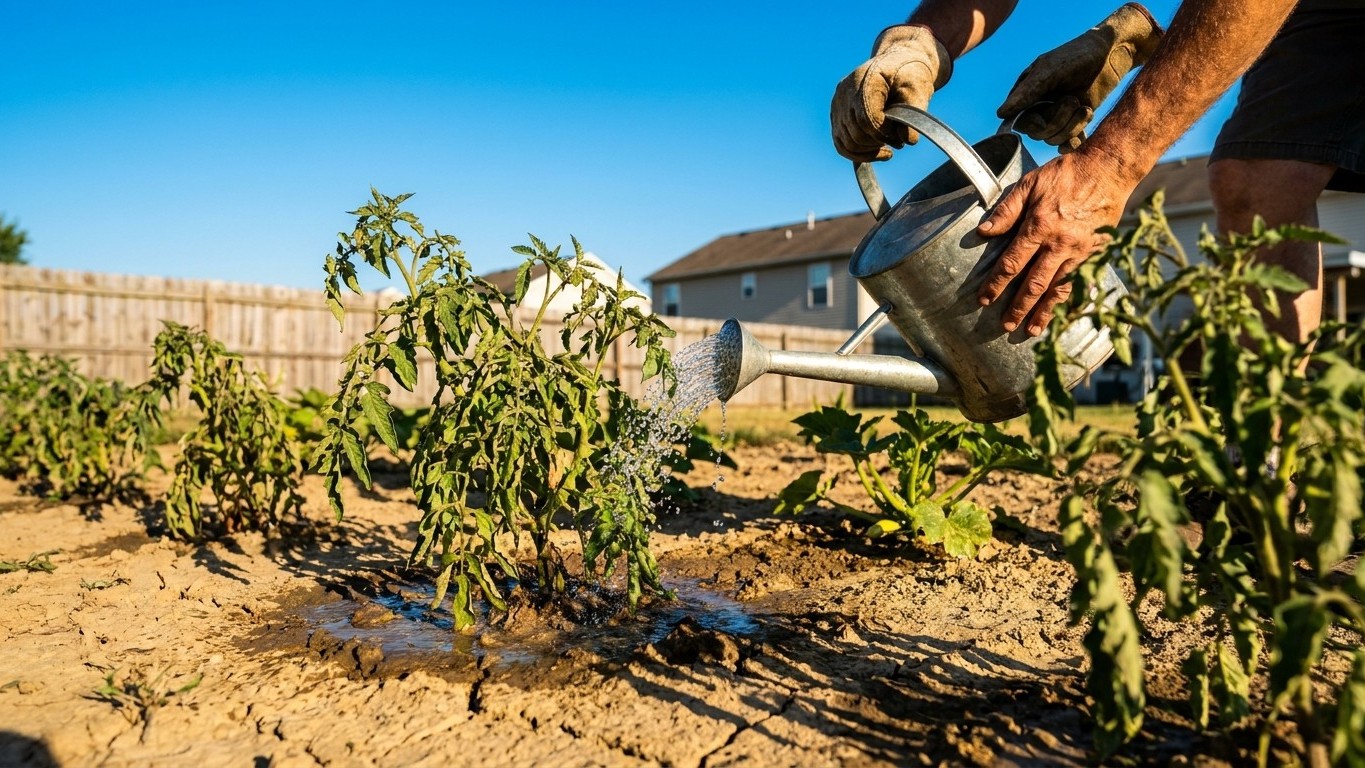

Watering during a dry Ohio summer means giving a full inch of water a week, delivered slowly at the base of the plant rather than sprinkled daily overhead. Rainfall alone rarely covers it once August turns dry and hot, so the gap between what the sky drops and what a bed actually needs has to be made up by hand, on a schedule the soil and the heat both dictate.
What changes here

Two numbers set the terms for every Ohio garden trying to survive a dry stretch: 3.74 inches of rain in August, the driest summer month, and 15.3 days a year that reach 90F or higher. Put together, that’s a month with the least rain landing right when heat is doing the most damage to soil moisture. A garden doesn’t pause its water needs because the sky went quiet.
The standard rule of thumb for most vegetable and flower beds is about an inch of water a week. Spread that August total of 3.74 inches across the roughly 4.3 weeks the month contains, and the sky is only supplying around 0.87 inch a week on average. That leaves a shortfall of roughly 0.13 inch a week that has to come from a hose, a can, or a drip line, and that’s assuming the rain falls in gentle, evenly spaced doses rather than a single afternoon downpour that runs off a hard, dry crust before it soaks in.
Why the same inch acts differently depending on the ground
An inch of water doesn’t behave the same everywhere it lands. On sandy, fast-draining ground, that inch moves through the root zone quickly and much of it is gone within a day, so the shortfall from August’s rain gets worse, not better, on light soil. On heavy clay, the same inch can sit near the surface for a week, which sounds like an advantage until a gardener adds more water on top of ground that hasn’t dried yet and starves the roots of oxygen instead. Neither soil type gets a free pass during a dry spell; each just fails in a different direction if the gardener doesn’t check before watering.
The 15.3 days above 90F matter because heat drives evaporation straight out of the top few inches of soil, the exact zone where young transplants and shallow-rooted annuals are trying to survive. A bed that looked adequately watered on Monday can be bone dry by Wednesday afternoon if several of those 90-degree days land in a row, which is precisely the pattern Ohio’s climate normals describe for a typical August.
How to water when it matters
Deep, infrequent watering at the base of the plant, done in the morning, beats a daily sprinkle every time a dry spell sets in. Deep watering pushes moisture down to where roots actually live, training them to grow downward instead of clustering near a surface that bakes dry within hours. Morning watering gives leaves time to dry before nightfall, and watering at the base instead of overhead keeps foliage dry altogether, which matters because wet leaves sitting in the dark are exactly what fungal disease needs to take hold.
Checking the soil at root depth, not just the surface, is the step most gardeners skip. A finger pushed two inches down, or a trowel turned over near the plant, tells the real story; the top half-inch can look and feel dry within hours of a good soaking even when the root zone below is still holding plenty of moisture.
A sequence to start from
- Push a finger or trowel two inches into the soil near the root zone before watering at all; if it’s still moist, wait another day.
- Water slowly at the base of the plant, aiming for roughly one inch total for the week, applied in one or two deep sessions rather than several light ones.
- On sandy ground, split that inch into two shorter, more frequent soakings, since light soil holds little and lets water pass through fast.
- On heavy clay, apply the water in a single deep session and then leave it alone until the two-inch check shows dry ground again, since clay holds moisture a week or more and drowns roots if watered too soon.
- Water in the early morning so foliage dries before evening, and check again before the next scheduled watering rather than watering on a fixed calendar.
That inch-a-week starting point holds for an average week, not for a run of 90-degree days back to back; treat it as a baseline to test against the finger check, not a fixed rule to follow blindly.
What goes wrong
Watering a little every day
A light daily sprinkle wets only the surface, and roots follow the water, staying shallow instead of growing down toward the moisture that persists deeper in the soil. Those shallow roots are the first to burn once a 90-degree afternoon arrives, because they sit in the layer of ground that heats and dries fastest.
Watering the leaves at night
Soaking foliage in the evening leaves it wet for hours in the dark, exactly the conditions fungal disease needs to spread. A base-level soaking in the morning avoids the problem entirely and still gets water where the roots can use it.
Trusting a rain shower that never soaked in
An afternoon thunderstorm can look generous while only wetting the top half-inch of soil, especially on ground that’s already dry and crusted. The finger-check two inches down settles the question a rain gauge alone can’t answer.
Skipping mulch
Bare soil gives back moisture to the sun almost as fast as it’s applied, particularly across the 15.3 days a year that push past 90F. A two- to three-inch layer of mulch around the base of a plant slows that loss and stretches the interval between waterings, which matters most in exactly the stretch of summer when Ohio’s rainfall is thinnest.
Local help
Ohio State University Extension publishes region-specific guidance for home gardeners dealing with dry-spell watering, soil types, and seasonal planting windows. Find local office contacts and current resources at extension.osu.edu. Watering restrictions vary by municipal water district and can change during a drought, so check with the local water provider before setting a watering schedule for a dry summer.
Common questions
How often should I water my garden during an Ohio dry spell?
Aim for about an inch of water total per week, delivered in one or two deep sessions rather than daily light watering, and adjust the frequency based on whether the soil is still moist two inches down.
Is August really the driest month in Ohio?
Yes, based on 1991-2020 climate normals for the reference station, August averages 3.74 inches of rain, less than June’s 4.33 inches or July’s 4.67 inches.
Does sandy soil need more water than clay soil during a dry spell?
Sandy soil drains fast and holds little moisture, so it typically needs shorter, more frequent watering, while clay holds water for up to a week and risks root damage if watered again before it dries.
What’s the biggest watering mistake during Ohio’s hottest days?
Watering lightly and often is the most common failure during the days that reach 90F or above, since it keeps roots shallow and exposed to the heat instead of encouraging them to grow deeper where moisture lasts longer.