
Colorado potato beetle adults start crawling out of Oklahoma soil as early as mid-March in the southern part of the state, sometimes even late February during a mild winter, and they keep working through October in a good year. That six-to-seven-month window is longer than almost anywhere else the pest operates, and it’s the reason Oklahoma potato and tomato growers deal with two to three generations a season instead of the single generation typical in Minnesota or Maine.
The insect itself isn’t native to the state, or even to potatoes originally. Leptinotarsa decemlineata evolved feeding on wild nightshade plants in the Rocky Mountain foothills and jumped onto cultivated potatoes once settlers started planting them nearby in the 1800s. From there it spread across nearly the entire continental United States. Oklahoma sits well within its year-round range now, and the state’s warm springs just mean the beetle gets a head start most other regions don’t offer it.
Colorado Potato Beetle Timeline in Oklahoma

Adults overwinter four to six inches deep in garden soil, field edges, and windbreaks, then emerge once soil temperatures climb past roughly 50°F. In central and southern Oklahoma that threshold often hits by mid-March. In the Panhandle, where elevation and colder air pockets slow things down, emergence can lag two to three weeks behind the rest of the state.
Once above ground, adults feed for a few days before mating and laying eggs on the underside of leaves. A single female can lay 300 to 500 eggs over her lifetime, deposited in clusters of a few dozen at a time. Those clusters are bright orange-yellow and easy to spot if you flip leaves over early in the season, which is exactly when catching them matters most.
Eggs hatch in four to nine days depending on temperature. The larvae, humpbacked and brick-red with two rows of black spots, go through four growth stages over roughly two to three weeks before dropping into the soil to pupate. Adults emerge five to ten days later, and in Oklahoma’s climate that turnaround is fast enough to squeeze in a second full generation by July and sometimes a partial third generation before frost. That’s the practical difference between growing potatoes in Oklahoma versus growing them in a northern state: the pest pressure doesn’t let up after one flush, it compounds.
Why the Second Generation Does More Damage
First-generation beetles emerge into young, still-recovering plants. Second-generation beetles hit in June and July, right when potato foliage is trying to bulk up tubers underground. Defoliation at that stage costs yield directly, because the plant simply can’t photosynthesize enough to finish filling out the crop. Extension entomologists in warm-climate states consistently flag that second wave as the one that actually determines harvest size, not the first.
Spotting the Damage Before It Spreads
Colorado potato beetle isn’t picky within the nightshade family. Potatoes are the preferred host, but eggplant, tomato, and pepper plants all get attacked when beetle populations build up or when potatoes aren’t available. Backyard gardeners growing a small mixed vegetable bed sometimes assume they’re dealing with a different pest because the damage shows up on tomatoes first, especially if potatoes were planted a season earlier and removed.
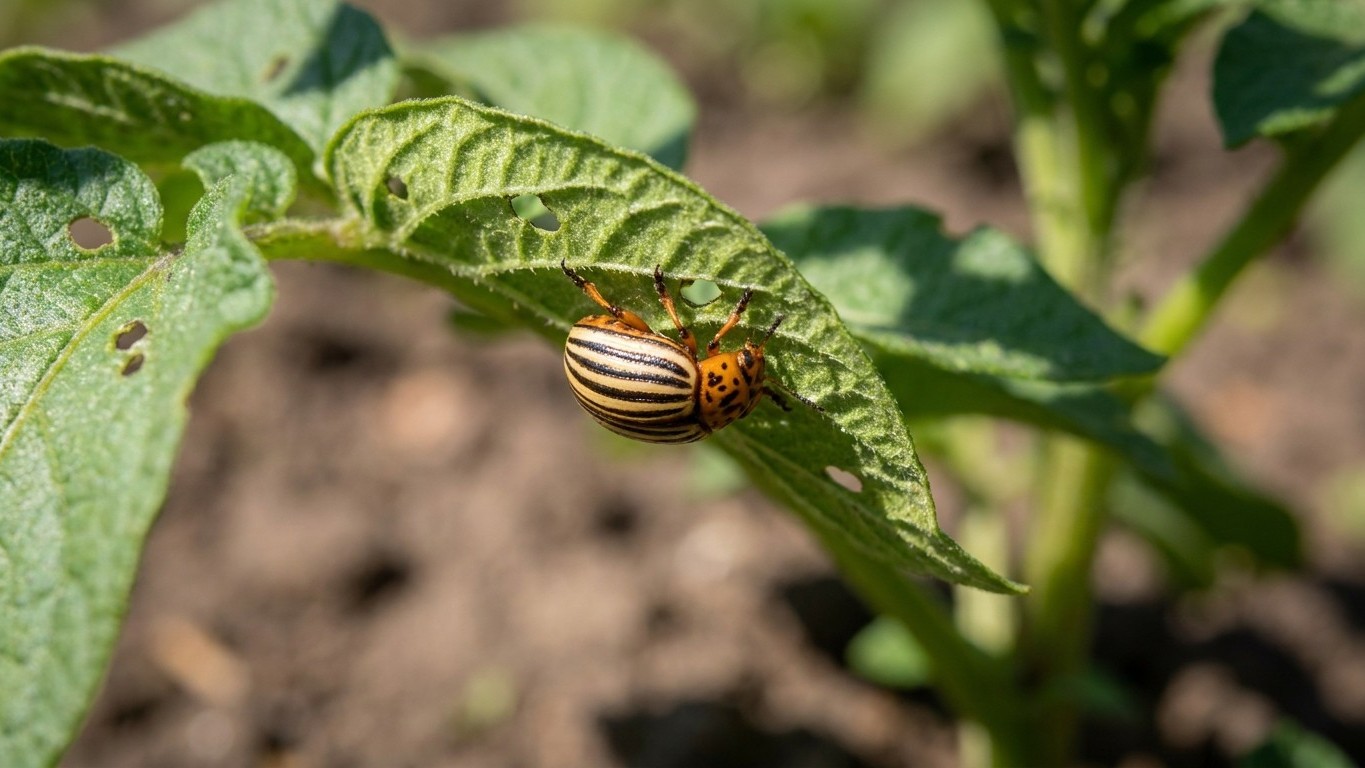
Both adults and larvae chew leaf tissue, working from the edges inward and eventually skeletonizing entire leaves if left alone. A heavy larval infestation can strip a young potato plant bare within a week. Adults are roughly three-eighths of an inch long, yellow-orange with ten black stripes running down the wing covers, which makes them one of the easier garden pests to identify by sight without a magnifying glass.
The tell that separates this beetle from lookalikes like the false potato beetle is stripe count and pattern consistency. Colorado potato beetle always shows five black stripes per wing cover, ten total, arranged in even lines. Confusing it with a similar-looking but harmless beetle wastes treatment effort on the wrong target, so a close look before spraying anything is worth the extra thirty seconds.
What Actually Stops Colorado potato beetle in Oklahoma
No single tactic handles this pest on its own, and that’s not an exaggeration for effect. Colorado potato beetle has one of the longest documented histories of insecticide resistance of any agricultural pest in North America, with populations in various regions having developed resistance to organophosphates, carbamates, pyrethroids, and in some cases neonicotinoids over the past several decades. That track record is why extension programs push a layered approach rather than relying on one product.
Crop rotation is the first line of defense and the cheapest. Overwintering adults emerge in the same spot they buried themselves the fall before, so moving nightshade crops at least 200 yards from the previous year’s planting site forces beetles to search farther for food, which cuts survival rates significantly during that vulnerable early crawl.
Deep fall tillage after harvest exposes overwintering adults to freezing temperatures and predators before they can dig in properly. In Oklahoma, where the ground often doesn’t freeze hard until December or stays unfrozen entirely in warmer counties, this timing matters more than it does farther north, since beetles have a longer window to bury themselves deep enough to survive.
Straw mulch applied thickly around young plants delays colonization because walking adults have a harder time navigating through loose straw to reach stems. Some Oklahoma market gardeners combine this with row covers left on until flowering, removed only once pollination needs access, which blocks the first wave of adults from reaching plants at all.
Biological and Targeted Chemical Options
Bacillus thuringiensis var. tenebrionis, sold under various trade names as a Bt formulated specifically for leaf beetles, remains effective against young larvae when applied at the first sign of hatching egg masses. It doesn’t touch adults, so timing the application to larval emergence rather than adult sightings makes the difference between a useful spray and a wasted one.
Spinosad-based products offer another option with a lower resistance profile than older synthetic chemicals, though extension guidance generally recommends rotating between different modes of action within a season rather than spraying the same product repeatedly, precisely because of the beetle’s resistance history.
Natural predators help more than most home gardeners realize. Ground beetles, spined soldier bugs, and certain lady beetle species feed on Colorado potato beetle eggs and small larvae. Avoiding broad-spectrum insecticide use early in the season preserves these predators long enough for them to make a dent in the first generation, which then reduces pressure from the more damaging second generation in June.
Hand-picking remains genuinely effective for small backyard plots. Checking the undersides of leaves twice a week starting in March, crushing egg clusters and dropping larvae into soapy water, keeps populations low enough on a garden scale that chemical intervention often isn’t necessary at all. It’s tedious, but for a dozen plants it takes less time than driving to buy a pesticide.
Timing Treatment Around Oklahoma’s Extended Season
Because Oklahoma’s warm spring pushes emergence earlier than most regional pest calendars account for, growers who wait for generic “spring” pest alerts often miss the first beetle wave entirely. Checking plants by early to mid-March in the southern two-thirds of the state, and by late March in the Panhandle, catches the overwintering adults before they’ve laid a full round of eggs.
The second generation in late June through July deserves just as much attention as the first, more given the yield impact during tuber bulking. Growers who treat once in spring and assume the problem is solved often get caught off guard by a larval outbreak in midsummer that does more economic damage than the initial infestation ever did.
Rotating control methods across the season, mechanical removal early, Bt for first-generation larvae, targeted spinosad if the second generation gets ahead of hand-picking, keeps any single tactic from being overworked to the point of failure. Given how quickly this insect has adapted to chemical pressure elsewhere in the country, that rotation isn’t optional advice so much as the only strategy with a track record of holding up over multiple seasons.
Related guides
- Colorado potato beetle in Kansas: When It Shows Up and What Stops It
- Colorado potato beetle in Ontario: When It Shows Up and What Stops It
- Colorado potato beetle in Pennsylvania: When It Shows Up and What Stops It