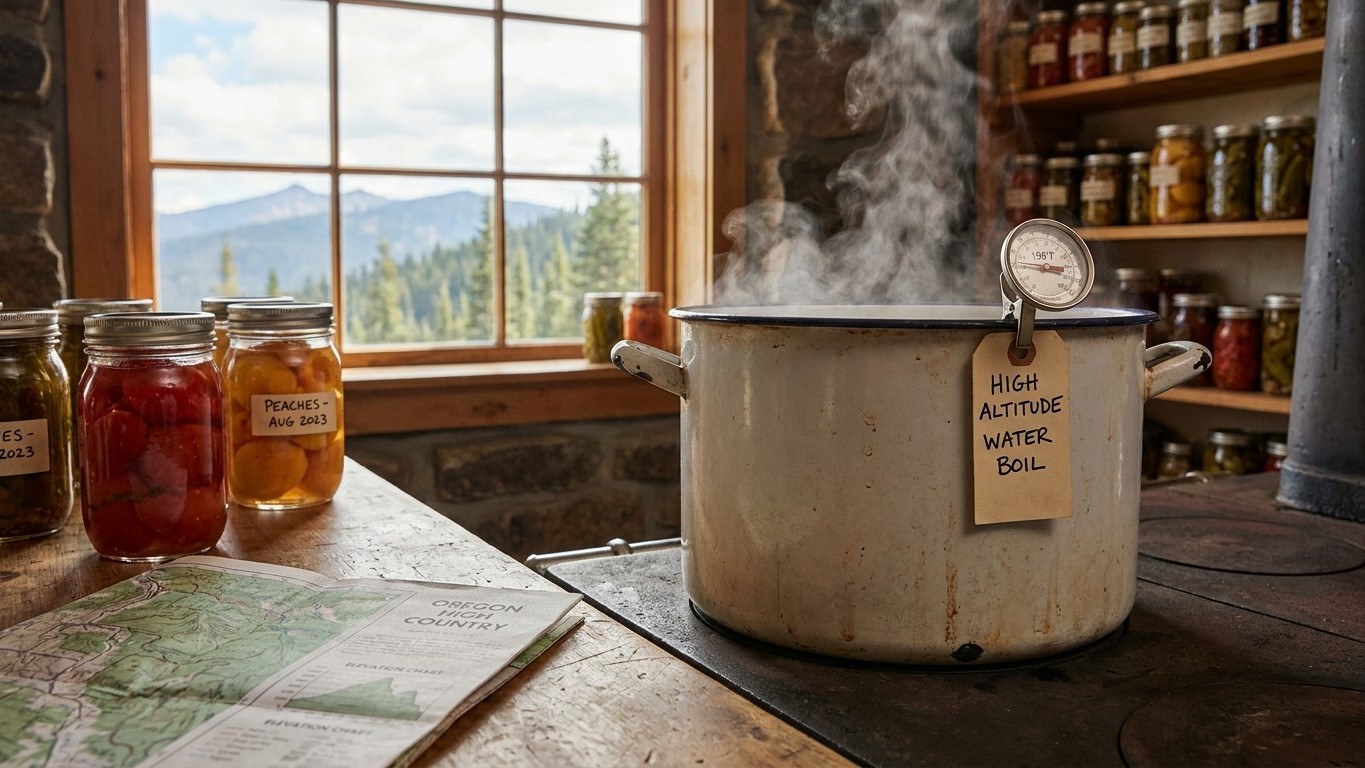

Portland sits at 39 feet above sea level, where water boils between 208°F and 212°F. At that elevation, the standard canning tables built for sea level still apply without changes. But Oregon runs from Pacific tide pools to the 11,249-foot summit of Mount Hood, and if your kitchen sits somewhere up that slope, the answer changes completely.
The short answer

Portland, the reference city for this piece, sits at 39 feet, and water there boils somewhere between 208°F and 212°F depending on weather and barometric pressure. That range comes from the USDA’s own elevation bands, which group locations from sea level up to 2,000 feet into a single “no adjustment” category. For a canner working at 39 feet, this is about as flat as canning gets in the continental United States.
Here’s the catch, and it matters more in Oregon than in most states: 39 feet describes Portland, not Oregon. A state’s elevation isn’t a single number any more than its rainfall is. Bend sits around 3,600 feet. Ashland climbs past 1,900. Head into the Cascades or the Wallowas and you’re well above 4,000 feet before you’ve noticed the grade. Each of those places boils water at a lower temperature than Portland does, and each one needs a different canning adjustment as a result.
So the real question isn’t “what does Oregon’s elevation change.” It’s “what does your elevation change,” and the honest answer depends entirely on where your stove sits, not where the state capital sits or where the nearest big city sits.
Why 2,000 feet is the line that matters
The USDA’s canning guidance treats 0 to 1,000 feet as needing no adjustment at all in boiling-water canning, with the first adjustment tier starting above that. Pressure canning has its own separate tiers, starting even lower. Portland’s 39 feet falls comfortably inside the no-adjustment zone for boiling-water processing. A reader in Bend or in the foothills outside Medford does not get that same pass. The moment you cross roughly 1,000 feet, the clock most recipes assume no longer matches the clock your kitchen actually needs.
This is why a canning question that sounds like it should have one tidy answer for “Oregon” actually splits into dozens of answers, one for something close to every town. The elevation band is the tool. Your own address is what tells you which band you’re in.
Why a lower boil is a weaker process
Water boils at 212°F at sea level. Climb to 10,000 feet and that same pot of water boils at 194°F. Nothing else changes about the water; it’s still boiling, still rolling, still throwing off steam. But the temperature ceiling has dropped, and that ceiling is the whole story.
Canning relies on heat to destroy the microorganisms that would otherwise spoil food or, worse, produce toxins inside a sealed jar. Bacteria and their spores have different tolerances for heat, and the tested processing times in canning recipes assume a specific temperature is being held for a specific number of minutes. Drop that temperature by even a few degrees, and the same amount of time no longer delivers the same kill. A process built around 212°F does less work at 205°F, and considerably less at 194°F, even though the water looks identical in the pot.
This is where a common instinct backfires. A cook who knows their water isn’t getting as hot might crank the burner higher, assuming a harder boil will compensate. It won’t. Once water is boiling, more heat under the pot doesn’t raise its temperature further, it just makes it boil more vigorously at the same ceiling. Boiling water cannot get hotter than boiling water. The only two things that actually restore the lost processing power are time and pressure.
In a boiling-water canner, the fix is length: leaving jars in the boiling water longer than a sea-level recipe calls for, so the lower temperature has more minutes to do the work a higher temperature would have done faster. In a pressure canner, the fix is different. Pressure canners can push water past 212°F regardless of elevation, but the gauge has to be set higher at altitude to reach the same effective temperature a lower elevation gets at a lower pressure setting. Both canner types have published, food-specific adjustments for exactly this reason, and both adjustments move in the same direction: up, never down, as elevation increases.
Finding your own elevation
Portland’s 39 feet is useless to a canner who lives somewhere else in Oregon. Before adjusting anything, you need your own number, and it’s easier to find than most people expect.
- Start with your street address, not your city’s average or your county’s average. Elevation can shift by hundreds of feet within a few miles, especially anywhere near foothills or river valleys.
- Use the National Center for Home Food Preservation’s “Find Your Elevation” page, built specifically so home canners can look up their own figure instead of guessing from a city name.
- Round to the nearest elevation band listed in your recipe’s adjustment table, rather than trying to interpolate between bands yourself.
- Recheck if you’ve moved, even locally. A move from a valley floor to a hillside a few miles away can be enough to cross into the next adjustment tier.
- Write the number down somewhere you’ll see it at canning time. It’s not something most people remember off the top of their head, and guessing defeats the purpose.
Skipping this step is the single most common shortcut that turns a well-intentioned batch of home-canned food into a risk nobody wanted to take.
What goes wrong
- An under-processed jar that looks perfect. Jars can seal, look clear, and show no sign of spoilage while still carrying an inadequate process from a boil that never got hot enough for long enough. The remedy is following the elevation-adjusted time or pressure exactly, not judging the jar by its appearance afterward.
- A recipe pulled from a sea-level source. Plenty of recipes online and in older family notebooks were written by or for someone canning near sea level, with no elevation adjustment built in. The remedy is checking every recipe against a current elevation-adjustment table before using it, regardless of how many times a family has made it before.
- A pressure gauge read as if elevation didn’t exist. Setting a pressure canner to the same PSI used at sea level, without adding the extra pressure required at altitude, quietly weakens the entire process even though the gauge needle looks correct. The remedy is checking the food-specific pressure adjustment for your exact elevation band, every time, not just the first time you canned that food.
- Switching canner types without switching tables. Boiling-water adjustments and pressure-canner adjustments are not interchangeable, and moving from one method to another for the same food requires pulling the correct table for that method. The remedy is confirming which canner type the adjustment applies to before starting.
Where the exact adjustment comes from
This page won’t give you a processing time or a pressure setting, and that’s deliberate. The correct adjustment depends on the specific food, the jar size, and the exact recipe you’re following, and pairing the wrong number with the wrong food is exactly how safe canning turns unsafe.
For the actual figures, go to the National Center for Home Food Preservation, which publishes elevation-adjusted processing times and pressures for tested recipes, organized by food type. That’s the only place this page will point you.
The reason for this caution isn’t bureaucratic. Botulinum toxin, the danger an under-processed jar can harbor, has no taste and no smell. A jar can look, smell, and taste completely normal and still be unsafe. That’s precisely why the adjustment has to come from a tested source rather than a guess, however reasonable the guess feels.
Common questions
Does Oregon have one official altitude for canning purposes?
No. Oregon’s elevation ranges from sea level to over 11,000 feet, and the adjustment always follows the canner’s own elevation, not a single statewide figure.
Does boiling water harder make up for a lower boiling point?
No. Once water reaches boiling, additional heat makes it boil more vigorously but does not raise its temperature further. The temperature ceiling is fixed by elevation, not by burner setting.
Is Portland’s elevation a safe default for canners across Oregon?
No. Portland’s 39 feet applies only to Portland. Someone canning in Bend, Ashland, or anywhere in the Cascades needs their own elevation figure, since those areas sit well above Portland’s elevation band.
Where should a home canner look up the exact adjustment for their food?
The National Center for Home Food Preservation publishes elevation-adjusted times and pressures organized by specific food and recipe, which is the appropriate source rather than a general estimate.